
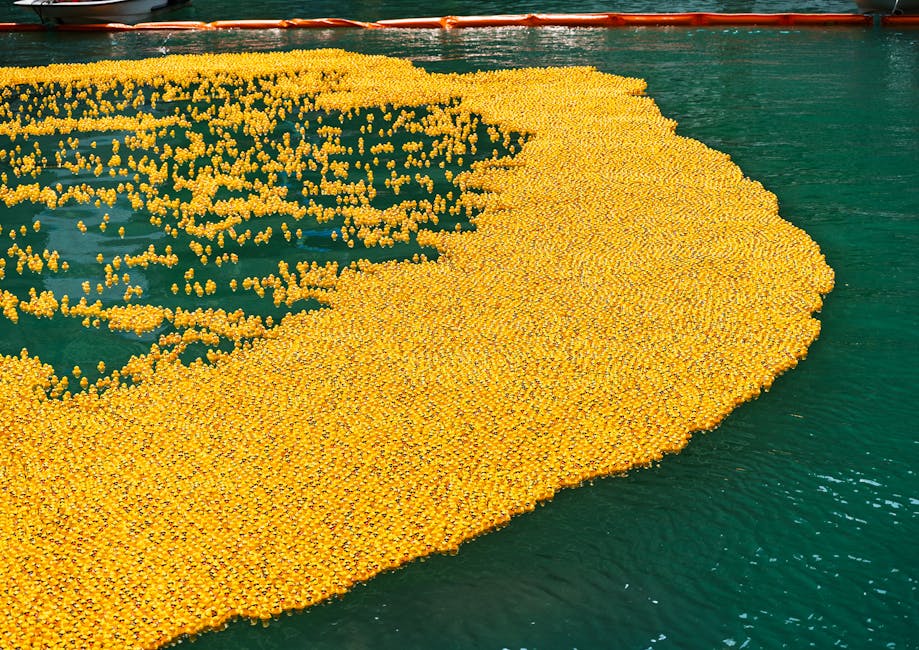

On January 10, 1992, a container ship hit a violent storm somewhere near the International Date Line on its way from Hong Kong to Tacoma, Washington. Twelve shipping containers slid off the deck and into the cold North Pacific. One of them split open, releasing 28,800 plastic bath toys — yellow ducks, red beavers, green frogs, and blue turtles — into the most heavily studied stretch of ocean on Earth. Curtis Ebbesmeyer, a Seattle oceanographer who already had a side career tracking flotsam, heard about the spill ten months later when the first faded ducks started washing up on beaches in Alaska.
He spent the next two decades chasing them.
The toys became known as the Friendly Floatees, and the accidental experiment they triggered did something no research grant ever could: it gave oceanographers tens of thousands of identical, dated, traceable objects, all dropped at the same point in the open ocean, drifting wherever the currents wanted to take them. The map that came out of it looked nothing like the tidy arrows in a high school textbook.
An accident that beat the research budget
Tracking surface currents the old-fashioned way meant tossing message bottles or specially designed drift cards off research vessels and waiting for beachcombers to mail them back. The returns were thin. A few hundred cards over a few years, scattered across a quarter of an ocean, did not make for a precise picture. The spill solved that problem by being enormous, public, and instantly recognisable. A yellow duck wedged between two pieces of driftwood on a beach in British Columbia did not need a return-postage label. Anyone who found one knew it did not belong there.
Ebbesmeyer, who had retired from a consulting career in physical oceanography, partnered with a former colleague named James Ingraham at the National Oceanic and Atmospheric Administration. Ingraham had built a computer model called OSCURS — Ocean Surface Currents Simulator — that used decades of wind and current data to predict where a floating object dropped at any given point in the Pacific would end up. The ducks became the test case. Ingraham would predict landfall dates and locations; Ebbesmeyer would collect reports from a network of beachcombers he had cultivated through a newsletter called Beachcombers’ Alert.
The model and the ducks agreed often enough to be useful, and disagreed often enough to be interesting.
The currents the textbooks got wrong
The textbook North Pacific circulates clockwise. Warm water moves north along Japan as the Kuroshio Current, swings east across the open ocean as the North Pacific Current, slides south down the North American coast as the California Current, and returns west as the North Equatorial Current. The Friendly Floatees confirmed the broad shape, and then complicated almost every detail.
Some ducks rode the Subarctic Gyre and beached in Alaska within a year, as expected. Others got caught in the slow rotation of what is now called the North Pacific Subtropical Gyre and circled for years, occasionally being spotted by fishing boats far from any coast. A smaller fraction drifted north through the Bering Strait, froze into Arctic pack ice, and were carried slowly across the top of the world over roughly five to six years before melting out into the North Atlantic. Those were the ducks that washed up in Maine, Massachusetts, and eventually on the western coast of Scotland and Ireland around 2007.
No one had ever traced a single drifting object from Hong Kong to the Hebrides before. The route confirmed that the Arctic Ocean was acting as a slow conveyor belt between the Pacific and the Atlantic — a connection oceanographers had inferred from salinity data but had never seen a physical object complete.
The man who turned bath toys into data
Ebbesmeyer was an unusual figure in the field. He held a PhD from the University of Washington, had spent years modelling currents for the oil industry, and treated beachcombers as legitimate research collaborators. He paid attention to anything that floated: Nike sneakers from a 1990 spill of 80,000 shoes, hockey gloves from a 1994 container loss, plastic Lego pieces from a 1997 spill off Cornwall that included, by coincidence, thousands of tiny plastic octopuses and divers.
Each spill became its own dataset. The sneakers, which floated higher in the water than the ducks and caught more wind, moved faster and landed in different places. The Lego pieces, denser and smaller, sank into a different layer of the surface current and tended to stay near the British coast. Comparing the three spills let researchers separate the contribution of wind, the contribution of surface drift, and the contribution of the upper few centimetres of moving water — variables that are nearly impossible to isolate in a controlled experiment.
By the early 2000s, Ebbesmeyer’s database held tens of thousands of reports from beachcombers in more than a dozen countries. Each report came with a date, a location, and usually a photograph. It was, in effect, a citizen-science project two decades before the term became fashionable.
What the ducks revealed about the garbage patch
The longest-drifting ducks did something that turned out to matter far beyond oceanography. They got stuck. The North Pacific Subtropical Gyre rotates slowly enough, and its centre is calm enough, that floating debris accumulates there over years. Charles Moore, a sailor who crossed the gyre in 1997, described an ocean dotted with plastic fragments stretching to the horizon. The region became known as the Great Pacific Garbage Patch.
The Floatees were among the first objects to demonstrate, with a clear origin and a clear timeline, how a piece of plastic released at a specific point and date would migrate toward that accumulation zone. Some of the ducks recovered in the 2000s had been at sea for more than fifteen years, bleached white by ultraviolet light, brittle, and breaking into smaller pieces. They became an early visual argument for what microplastic researchers would later confirm with sediment cores and trawl samples: ocean plastic does not disappear, it fragments, and the currents concentrate it in predictable places.
Recent efforts to map that concentration have moved from beachcombing to satellite data and machine learning. A team at Scripps Institution of Oceanography recently used an AI approach to reveal surface currents in unprecedented detail, identifying small-scale eddies and filaments that older models missed entirely. Those small features turn out to matter enormously for where a plastic duck — or a patch of microplastic — ends up.
Why drifting objects still teach things sensors cannot
Modern oceanography has satellite altimetry, autonomous floats, and tagged research buoys that report position by GPS every few hours. The Argo program alone has more than 3,000 floats drifting through the world’s oceans, measuring temperature and salinity down to two kilometres. By any reasonable measure, the science has moved far past the era of yellow ducks.
And yet drifting objects keep being useful. New AI-driven current models still need real-world validation, and validation means objects that started in a known place at a known time and ended somewhere measurable. Racing sailboats have begun carrying scientific instruments across remote stretches of the Southern Ocean, where research vessels rarely go, turning yacht races into floating laboratories. The principle is the same one Ebbesmeyer worked with: if something has to travel through the ocean anyway, it might as well collect data along the way.
Deep-water circulation shapes even microbial communities through the same currents that carried the ducks, a reminder that the surface drift Ebbesmeyer tracked is only the visible top layer of a much larger system. The decadal variability of North Pacific oceanic systems means the routes a duck took in 1994 are not necessarily the routes a duck dropped today would take. Currents shift on timescales of years and decades, and the spill happened to span enough years to capture some of that shift.
The ducks that are still out there
Of the 28,800 toys lost in 1992, only a few thousand have ever been recovered. The math suggests tens of thousands are still drifting, or buried in beach sand, or broken into pieces too small to recognise. A few have been bought by collectors for more than a thousand dollars each. Most are quietly orbiting the Pacific gyre or frozen in Arctic ice somewhere north of Russia, waiting for a warm summer to release them again.
Ebbesmeyer, now in his eighties and long retired from active research, built a database that is still cited in papers on plastic pollution, marine debris modelling, and Arctic-Pacific exchange. The current generation of ocean cleanup operations uses descendants of the same drift models that the ducks helped calibrate, refined by satellite data and machine learning into something far more precise than OSCURS ever was.
If you want to understand how a piece of plastic dropped in Hong Kong ends up on a beach in Scotland fifteen years later, you can read the equations. Or you can picture a faded yellow duck, sun-bleached almost to white, washing onto a stony beach in the Outer Hebrides on a grey morning in 2007, and a retired postman picking it up, turning it over, and noticing a small embossed mark on its belly that reads, in tiny letters, The First Years.