
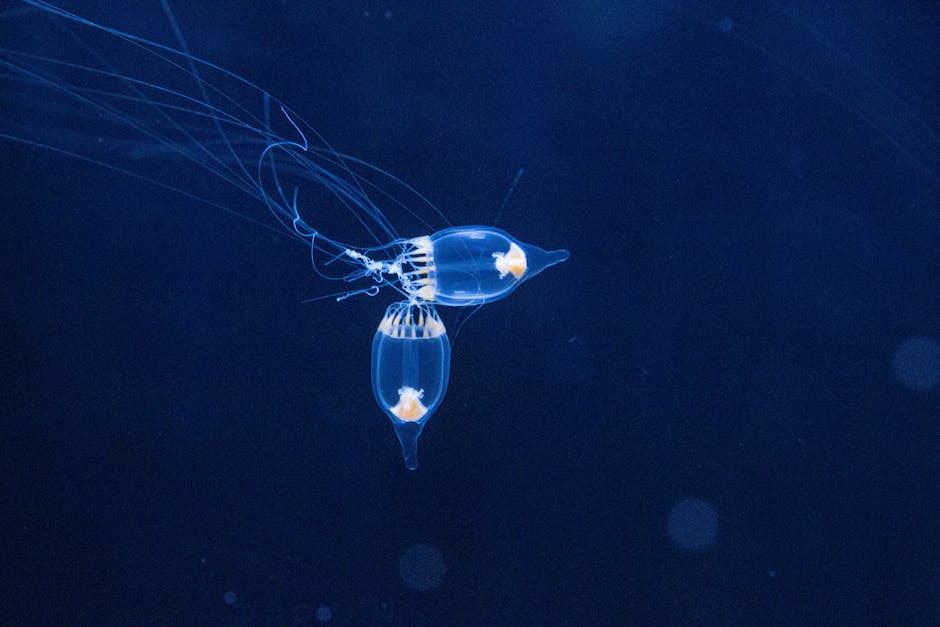
Shin Kubota keeps a tank of Turritopsis dohrnii in his lab at Kyoto University’s Seto Marine Biological Laboratory, on the Wakayama coast at Shirahama, and he has watched the same jellyfish die and un-die so many times that he has written karaoke songs about them. The animals are no larger than a pencil eraser. When one of them is stabbed, starved, or otherwise pushed toward death, it does not float away and decompose like a normal jellyfish. It collapses in on itself, settles to the bottom of the tank, and over a few days reorganises its own cells into a younger version of itself, a polyp, the larval stage it had supposedly outgrown years earlier. Then it grows up all over again.
Biologists call this transdifferentiation, and as far as anyone can tell, Turritopsis dohrnii is the only animal on the planet that can do it on demand, as a survival reflex, in apparent defiance of how aging is supposed to work.
The trick that broke a textbook
Most life cycles run one direction. A frog does not turn back into a tadpole. A butterfly cannot fold itself back into a caterpillar. Even cells inside the human body, once they commit to being skin or muscle or nerve, almost never change their minds. That one-way arrow is, for most of biology, the whole point.
Turritopsis dohrnii does not obey the arrow. When the adult medusa, the recognisable umbrella-and-tentacles form most people picture when they hear the word jellyfish, is wounded or stressed, its already-specialised cells rewrite themselves. Stinging cells, muscle cells, and nerve cells revert to a generic state and then redifferentiate into the cell types that make up a polyp, the stalk-like creature that anchors to a rock and reproduces by budding. The medusa, in effect, walks backward through puberty.
The jellyfish is roughly 4.5 millimetres across, smaller than a fingernail, and almost completely transparent except for a bright red stomach in the centre of its bell. It looks, frankly, like nothing. Researchers in the Mediterranean only began paying attention to it in the 1990s, when Christian Sommer, a German graduate student working on hydrozoans in Rapallo, Italy, noticed that adult medusae in his petri dishes were not dying when they should have been. They were reverting from the adult stage back to the polyp stage instead. The result was published in 1996 by Stefano Piraino, Ferdinando Boero, and their colleagues in the journal Biological Bulletin.
Why “immortal” is a word with footnotes
The popular name for this animal is the immortal jellyfish. The actual story is more careful. Turritopsis dohrnii does not live forever in the way a vampire in a novel lives forever. It can still be eaten by a fish. It can be crushed by a wave. It can be killed by a sudden temperature swing, a parasitic infection, or pollution. In lab conditions, some medusae that attempt the rejuvenation process fail and die anyway.
What it can do is sidestep the one form of death that is supposed to be inescapable: aging itself. In theory, a single Turritopsis dohrnii could cycle from polyp to medusa to polyp to medusa indefinitely, and the same genetic individual could persist for centuries, or longer. Nobody has yet watched one do that for a human lifetime, because nobody has yet been watching for a human lifetime. The rejuvenation behaviour was only published in the scientific literature in 1996.
That is the asterisk on the word immortal. The animal is not invincible. It is, more precisely, ageless.
The biologist who sings to them
Shin Kubota is the person most responsible for what the world knows about Turritopsis dohrnii. He has kept colonies of the jellyfish at the Seto Marine Biological Laboratory in Shirahama for decades, feeding them brine shrimp by hand, and he has documented individual medusae cycling through the rejuvenation process roughly ten times in succession over two years. He is also, separately, a prolific writer of karaoke songs about marine invertebrates, which he performs in costume. The combination has made him something of a folk figure in Japanese science television.
The lab work itself is unglamorous. The animals are tiny, fragile, and bad at being kept alive. They are picky about water temperature and almost impossibly easy to lose at the bottom of a beaker. Kubota has said in interviews that the rejuvenation process, once triggered, takes about 24 to 72 hours in a healthy adult and produces a small cyst of tissue that then reorganises into a polyp within a few days, after which the polyp can begin budding new juvenile medusae.
The genetic machinery behind that transformation is what interests the rest of biology. If researchers can figure out which genes flip on and off during transdifferentiation, and in what order, the answer may have implications for human medicine that have nothing to do with jellyfish at all. Aging research, cancer research, and regenerative medicine all run into the same wall: adult cells refuse to change their identity. Turritopsis dohrnii walks through that wall casually, several times a year, as a stress response.
How a fingernail-sized animal colonised the world
Turritopsis dohrnii was originally described from the Bay of Naples and named in 1883 in honour of Anton Dohrn, founder of the Stazione Zoologica in Naples. It has since been found in oceans almost everywhere on Earth, from Japan to Panama to the coast of Florida. The leading theory for how it spread is that polyps attach to the hulls of ships, or get sucked into ballast water tanks, and get carried across oceans as stowaways. Cargo shipping has, accidentally, distributed an ageless animal across most of the planet.
The jellyfish is not the only one doing this kind of stealth invasion. A freshwater cousin, Craspedacusta sowerbii, has turned up on six continents without much fanfare, often mistaken for an ocean species by people who find it in their local lake. Researchers studying lakes in Europe and North America have documented populations spreading through reservoirs almost invisibly, partly because the polyp stage is microscopic and partly because the adult medusae only appear for a few weeks a year. Jellyfish, as a group, are remarkably good at slipping past attention.
New species keep being found, too. Researchers recently described a new jellyfish off the coast of Japan, a reminder that the inventory of life in the ocean is still wildly incomplete.
What the cells actually do
The mechanics of rejuvenation, as far as biologists have worked them out, look like this. A healthy adult medusa drifts in the water column, hunting plankton with its tentacles. Something goes wrong, perhaps physical damage, starvation, or a sudden change in water chemistry. The medusa stops swimming. Its tentacles retract. Its bell collapses inward. Within hours it is a featureless blob on the sea floor.
Inside that blob, the cells are not dying. They are losing their specialisations. A muscle cell stops being a muscle cell. A nerve cell stops being a nerve cell. The genome inside each cell, which had been expressing only the genes relevant to its job, switches programs and starts expressing the genes for an earlier developmental stage. Over a few days the blob restructures itself into a polyp, anchors to the nearest hard surface, and begins budding off new juvenile medusae. The original adult is, biologically, the same individual. It has simply rewritten its body.
This is what makes Turritopsis dohrnii unique. Plenty of animals can regenerate limbs. Salamanders regrow legs. Starfish regrow arms. Some flatworms can be cut in half and become two flatworms. But none of those animals reverse their entire life cycle. None of them turn a sexually mature adult back into a pre-pubescent juvenile. That is the move Turritopsis dohrnii has, and nothing else does.
Why labs are paying attention
Jellyfish have become surprisingly useful to engineers and biologists for reasons that go far beyond aging. At the University of Colorado Boulder, the engineer Nicole Xu has been building cyborg jellyfish by fitting moon jellies with small microelectronic devices that stimulate their swim muscles, steering them through the water and one day, she hopes, letting them carry sensors into hard-to-reach parts of the ocean. The animals are appealing for the same reason they are weird: they have almost no skeleton, almost no brain, and almost no metabolic cost, which means they can drift for kilometres on energy that would barely move a fish.
The biotech interest in Turritopsis dohrnii is more theoretical. No drug company is going to bottle jellyfish rejuvenation and sell it as an anti-aging cream. The animal is too distant from humans, evolutionarily, for any of its specific molecules to drop neatly into mammalian biology. But the principle, that adult cells can be coaxed back into a younger, more flexible state, is the same principle behind induced pluripotent stem cells, the technique that won Shinya Yamanaka the 2012 Nobel Prize in Physiology or Medicine. Yamanaka showed that adult mouse fibroblasts could be reverted to an embryonic-like state by switching on just four genes. The jellyfish, presumably, is doing something analogous, with its own evolutionary toolkit, in seawater, every time it gets hurt.
If you have ever read about how the natural world keeps inspiring technology, this is another entry in that catalogue. Velcro came from burrs. Sonar came from bats. The current generation of stem cell research keeps looking back at small, soft animals that figured out tricks evolution has spent five hundred million years refining.
A fingernail-sized jellyfish, first described from the Mediterranean in 1883 and now drifting in harbours from Panama to Yokohama, has the ability to grow younger when it is dying. It does this by dismantling its own adult body and reassembling the cells into a juvenile. It can do this repeatedly. A single individual, in a sheltered tank with a careful keeper and a steady supply of brine shrimp, might already have been doing it for longer than anyone has been counting.
Kubota, in his lab on the Wakayama coast, has spent more than two decades feeding them, watching them collapse, and watching them sprout back. He has said in interviews that he believes the species will eventually unlock something important about human aging, and also that he does not expect to live long enough to see it. The jellyfish, presumably, do not have that problem. They are still in the tank, contracting and expanding in the dark, smaller than a coin, older than the lab they live in, with no particular reason to stop.