
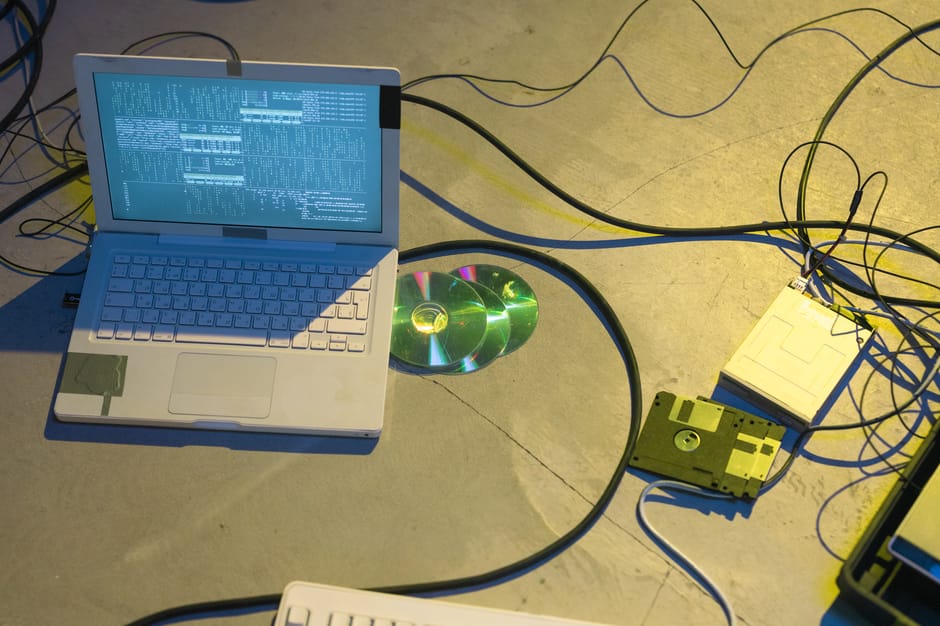
As recently as 2020, updating a Boeing 747-400’s navigation database meant a technician boarding the aircraft every 28 days with a sleeve of eight 3.5-inch floppy disks, sitting down in the captain’s seat, and feeding them one at a time into a drive mounted on the cockpit pedestal.
The job took about an hour. Each disk held 1.44 megabytes, less than a single photo from a modern phone camera. The 747-400 had entered service in 1989 with avionics certified by the FAA to read from those disks, and three decades later, the same airframes were still being updated the same way. Pen Test Partners documented the drive in a walkthrough of a retired British Airways 747-400 in August 2020, where a maintenance engineer pointed the camera at the loader tucked behind a locked panel and explained the 28-day cycle.
The disks themselves had stopped being manufactured by most companies years earlier. Sony, the last major producer, ended production in March 2011, citing demand that had collapsed more than ninety percent from a 1995 peak.
The reason the 747 kept eating floppies was not nostalgia. It was certification law. Anything that touches a flight-critical avionics system has to be qualified under FAA standards that demand exhaustive testing of every component in every failure mode. Swapping the floppy drive for a USB port would have triggered a recertification of the entire navigation subsystem, a process that would have been prohibitively expensive. The floppy was cheaper than the paperwork to replace it.
The icon outlived the object
Somewhere in the same years that the last 747-400s were rolling out of Everett, a generation of children was learning to use computers that had never shipped with a floppy drive. The first iMac, released in 1998, famously omitted one. By the mid-2000s, almost no consumer machine came with the slot. By 2015, a kid clicking Save in Microsoft Word was tapping a picture of a thing they had likely never held.
The save icon, that little square with the metal shutter at the top, is one of the most persistent skeuomorphs in software. It represents a physical object that has been functionally extinct in homes for close to twenty years. Most apps still use it. Microsoft Word uses it. Google Docs uses it. Photoshop uses it. The icon outlived the disk by a full generation and shows no sign of changing. The same flattened disk shape still marks “save” in browser extensions built decades after the format went obsolete.
The reason is partly inertia and partly something stranger. When a symbol becomes detached from its referent, it stops being a picture of a thing and becomes a glyph for an action. The disk-shape no longer means “floppy disk.” It means “save.” Children learning software today recognise the shape the way earlier generations recognised a stop sign without parsing the word.
How the disk got that shape in the first place
The 3.5-inch floppy was introduced by Sony in 1981 with the OA-D30V drive, a single-sided 400KB model that Hewlett-Packard adopted the following year for its HP-150. It replaced the 5.25-inch floppy, which itself replaced the 8-inch floppy that IBM had introduced in 1971. The format the world ended up with, the rigid plastic shell with a sliding metal shutter, became dominant after Apple chose Sony’s improved double-sided version for the original Macintosh in 1984. It fit in a shirt pocket and survived being dropped.
The capacity stayed stuck at 1.44 megabytes for almost the entire lifespan of the format. Various attempts to push it higher, the SuperDisk, the Zip drive, the HiFD, all failed in the consumer market. By the time anyone had a real reason to want more than 1.44 megabytes on removable media, the CD-R had arrived, then USB flash, then cloud sync, and the question stopped mattering.
The disks were also less reliable than memory tends to suggest. Magnetic media degrades. The plastic warps. The metal shutter springs lose tension. A floppy left in a hot car for a summer often came back unreadable. Archivists today treat the recovery of old floppy contents as a specialised skill, requiring rare drives, specific software, and patience. Popular Science profiled one such archivist who has spent years pulling data off disks that were never meant to last this long.
Where the floppy refused to die
The 747 was not alone. The United States Department of Defense ran its nuclear command-and-control system, the Strategic Automated Command and Control System, on 8-inch floppies until June 2019. A 2016 Government Accountability Office report on aging federal IT, Federal Agencies Need to Address Aging Legacy Systems, found that SACCS ran on an IBM Series/1 computer from the 1970s. The Air Force kept the system because the air-gapped, single-purpose nature of ancient hardware made it harder to hack than anything modern. Lt. Col. Jason Rossi, commander of the 595th Strategic Communications Squadron at Offutt Air Force Base, told Defense News the system’s age was the security feature: “You can’t hack something that doesn’t have an IP address.” The floppies were swapped for solid-state storage in June 2019.
Embroidery machines still use floppies. Industrial CNC mills in factories still use them. Some MRI machines, calibration tools for medical lasers, and yacht navigation systems all kept the format alive long after the consumer world abandoned it. The disks became artefacts of regulated industries, places where recertifying a working system means months of paperwork and a budget line that no one wants to defend.
San Francisco’s Muni Metro light rail still loads its Automatic Train Control System software each morning from 5.25-inch floppy disks, software that has been running since 1998. In October 2024, the SFMTA board approved a $212 million contract with Hitachi Rail to replace it. The new system is targeted for completion around 2028. Until then, the disks go in every morning.
The generation gap, visible in icons
The floppy save icon is one example of a broader pattern in software: interfaces full of references to objects the user has never owned. The phone icon on a smartphone shows a handset shape that has not been mass-produced in decades. The camera shutter sound on a digital phone mimics a mechanical mirror flip from a film SLR. The “carbon copy” line in email is named after sheets of carbon paper sandwiched into typewriters in the 1950s.
A worker in their sixties grew up with the objects the icons depict. A worker in their twenties grew up with the icons alone. Both click the same button. They mean the same thing by it. They are looking at slightly different pictures. For workers in their teens now, even the icons are starting to detach from the apps they once anchored: the floppy is one of several shapes — alongside the cassette, the rotary handset, and the manila folder — that arrived in interfaces preinstalled with no referent at all.
Why nobody redesigns it
Software companies have tried, occasionally, to replace the floppy. Apple’s macOS has experimented with various save-state behaviours, including autosave and version histories, that quietly remove the need for an explicit save command. Google Docs simply saves continuously and shows a small text indicator that says “All changes saved in Drive.” Both approaches sidestep the icon problem by changing the underlying action.
But in most desktop software, the explicit save still exists, and the icon stays. Designers have proposed alternatives, a downward arrow, a cloud, a checkmark, a hard drive silhouette. None of them have caught on. The floppy is too recognisable to retire and too generic to confuse. It has become, in interface terms, a logogram.
This is how symbols survive their referents. The Greek letter alpha was once a sketch of an ox. The dollar sign may have started as a Spanish peso abbreviation. The ‘@’ symbol has contested origins, possibly related to accounting abbreviations, that lived in obscurity for centuries before email brought it into daily use. Symbols decouple from their origins. They become themselves.
The disks that are left
Floppy disks are still sold, in small numbers, by Tom Persky, a 73-year-old American who runs floppydisk.com out of a warehouse in Lake Forest, California. Persky started in the disk-duplication business in the 1980s, and around the time Sony halted production in 2011 he stocked up on roughly two million blank disks, which he has been selling down ever since. In an interview included in the 2022 book Floppy Disk Fever, Persky told Eye on Design that roughly half of the world’s airfleet is more than twenty years old and still uses floppies in some of its avionics, with embroidery shops the single biggest customer base. He sells about 500 disks a day.
When the supply finally runs out, the industries still using floppies will be forced to upgrade. Some already have. As airlines retired their 747-400 fleets through the early 2020s, accelerated by the pandemic-era collapse in demand for four-engine widebodies, the floppy-based navigation update became a niche of a niche. The 747-8, the final variant of the type, ships with electronic flight bags and modern data loaders. It never used floppies.
The last 747 of any kind rolled off the Everett assembly line in December 2022, a 747-8 freighter built for Atlas Air. With it went the most famous remaining production-line use of the format in aviation. Other holdouts persist. The disks themselves, the ones already manufactured, will keep turning up in drawers and storage closets for decades, slowly demagnetising. If you have an old USB drive in the same drawer, the easier path is to repurpose the flash; the floppy beside it is mostly an artefact.
Open any word processor right now and look at the top-left corner of the toolbar. The square is still there. The metal shutter is still drawn at the top. The little label that slides into a slot on the front is still visible if the icon is rendered large enough.
It is a picture of an object that fit in a shirt pocket, held less data than a single text message with photos attached, and was the standard way to move files between computers for roughly fifteen years of the late twentieth century. It is also a button. Clicking it writes the current document to disk, except there is no disk, only flash memory or a remote server in a data centre in Oregon. The picture and the action have nothing left in common except habit.
Habit, in interface design, is most of what there is. The floppy will probably outlive everyone reading this, frozen into menus and toolbars long after the last working drive has been dismantled for parts. It will keep meaning “save” the way a red octagon keeps meaning “stop,” detached from any object, doing its job.