

The Amazon looks like the last place on Earth that would need a delivery. Its soils sit under a canopy dense enough to hide entire tribes, fed by rivers that discharge roughly a fifth of all the freshwater reaching the oceans.
Yet the same tropical downpours that make the forest possible also strip it. Rain leaches nutrients out of the topsoil and washes them downriver, and phosphorus — the element plants need to build DNA, cell membranes, and the machinery of photosynthesis — bleeds away fastest of all. Left alone, the Amazon should be starving.
It isn’t, because roughly once a year the sky above it turns faintly beige. The dust that tints it started as pulverised rock in a dry lake bed on the other side of the Atlantic, more than 5,000 kilometres away.
A desert feeding a forest
In 2015, a team led by Hongbin Yu — an atmospheric scientist with the University of Maryland who works at NASA’s Goddard Space Flight Center — used seven years of measurements from the CALIPSO satellite to quantify, for the first time from space, how much Saharan dust actually reaches South America. Their answer, published in Geophysical Research Letters, was that an average of 182 million tonnes of dust leaves the west coast of Africa each year, of which about 27.7 million tonnes settle over the Amazon basin.
Between those two figures, the plume sheds most of its mass. Of the roughly 182 million tonnes that leave Africa — the equivalent of nearly 700,000 semi trucks — about 132 million tonnes are still aloft as the plume nears South America. Around 43 million tonnes travel on to settle over the Caribbean, and the remainder rains into the Atlantic along the way.
Much of the dust begins in a single, extraordinary place. The Bodélé Depression, a dry lakebed in northern Chad tucked between the Tibesti and Ennedi mountains, is the most intense dust source on Earth.
It is the ghost of Mega-Chad, an inland sea that during the African Humid Period, roughly 7,000 years ago, covered an area larger than modern Germany. When the lake dried, it left behind sediments of diatomite — the fossilised skeletons of freshwater algae — enriched in the phosphorus those organisms had spent millennia concentrating from the water.
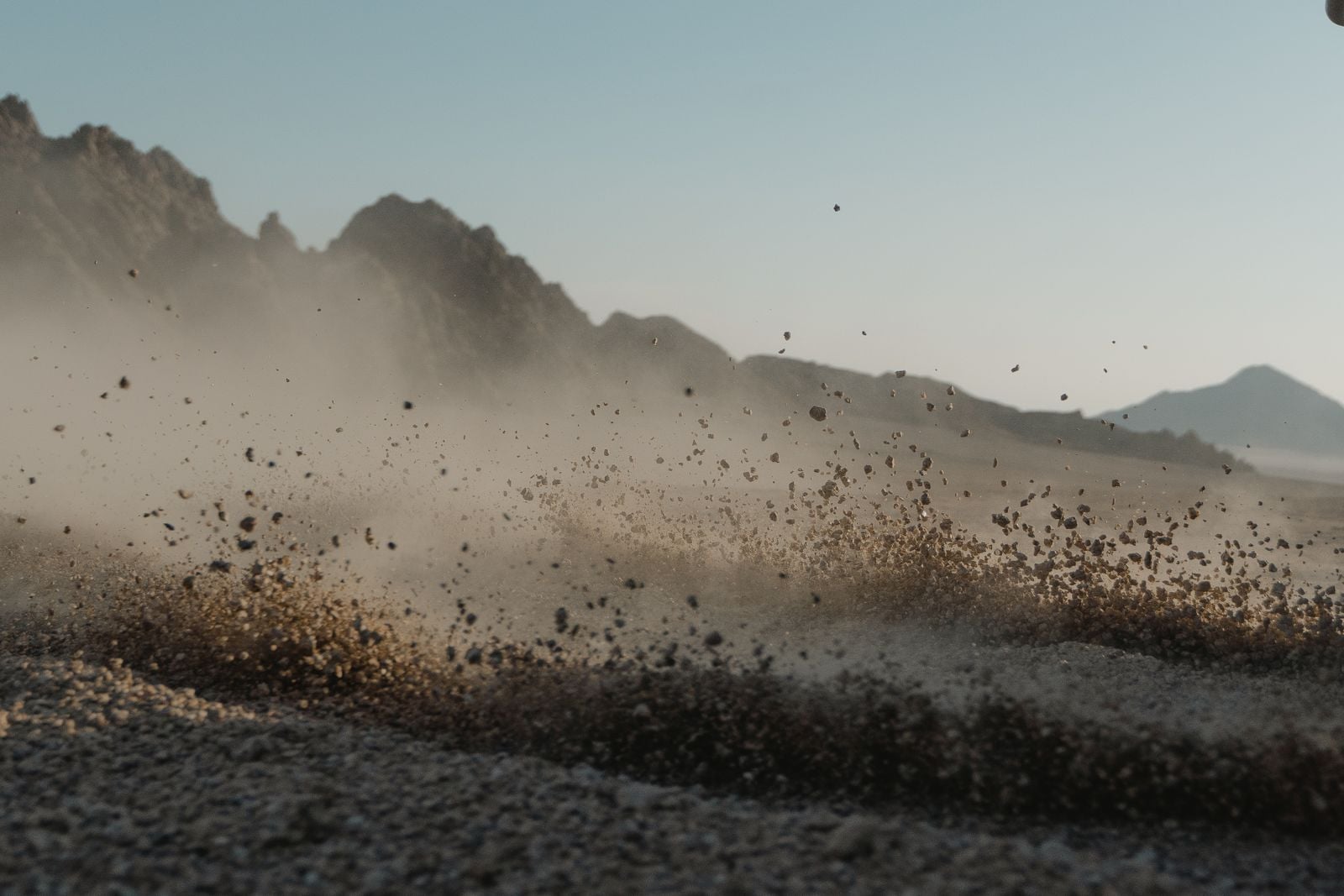
The Bodélé sits inside a natural wind tunnel. Northeasterly trade winds funnel between the two mountain ranges and accelerate across the exposed sediment, lofting diatomite powder several kilometres into the atmosphere. From there, weather systems carry it west, out over the Atlantic, in a river of dust known as the Saharan Air Layer.
Just how much of the Amazon’s dust the Bodélé supplies is not settled. A 2006 analysis by Ilan Koren and colleagues estimated that the depression — around 0.5 percent of the Amazon’s area — produces roughly half the mineral dust reaching the basin. Later work has challenged even that, arguing the Bodélé’s share of the fertilising dust may be smaller than the early framing implied. What no one disputes is that it is the single most productive dust source on the planet.
The phosphorus arithmetic
Yu’s team estimated that the 27.7 million tonnes of dust reaching the Amazon carry roughly 22,000 tonnes of phosphorus a year. That figure is close to what ecologists calculate the forest loses annually to rainfall runoff and flooding — a rough but suggestive match. The dust, in other words, appears to balance the ledger.
The calculation isn’t clean. Estimates of Amazon phosphorus loss vary, dust deposition swings by a factor of five between wet and dry years, and not all the phosphorus in the falling dust is chemically available to plants.
Chemical studies of the sediment complicate it further. An analysis of Bodélé dust and its source beds found that most of the phosphorus is bound as sparingly soluble apatite or attached to iron oxides, but that a portion is far more available — including material identified as fossilised fish bone and scale, the first such find in wind-blown dust. That fish-derived phosphorus dissolves relatively easily, the way bone meal does in a garden, while the rest is released only slowly by weathering. Exactly what fraction ends up feeding a tree near Manaus is still debated.
What isn’t debated is the direction of the flux. The Amazon receives more phosphorus from African dust than from any other external source. A single evaporated lake bed, half a world away, is quietly helping to run the fertiliser supply for the largest rainforest on the planet.
Seeing the plume from orbit
The dust bridge has been visible in satellite imagery for decades, but it took CALIPSO — a joint NASA/CNES mission carrying a lidar instrument that fires laser pulses at the atmosphere and measures what bounces back — to give it a vertical structure. CALIPSO can distinguish dust from smoke and sea salt, and it can tell how high in the atmosphere each layer sits.
The Saharan Air Layer typically travels between about 1.5 and 6 kilometres above the ocean: dry, warm, and dense enough to suppress the formation of hurricanes beneath it.
The plume is not constant. It is strongest in boreal spring and early summer, when the Sahara is hottest and the intertropical convergence zone sits far enough south to steer trade winds directly toward South America.
By late summer the plume shifts north and begins delivering dust to the Caribbean and the southeastern United States instead — which is why Miami skies occasionally take on a milky cast in June, and why Puerto Rican air-quality monitors sometimes register their worst readings on days with no local pollution source at all.
Yu’s team also found the plume varies from year to year by as much as 86 percent between the smallest and largest observed transport. That variability appears to track rainfall in the Sahel, the semi-arid strip immediately south of the Sahara: wetter Sahel years produce more vegetation, less exposed soil, and less dust; drier years produce more. The system is coupled in ways that are still being worked out.
Why phosphorus, and why it matters
Every living cell needs phosphorus. It forms the backbone of DNA and RNA, the head group of the lipids in cell membranes, and the P in ATP — the molecule cells use to move energy around.
Unlike nitrogen, which some bacteria can pull straight from the atmosphere, phosphorus has no gaseous phase at Earth’s surface. It moves through the biosphere as dust, as dissolved ions in water, and as rock weathering slowly on geological timescales. When a tropical rainforest loses phosphorus to a river, the only way to get it back — short of waiting for the bedrock beneath to erode — is for something to physically carry it in from somewhere else.
The Sahara-to-Amazon connection is one of the clearest examples of the planet behaving as a single interconnected system. It links the desertification of the Sahel, the drying of an ancient African lake, and the productivity of a South American forest that stores enough carbon to matter to the global climate. Disturb any part of it — pave the Bodélé, shift the trade winds, alter Sahelian rainfall — and the effects propagate.
What the picture still misses
There are open questions. It is not clear how much of the deposited phosphorus is taken up by trees versus washed out again by the next rainy season. It is not clear whether the flux has been stable over centuries or whether it varies with African climate cycles the way ice cores hint it might. And it is not clear what happens if the Sahel greens or browns significantly under future warming: the models disagree about the sign of the change, let alone the magnitude.
The broad picture, though, holds. Sit in the Amazon in April, look up on a hazy afternoon, and some of what is drifting overhead began as microscopic algae that lived in a lake in Chad when the Sahara was still green, died, sank, dried, and waited seven thousand years to be picked up by the wind. It crossed an ocean at altitude, fell through the canopy, and landed at the base of a tree that will use it to build a leaf. Few things on Earth make the phrase global system feel quite so literal.
For more on the strange machinery that keeps the planet, and the technology watching it, running, see how GPS satellites correct for Einsteinian time dilation and how Voyager 1 keeps transmitting from interstellar space on a budget of decaying plutonium.