
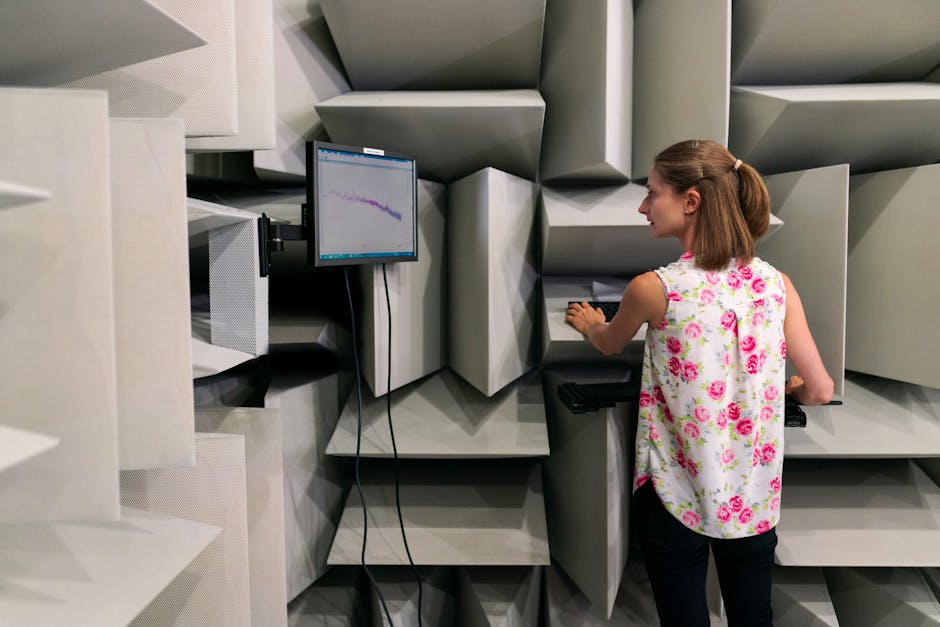
Building 87 on Microsoft’s Redmond campus contains a room that registers a background sound level of negative 20.35 decibels, a measurement so far below the threshold of human hearing that the air molecules themselves are barely loud enough to be detected. The chamber holds the Guinness World Record for the quietest place on Earth, and according to its principal designer Hundraj Gopal, no one has managed to sit inside it in total darkness for longer than about 45 minutes.
The threshold of human hearing sits at 0 decibels. Negative 20 is significantly quieter than that.
Inside the room, the brain runs out of external noise to process and starts listening to itself.
The room itself
The chamber is a six-sided box suspended on 68 vibration-damping springs, isolated from the rest of the building so that footsteps on the floor above cannot bleed through. Microsoft’s own account of Building 87 describes the chamber as sitting on its own foundation, surrounded by six concrete-and-steel shells, each layer up to 12 inches thick. Every interior surface, walls, ceiling, and the steel-cable mesh floor that visitors stand on, is covered in fiberglass wedges roughly a meter long. The wedges absorb sound waves instead of reflecting them, which is what gives anechoic chambers their dead, pressurized feel.
A normal quiet bedroom at night runs about 30 decibels. A recording studio might get down to 10. The Redmond chamber, at roughly minus 20, sits about 30 decibels below the studio and 50 below the bedroom.
A BBC Future feature on the room describes standing inside as a disorienting experience where the body becomes the loudest thing in the environment. The grinding of joints. The rush of blood through the carotid artery. The faint hiss that turns out to be the auditory nerve firing into silence.
Why Microsoft built it
The chamber exists for a practical reason. Microsoft uses it to test the acoustic signature of hardware, the click of a Surface keyboard, the fan whine in an Xbox, the hinge of a laptop, the chime that plays when a Teams call connects. Engineers need to know what those sounds actually sound like, stripped of every echo and ambient hum a normal room would add.
Audio testing for Cortana and the array microphones inside HoloLens also happens here. To calibrate a microphone that can pick up a whisper across a room, the room first has to contain nothing else.
The chamber doubles as a research tool for Microsoft’s audio team, who study how speakers, headphones, and voice-recognition systems perform when the environment contributes literally nothing. The chamber was built in collaboration with Eckel Noise Control Technologies, the same firm that built the previous record-holder at Orfield Labs.
What 45 minutes inside feels like
Visitors who have spent extended time in the room describe a predictable progression. The first minute is novelty, the silence feels luxurious. Then the body starts surfacing.
Heartbeat becomes audible. Breathing sounds amplified, almost embarrassing. The stomach gurgles loud enough to startle. Move an arm and the joint produces a soft creak that, in any other room, would be masked by the air itself.
After several minutes, the brain begins to produce sound on its own. A ringing in the ears, what most people experience as faint tinnitus, becomes a sustained tone. Some visitors report low rumbles, ticking, or whooshes that have no external source. The auditory cortex, deprived of input, starts generating its own signal.
By 30 to 45 minutes, balance starts to go. Anechoic chambers absorb the tiny acoustic cues the inner ear uses to orient itself in space, and without them, standing upright becomes harder. Most people sit down. Some have to be guided out.
The widely repeated 45-minute number is not a certified endurance record. Gopal has given different figures in different interviews, sometimes 45 minutes, sometimes closer to 55, and the original 45-minute reporter’s record story actually traces back to the Orfield chamber in Minneapolis. Microsoft does not run the room as an endurance challenge. Audio engineers who use it regularly describe acclimating to it over time, especially when there is equipment to focus on. Strip away the dark and add a job to do, and the experience changes. The brain has something to anchor to.
Why the brain hallucinates in silence
The phenomenon is not mystical. It is a well-documented quirk of how the nervous system handles sensory input.
The brain expects a constant baseline of ambient sound. Wind, traffic, the hum of an HVAC system, the faint static of air molecules colliding. When that baseline vanishes, the auditory system does not register silence as zero, it registers it as a problem and starts amplifying whatever signal remains.
That amplification is why blood flow becomes audible. The sound of arteries was always there, the brain was just filtering it out. Take away the filter and the signal floods in.
Research on sensory deprivation suggests that when external input drops, subcortical regions of the brain start producing spontaneous activity that the cortex interprets as real perception. The same mechanism explains why people in pitch-dark isolation tanks sometimes see flashes of light or geometric patterns.
A 2023 paper in PNAS by Rui Zhe Goh, Ian Phillips, and Chaz Firestone at Johns Hopkins demonstrated that silences can substitute for sounds in standard auditory illusions, evidence that the brain perceives silence as its own auditory event rather than the absence of one. The university’s own write-up calls the finding “the sound of silence.” In a chamber like Microsoft’s, that perceptual machinery is running with no input to work on.
Hearing is not a passive recording of the outside world. The ear and the brain are constantly making decisions about what to filter, what to amplify, and what to ignore. Most of those decisions happen below conscious awareness. In a normal room, the brain ignores the faint signal from the auditory nerve because there is louder, more relevant sound to process. In an anechoic chamber, that hierarchy collapses. The nerve signal becomes the loudest thing available, so the brain treats it as meaningful.
Research on auditory hallucinations and sensory impairment shows the same pattern in people with hearing loss, who often experience phantom sounds because the auditory system compensates for missing input by generating its own. The chamber produces a temporary, reversible version of the same effect.
Other rooms in the running
Microsoft’s chamber has held the Guinness record at negative 20.35 decibels since 2015. Orfield Laboratories in Minneapolis previously held the title with a chamber that measured negative 13 decibels, certified in 2004 and again in 2012 before Microsoft took the title.
Both chambers produce the same psychological effects. Microsoft’s is just quieter.
Outside controlled chambers, the quietest naturally occurring places on Earth, deep caves, certain points in Antarctica, register around 10 to 20 decibels. Even those are deafening compared to Building 87. The theoretical floor is somewhere around negative 23 decibels, the noise made by air molecules colliding through Brownian motion. The Redmond chamber sits within three decibels of physics.
The downside of total quiet
Silence is often sold as restorative. Meditation retreats, noise-cancelling headphones, quiet-car train carriages, the cultural assumption is that less sound equals more peace.
The Microsoft chamber complicates that assumption. Extreme quiet can intensify intrusive thoughts and self-awareness in ways that are not always pleasant. With no external input to occupy attention, the mind turns inward, and what it finds there is not always restful. Prolonged absence of stimulation can produce effects that overlap with sleep deprivation, including impaired judgment and mild dissociation.
The chamber is a useful tool because it is extreme. For testing a fan whine or a microphone array, the silence is the whole point. For sitting in for fun, the silence is the problem.
The visitors who describe the experience tend to land on the same images. The blood in the ears sounds like a distant ocean. The joints sound like a wooden floor settling. The breath sounds like wind in a tunnel. Eventually, if the silence holds long enough, a high-pitched tone emerges that does not seem to come from anywhere. That tone is the auditory nerve firing into the void, the sound, if it can be called that, of a sense organ with nothing to sense.
The door of the chamber is heavy, padded, hinged like a bank vault, sealed against the rest of the building. When it closes, the seal is acoustic as much as physical. Whatever happens inside stays inside, including the visitor’s own pulse, suddenly loud enough to count.