

On the morning of 2 September 1859, telegraph operators along the American East Coast began arguing with their own equipment. Sparks were jumping from the keys. Paper tape was scorching. Operators reported jolts strong enough to knock them back from their desks. And then, after the batteries were disconnected, the lines kept working anyway, humming with current that had no human source.
The current was coming from the sky.
What the operators were feeling, and what astronomer Richard Carrington had watched erupt from the surface of the Sun the previous morning from his private observatory in Redhill, England, was the largest geomagnetic storm ever recorded. It has carried his name ever since. And the strangest detail of that night, the part that still makes electrical engineers go quiet, is that the telegraph network briefly ran on the aurora alone.
What Carrington saw, and the sky that followed
Carrington had built an observatory so he could map sunspots. On the morning of 1 September 1859 he was sketching a particularly large group when two patches of brilliant white light appeared inside it, bright enough to be mistaken for a hole in his projection screen.
He watched them before they faded. He had become the first human to witness a solar flare. A fellow astronomer saw it independently from his own observatory the same morning.
Less than a day later, the consequences arrived at Earth. That timing is itself remarkable. A typical coronal mass ejection takes several days to cross the 93 million miles between the Sun and Earth. The 1859 ejection did it far more quickly, which means the plasma cloud was moving at extraordinary speed, plowing through a path that had likely been cleared by an earlier, smaller eruption a few days before.
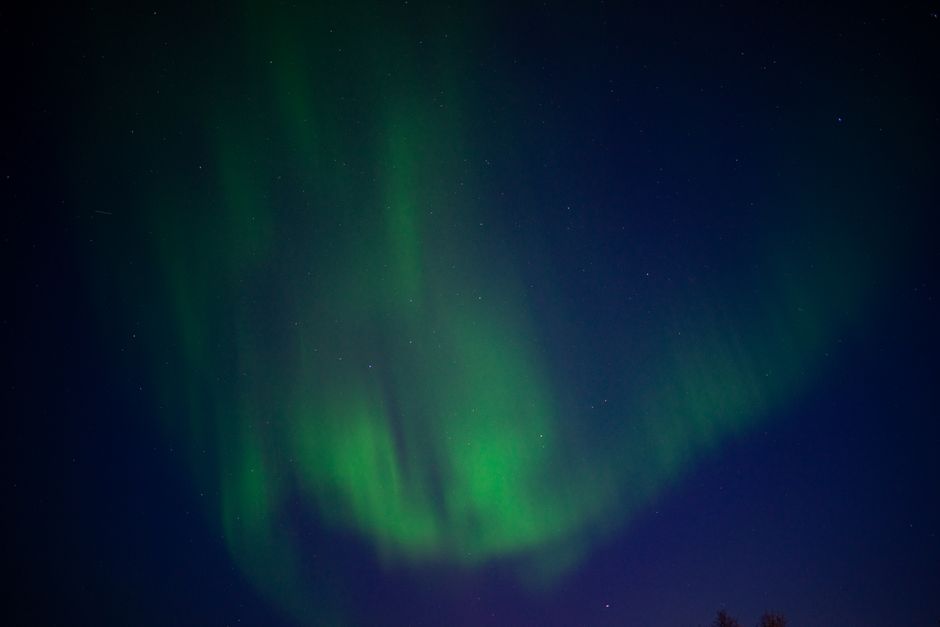
The aurora that followed was visible in places that had never seen one and have not seen one since. Reports came from far south of the usual aurora zones. Witnesses in low-latitude regions watched red and green curtains roll across the sky. In some cities, the light was bright enough to read by.
The colors were wrong, too. Auroras at low latitudes tend to glow blood red, because the oxygen atoms producing the light are higher in the atmosphere and emit at a different wavelength than the familiar green of polar displays. Witnesses described the sky as the color of fresh blood.
And then the wires started to misbehave.
Why the telegraph caught fire
Telegraph systems in 1859 were elegantly simple. A battery at one end pushed direct current through a long iron or copper wire strung on poles, and a key at the other end interrupted that current to spell out dots and dashes. The whole continent was effectively wrapped in conductive thread.
That thread turned out to be an excellent antenna for what physicists now call geomagnetically induced currents. When the magnetic field around Earth shifts violently, the change induces an electric field in the ground and in any long conductor near it. The longer the conductor, the bigger the induced voltage. A telegraph line from Boston to Portland was, in effect, a several-hundred-mile-long pickup coil draped across a planet that had suddenly started shouting.
The induced voltages were strong enough to overpower the station batteries. When the batteries were connected in the normal polarity, they fought the aurora and the system threw sparks. When operators reversed the batteries, the aurora and the battery added together and burned the paper. When the batteries were removed entirely, the aurora simply ran the line by itself.
The unplugged conversation
The exchange from that night was recorded between operators in Boston and Portland in the small hours of 2 September. According to contemporaneous accounts reprinted from the Boston Evening Traveller, the two operators agreed to disconnect their batteries and continue transmitting using only the electrical current induced by the aurora itself. They sent messages up and down the line using no battery power at all, just the current the storm was pushing through their wire, and one of them remarked that it worked better that way than with the batteries on.
Operators elsewhere reported streams of fire pouring from equipment. Telegraph stations across the East Coast reported arcs and sparks. In some offices, the contacts inside the relays were damaged by the current. Paper tape ignited where it touched the sounders. The American Telegraph Company’s lines were essentially unusable for hours, then strangely productive, then unusable again as the storm pulsed.
None of these effects required a power plant. There were no power plants. The first commercial electrical grid in the United States would not open for another two decades. The Carrington Event hit a civilization whose only significant electrical infrastructure was the telegraph, and it hit it hard enough to make the telegraph the story.
What the same storm would do to a modern grid
The reason researchers still talk about Carrington is that the modern world is built out of long conductors. High-voltage transmission lines, pipelines, undersea cables, rail networks, and the copper plumbing inside every transformer are all, electrically speaking, the same kind of antenna the 1859 telegraph network was. They are simply longer, more interconnected, and connected to equipment that is far less tolerant of unexpected current.
A geomagnetic storm a fraction of Carrington’s strength took down the entire Quebec power grid in March 1989, leaving millions without electricity for hours. The May 2024 geomagnetic storm, the strongest in two decades, knocked GPS-guided farm equipment off its rows across the American Midwest during planting season, degraded satellite navigation, and disrupted high-frequency radio, and pushed auroras as far south as Florida and Mexico.
A peer-reviewed analysis of that May 2024 storm published in Geophysical Research Letters found measurable geomagnetically induced currents in the Mexican power grid, a system at a latitude that historically would have been considered safe from this kind of interference. The protective assumption that solar storms are a high-latitude problem is no longer holding.
Estimates of what a true Carrington-class storm would do to the modern grid range from localized outages lasting weeks to continent-scale blackouts lasting months. The wide range exists because nobody has run the experiment. Carrington happened before grids existed. Every storm since has been smaller.
The vulnerable components are the very large transformers that step voltage up and down at the edges of long transmission lines. They are custom-built, with long lead times for replacement. A storm that destroyed dozens of them at once would leave whole regions without the equipment needed to move electricity at all. As one recent assessment put it bluntly, the sun is stronger than the electric grid and the grid is largely defenseless.
Forecasting helps, a little. The Solar Dynamics Observatory and other spacecraft watch the Sun continuously, and a coronal mass ejection heading for Earth gives warning once it crosses the L1 Lagrange point, where monitoring satellites sit. That is enough time to take some transformers offline if grid operators believe the warning and act on it. It is not enough time to manufacture replacements for what might burn.
The portrait, finally
Carrington himself died in 1875. For more than a century, no confirmed photograph of him existed. In February 2026, researchers announced they had identified his only known portrait, a photograph held by the Royal Astronomical Society. Historians have noted that Carrington had a unique vantage point for observing solar activity, having been the first to witness and document a solar flare.
It is a strange thing to think about, the face of the man who first saw a solar flare appearing 167 years after he watched the patch of light bloom on his projection screen. The portrait is older than the grid he would have destroyed.
What it felt like in Portland that night
The telegraph operators who worked through the Carrington Event were not engineers. They were clerks and railway workers who had been taught a code and trained to send it. Most of them had never seen an aurora. None of them had any framework for understanding why the wire on their desk was alive after they had unplugged the battery.
Their logbooks describe the experience with a kind of careful confusion, the way people describe an earthquake they did not know was an earthquake. They wrote down the times. They wrote down the colors of the sparks. They wrote down the messages that came through the dead system, including, in one Boston-to-Portland exchange, an agreement to keep working. The operators continued their transmissions using only the auroral current flowing through the telegraph lines.
Somewhere up the line, in a sense, it was. The same magnetic disturbance that lit the sky red over distant regions was pushing electrons through a copper wire strung between two New England cities, and in the small hours of a Friday morning in 1859, a sentence written by a man in Massachusetts arrived in Maine carried on nothing but sunlight bent into current by the planet itself.