
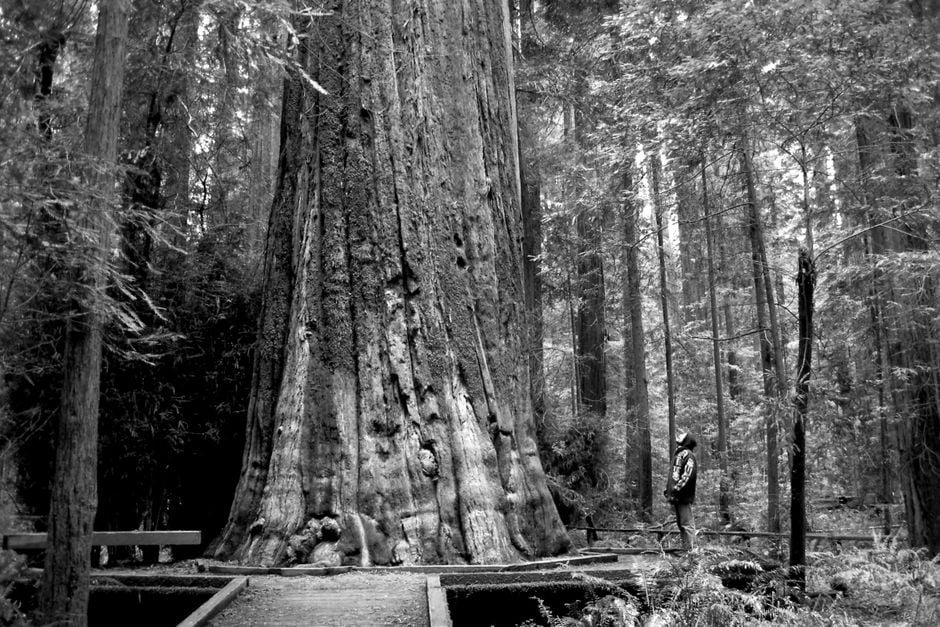
In August 2006, two naturalists named Chris Atkins and Michael Taylor waded through ferns and fallen branches in a remote corner of Redwood National Park in northern California, pointed a laser rangefinder up through the canopy, and recorded a preliminary height just under 380 feet on a coast redwood nobody had ever measured before. The tree, a Sequoia sempervirens later named Hyperion, was taller than the Statue of Liberty from torch to base, taller than a 35-story building, and the tallest known living thing on Earth.
The National Park Service has refused to publish its coordinates ever since.
A tree taller than Big Ben
Hyperion stands roughly 380 feet from root flare to topmost needle. Big Ben’s clock tower in London reaches 316 feet. The Statue of Liberty, including the pedestal, reaches 305. A football field stood on end would barely cover it.
The trunk holds an estimated 18,600 cubic feet of wood. The tree’s age is estimated somewhere between 600 and 800 years, which means Hyperion was a seedling around the time the Magna Carta was being argued over in England.
And yet by redwood standards, Hyperion is young. Coast redwoods can live more than 2,000 years. The tree is still growing, slowly, at the top.
How two amateurs found it
Chris Atkins and Michael Taylor were not professional foresters. They were citizen naturalists who had spent years systematically searching the steep, fog-soaked drainages of Redwood National Park with topographic maps and laser instruments, looking for tall trees the way some people look for rare birds. Atkins had already discovered the previous world-record holder, a 370.5-foot redwood called the Stratosphere Giant, in Humboldt Redwoods State Park in 2000.
Their method was patient and physical. They would identify a drainage with deep soil, abundant fog drip, and protection from wind, then bushwhack through dense undergrowth for hours, eyes on the canopy. When they spotted a candidate, they shot it with a laser rangefinder, then arranged for climbers to drop a tape from the highest live needle to the ground for a verified measurement.
Hyperion was the third record-breaking tree they found that summer. Helios, at 376.3 feet, and Icarus, at 371.2 feet, came out of the same expedition. Hyperion topped them both.
In September 2006, Stephen Sillett, a redwood ecologist then at Humboldt State University and a pioneer of canopy research on coast redwoods, climbed Hyperion and dropped a fiberglass tape from the topmost shoot. The verified height came in at 115.55 meters, or 379.1 feet, according to the university’s announcement at the time. The number held. Guinness World Records certified it. The tree has been the tallest known living thing on Earth ever since, and has continued to grow — it was measured at about 381 feet in 2019.
Why the location is a state secret
Redwood National Park has never released Hyperion’s coordinates. Park rangers will not confirm which drainage it is in. Scientists and their colleagues sign agreements not to disclose. Maps published in scientific papers blur the location. The few people who know how to find it are bound by an informal but serious code of silence.
The reason is mundane and brutal. Foot traffic kills redwoods.
Coast redwoods evolved in undisturbed soil that stays loose, moist, and full of fungal networks. When dozens of people start hiking off-trail to reach a specific tree, they compact the soil around the root flare. Compacted soil suffocates the fine feeder roots that take up water. The tree begins to decline from the bottom up, often invisibly, for years before anyone notices.
Hyperion sits in a remote part of the park with no maintained trail. The forest floor around it is steep, fragile, and braided with the kind of root systems that take centuries to build.
The $5,000 fine
By 2022, social media had done what the Park Service had feared. Hikers were posting GPS tracks. A few blog posts narrated the route in enough detail to follow. Visitors were finding the tree, and rangers were finding the damage they left behind.
In 2022, Redwood National Park made the prohibition explicit. The park’s own page on the tree, titled bluntly “Should I Hike to Hyperion?”, warns that anyone caught off-trail in the area faces fines of up to $5,000 and up to six months in jail. The language was unusually blunt for an agency that normally trades in mild advisory tone.
According to the park, the tree has experienced a surge in visitors due to increased online attention from bloggers, travel writers, and websites, despite the difficult journey required to reach it. Hikers had been trampling vegetation, leaving human waste and toilet paper at the base of the tree, and compacting the soil that keeps Hyperion alive.
Park officials told reporters at the time that the tree’s base had been visibly degraded. The undergrowth around it, once a dense mat of sorrel and sword ferns, had been worn down to bare dirt in places.
What a redwood actually is
Hyperion’s height is not just a record. It is close to the physical ceiling for any tree.
In a landmark 2004 paper in Nature, George Koch, Stephen Sillett, and colleagues used measurements taken inside the crowns of California’s tallest redwoods to estimate a maximum tree height of roughly 122 to 130 meters — about 400 to 425 feet. Above that range, the cohesion-tension mechanism that pulls water up the xylem from roots to needles breaks down. The water column literally cannot hold itself together against gravity. The topmost needles of a tree this tall already show signs of drought stress on dry summer days, even when the soil at the base is wet.
That is why Hyperion lives where it does. The grove sits in a fog belt where Pacific marine layer condenses on needles each morning and drips down through the canopy. Research by UC Berkeley biologist Todd Dawson has shown that summer fog can supply 30 percent or more of a coast redwood’s annual water budget — the trees absorb mist directly through their needles and take up fog-drip through their roots. The tree drinks from above as well as below. Take away the fog and a tree like Hyperion cannot exist.
This is also why climate change makes the silence around Hyperion’s location feel less like bureaucracy and more like triage. The fog belt is shrinking. Summers in northern California are getting hotter and drier. The conditions that produced a 380-foot tree may not produce another one.
The forest the loggers missed
According to Save the Redwoods League’s State of Redwoods Conservation Report, roughly 95 percent of the original old-growth coast redwood forest was cut down between the 1850s and the 1970s. The trees that built San Francisco, that framed Victorian houses up and down the Pacific coast, that became fence posts and railroad ties and water tanks, came from groves that no longer exist.
Hyperion survived because it grew in a drainage too steep and too remote for the logging crews of the early twentieth century to reach economically. The area sat inside the original 1968 boundary of Redwood National Park, expanded under the Carter administration in 1978 to pull additional previously logged and unlogged land into protected status.
If the boundary had been drawn a half-mile differently, Hyperion would have been a deck of two-by-fours by 1965.
Why people want to find it anyway
The pull toward old trees is not new and not irrational. A 2015 study led by Stanford researcher Gregory Bratman, published in the Proceedings of the National Academy of Sciences, found that volunteers who took a 90-minute walk through a natural setting showed measurably lower activity in the subgenual prefrontal cortex — the brain region linked to rumination — than volunteers who walked the same length of time through an urban environment.
The effect appears to scale with the complexity and antiquity of the environment. An old-growth redwood grove, with its layered canopy and centuries-old structure, is about as far from urban as a place gets on the North American continent.
The Park Service is not arguing with that observation. It is arguing with the arithmetic. A grove can absorb the attention of a few people. It cannot absorb the attention of a few million. The other 250 miles of trail through Redwood National Park’s old growth offer the same neurological experience without putting one specific 380-foot tree at risk.
A tree the public owns and cannot visit
Hyperion belongs to the federal government, which is to say it belongs to every American taxpayer. It sits on public land. It is, in principle, a public asset.
And the agency charged with managing it has decided that the only way to keep it alive is to make sure almost nobody ever sees it.
This is a quietly radical position for a public lands agency to take. National parks were founded on the premise that wonders should be visible. Yellowstone has boardwalks to the geysers. Yosemite has a paved loop to El Capitan. The Grand Canyon has a hotel on the rim. The default assumption since 1872 has been that protection and access can coexist.
Hyperion is the exception. The Park Service has decided this particular tree cannot survive being loved.
What it sounds like, what it smells like
The people who have stood at Hyperion’s base, mostly scientists with permits and the climbers who help them, describe the same things. The ground is spongy with centuries of fallen needles. The light comes down green and filtered, like the inside of a cathedral with stained glass made of leaves. Banana slugs the size of fingers move across the duff. The trunk, eight to nine feet across at chest height, disappears upward into a column that the eye loses before it reaches the crown.
From the ground, a person cannot actually see the top of Hyperion. The canopy of the surrounding forest blocks the view. To see the highest needle, a climber has to be 350 feet up the tree, looking at the last 30 feet of trunk taper away into a single living shoot, no thicker than a finger, that is the tallest point of any organism on this planet.
That shoot adds about an inch and a half each year. Somewhere in a drainage the National Park Service will not name, in a fog bank rolling in off the Pacific, it is doing that right now.