
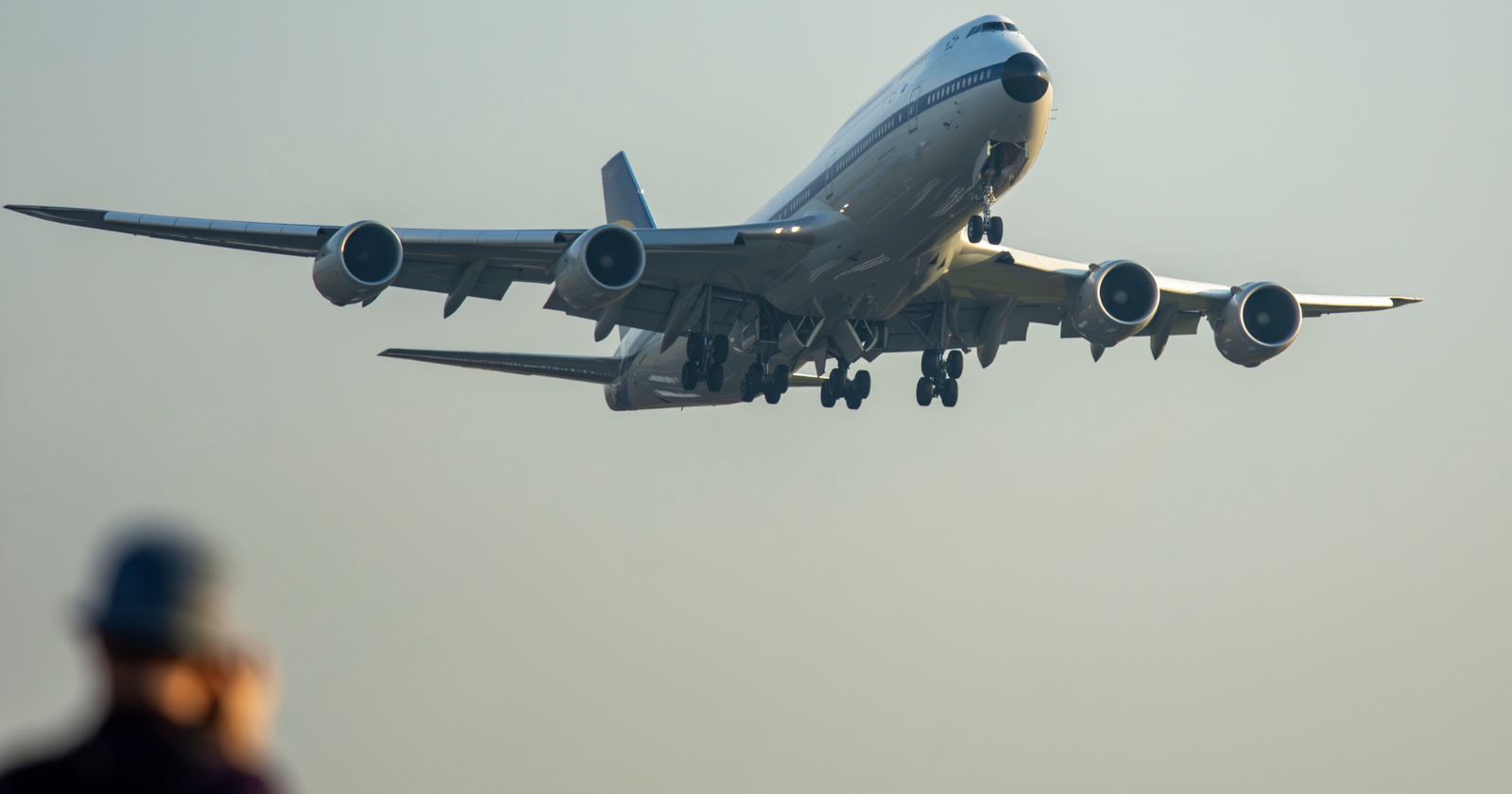
Joe Sutter’s Boeing team began shaping the 747 around a future they thought would pass it by: a supersonic age in which the huge, slower jumbo would eventually make its real living as a freighter.
That assumption is why the cockpit sits on a hump.
By lifting the flight deck above the main deck, Boeing left room for a nose that could swing upward on freighter versions of the airplane, letting cargo loaders feed pallets and outsized freight straight into the long tube of the fuselage. Every passenger lounge, every Pan Am poster, every 747-8F still hauling cargo at night carries the outline of that prediction.
The supersonic bet behind the jumbo
In the mid-1960s, Boeing was working on the 2707, the American supersonic transport meant to rival Concorde. The Museum of History & Industry notes that the 2707 was ultimately cancelled in 1971 after design, environmental, and sonic-boom concerns helped kill the program.
The 747 belonged to the same moment. Pan Am chairman Juan Trippe wanted a jet far larger than the 707, while Boeing had to protect itself against a future in which high-paying long-haul passengers might migrate to faster aircraft. The answer was a plane that could carry hundreds of people first, then survive as a cargo hauler later.
Sutter, who led the 747 design team, took over the project in 1965. Boeing says production began in 1967, the first 747-100 flew in 1969, and the family eventually reached 1,574 aircraft across more than half a century of production.
It was not the only machine from that era built around a future that partly missed. Make Tech Easier has covered other engineering bets that became strange cultural artifacts, from Mariner 1’s missing software mark to Apollo’s hand-woven guidance computer memory.
Why the cockpit moved upstairs
A conventional airliner puts its pilots in the nose. A freighter that needs to load through the nose cannot do that, because the flight deck would sit exactly where the hinge and cargo opening need to be.
The 747 solution was to move the flight deck up and back. Smithsonian’s Air & Space Magazine traces the hump to this front-loading cargo logic, explaining that Boeing placed the flight deck above the passenger cabin so a hinged nose could be added for freighter use.
That design left the main deck as a cleaner cargo path. Boeing’s airport-planning data for the 747-400 Freighter describes a main-deck nose door that swings upward so pallets or containers up to 40 feet long can be loaded straight in on motor-driven rollers.
The earliest passenger 747s did not all have noses that opened. The point was that the architecture made a freighter future possible, and later 747 freighters turned that possibility into the airplane’s most distinctive working trick.
The hump became glamour by accident
The upper deck was first a consequence of the cockpit move, not a styling flourish. It also created a small space behind the pilots that airlines quickly learned how to sell.
Northwestern University’s 747 anniversary project notes that the 747’s upper-deck lounge was initially conceived as a rest area for flight crews, then became a first-class passenger lounge after consultations with Juan Trippe and Pan Am. Boeing Images preserves the period look: spiral staircase, upper-deck lounge, and late-1960s cabin mock-up glamour.
Pan Am turned the space into part of the mythology of the airplane. The Pan Am Historical Foundation describes the first wide-body 747 era as bringing back a cruise-ship feeling for first-class passengers, with a flying restaurant, bar, and lounge.
Other carriers became even more theatrical. Some 747s carried bars and lounges elsewhere in the cabin, and American Airlines became famous for a piano bar on its 747s. But the hump itself lasted because it was not decor. It was structure.
The future arrived slower than Boeing expected
Boeing’s 2707 never entered service. Concorde did, beginning commercial flights in 1976, but it remained a prestige machine rather than a mass-market replacement for subsonic jets.
The economics moved against the supersonic dream. Fuel became more expensive after the 1973 oil shock, noise rules tightened, and airlines wanted aircraft that could move more people at lower cost per seat. The 747, built with a freighter second life in mind, became exactly the passenger airplane the supersonic future was supposed to make temporary.
Northwestern’s account of the first service places Pan Am’s 747 introduction on the New York to London route on January 22, 1970. The size was the shock: more than 350 passengers in typical early layouts, room for wide aisles, lounges, and a sense of scale no previous airliner had offered.
The same decade that stranded the American SST made the 747 the face of long-haul travel. It was slower than Concorde, but it could carry the crowd.
The freighter plan finally came true
The passenger 747 became the icon, but the freighters quietly fulfilled the original insurance policy. The 747-400F and 747-8F kept the nose-door idea alive for cargo that was too long, too awkward, or too valuable to load easily through side doors alone.
NASA found another use for the airframe. Its Shuttle Carrier Aircraft fact sheet says the agency flew two modified Boeing 747 jetliners to ferry space shuttle orbiters, one a 747-123 and the other a 747-100SR-46.
By the 2000s and 2010s, twin-engine aircraft such as the 777, 787, A330, and A350 were taking over the passenger routes that four-engine jumbos had once dominated. The 747’s passenger crown slipped away, but its cargo shape still made sense.
Boeing delivered the final 747, a 747-8 Freighter, to Atlas Air on January 31, 2023. Boeing’s announcement said employees known as the Incredibles, the team that had built the first 747, returned to the Everett factory for the ceremony.
That last airplane was the 1,574th 747. It left the same factory system that had been built because the original jet was too large for Boeing’s existing plants, a production world created around one airplane’s improbable scale.
The 747 began as a hedge against a faster century and ended as a freighter with the old logic still visible in its bones. Hump on top. Nose that opens. A passenger legend shaped by cargo, still carrying the trace of the supersonic age that never really arrived.