
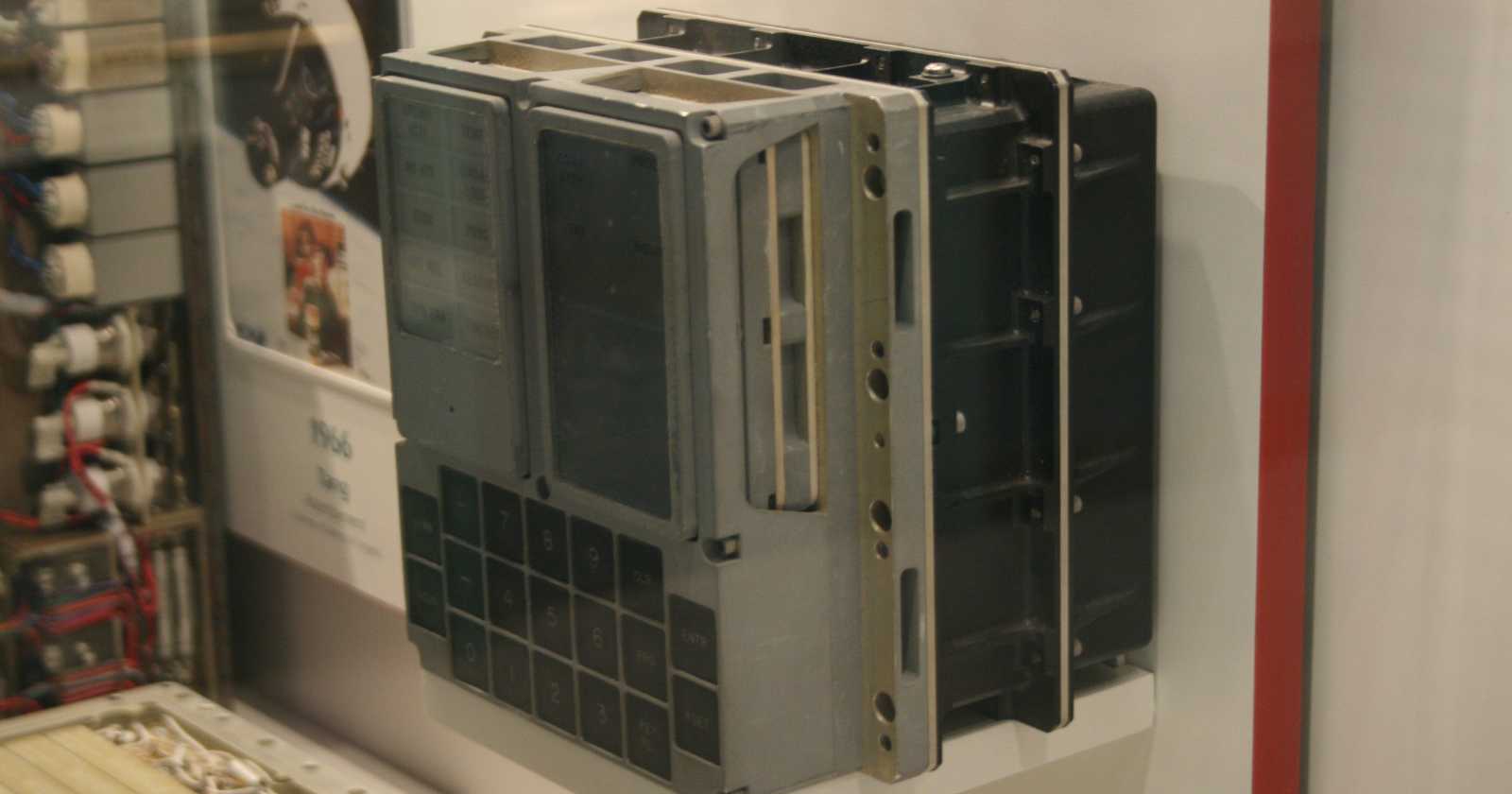

The Apollo Guidance Computer that landed Neil Armstrong and Buzz Aldrin on the Sea of Tranquility in July 1969 ran on software that had been physically sewn into its memory by women sitting at workbenches in a Raytheon factory in Waltham, Massachusetts. Each one of them threaded thin copper wires through, or around, tiny ferrite rings the size of a pencil tip. A wire passing through the ring stored a 1. A wire passing around it stored a 0. The program could not be overwritten because it was, in the most literal sense, a textile.
The engineers at the MIT Instrumentation Laboratory who designed the computer had a nickname for this storage method. They called it LOL memory, short for Little Old Lady memory, because the women on the factory floor were older, experienced textile workers hired specifically for the precision of their hands.
What makes the story unsettling now is the tactile fact of it. Software was once a physical object, written by human hands, at human speed, with human consequences for every mistake. To change a single bit on a finished rope module, someone had to find that bit among thousands of others, cut it out, and weave a new one in by hand.
Why the software had to be woven
The Apollo Guidance Computer, or AGC, was one of the first machines anywhere to use silicon integrated circuits. It carried 2,048 words of erasable magnetic-core RAM and 36,864 words of read-only core rope ROM — roughly 4 kilobytes of working memory and 72 kilobytes of program storage. Its master clock ran at 2.048 MHz, which let the computer execute around 85,000 simple instructions per second. A modern phone has many millions of times more, and yet the AGC had to fly humans to another world and bring them home.
NASA needed the flight software to be incorruptible. A cosmic ray, a power surge, an astronaut hitting the wrong switch — none of it could be allowed to scramble the code that fired the descent engine. Magnetic core rope memory solved that problem by making the program a physical object. Once woven, the bits could not be changed by electricity. Only by scissors.
The Block II AGC carried six rope modules. Each module held 512 ferrite cores, with 192 sense wires passing through or around each one, storing 6,144 sixteen-bit words — about 98,000 bits per module — for a total of 36,864 words across the six. The cores themselves were not the storage; the route the wire took through them was.
That distinction is what made the memory non-volatile in a way no semiconductor of the era could match. Pull the power from the AGC, leave it in a vacuum for a decade, and the program would still be there when you switched it back on.
The Apollo 11 flight software, written by a team led by Margaret Hamilton, weighed several pounds in printed form. The widely circulated 1969 photograph of Hamilton standing next to a stack of source listings as tall as she was captures the scale of the work. Every line of that stack had to be translated, by hand, into a thread path.
The Smithsonian later called Hamilton the “Rope Mother” for her role in shepherding the code into the cores. By the time the listings became wire, every line of her team’s work would live as copper geometry — a path through a grid of ferrite that no edit could touch.
Inside the Raytheon factory
Raytheon held the manufacturing contract. At the Waltham plant, two women worked on each rope module. One sat on each side of a frame holding the ferrite cores. A long hollow needle, loaded with a single insulated wire, passed back and forth between them, guided by a paper tape that punched out the program one address at a time.
If the tape said the next bit should be a 1, the needle went through the core. If it should be a 0, the needle went around it. A single wrong pass meant the program would not run, and the only fix was to start that section again.
The workers were drawn largely from the New England textile industry, which by the 1960s was contracting. Many had spent decades at looms and sewing benches. Others came from the nearby Waltham Watch Company, which had also helped produce the high-precision gyroscopes used on Apollo. Raytheon’s hiring managers were explicit about the reason: a misthreaded wire on a sweater is a flaw, but a misthreaded wire on a rope module could kill astronauts. The women who had spent a lifetime catching their own mistakes by touch and sight were considered more reliable than any mechanism the engineers could build.
The MIT engineers, meanwhile, treated the factory floor with a reverence that was unusual for the time. Hamilton and her colleagues regularly travelled to Waltham to verify the weave, sometimes spending hours watching a single bit being threaded. A late change to the code could mean tearing out weeks of work, and the engineers knew it. Decisions about whether to fix a bug or live with it were made with the rope in mind.
The weaving of one Apollo rope module took roughly eight weeks and cost about $15,000 in 1960s dollars, according to engineer Ken Shirriff’s documentation of the process. Every manned Apollo mission that flew — Apollo 7 through Apollo 17 — carried software that had been threaded by hand in that building.
Each completed module was tested for weeks at Raytheon before being shipped to Cape Canaveral. According to historian David Mindell’s Digital Apollo, every memory module had to demonstrate near-perfect accuracy across thousands of bits, with no margin for the kind of fault an Earth-bound mainframe could tolerate. Once a module passed, it was potted in epoxy and could not be modified again.
The astronauts trusted the thread
During the Apollo 11 descent, the AGC famously threw a series of 1201 and 1202 alarms. The computer was being overwhelmed by extra data from the rendezvous radar, which had been left in the wrong configuration during the descent. It did not crash. It rebooted, dropped low-priority tasks, and kept guiding the lander. That graceful failure was baked into the rope.
Hamilton’s team had insisted on priority scheduling, and once that logic was woven into the cores, no glitch could erase it. Aldrin and Armstrong landed with less than thirty seconds of fuel to spare, partly because the software the seamstresses had stitched refused to give up.
There is a quiet detail worth dwelling on. The decision to include priority scheduling was, at the time, controversial inside the program. It added complexity, added bits, and added weeks to the weaving schedule. Hamilton fought for it anyway. By the time the 1202 alarms began to flash on Aldrin’s display, the argument was already settled, stitched into copper and ferrite, immune to second-guessing.
From woven memory to silicon
The distance between that machine and the device on the nightstand is hard to fathom. The AGC required two months of human handwork to hold a single program. A current smartphone holds tens of thousands of programs and refreshes them silently overnight.
The cost of altering a behaviour, at the level of the machine, used to be measured in days of human labour. Today it is measured in the seconds it takes a server to push a new build. In Waltham, the needle did not move until the engineer beside it was sure. Every bit was a decision that had to survive vacuum, vibration, and the gaze of three astronauts in a tin can.
The thread is still there, in a way
Several Apollo rope modules survive. One is on display at the Smithsonian National Air and Space Museum. Up close, the copper wires are visible to the naked eye, looped through black ferrite donuts in a pattern that, if read correctly, would still describe how to land on the Moon. IEEE Spectrum has documented surviving examples, including a Burroughs prototype from 1963 that helped evaluate the technology before Apollo committed to it.
The women who wove those modules are mostly gone now. Their fingerprints are on the bits. Each pass of the needle was a deliberate, slow human decision: through for a one, around for a zero, with no possibility of an automatic update, no notification, no buzz against the thigh asking to be checked.
Billions of people now carry the distant descendants of the AGC in their pockets. The machines are faster, smaller, and almost infinitely more flexible than the rope ever was. What they no longer have is anyone, anywhere, holding a needle and deciding, one bit at a time, whether the program is worth threading.