
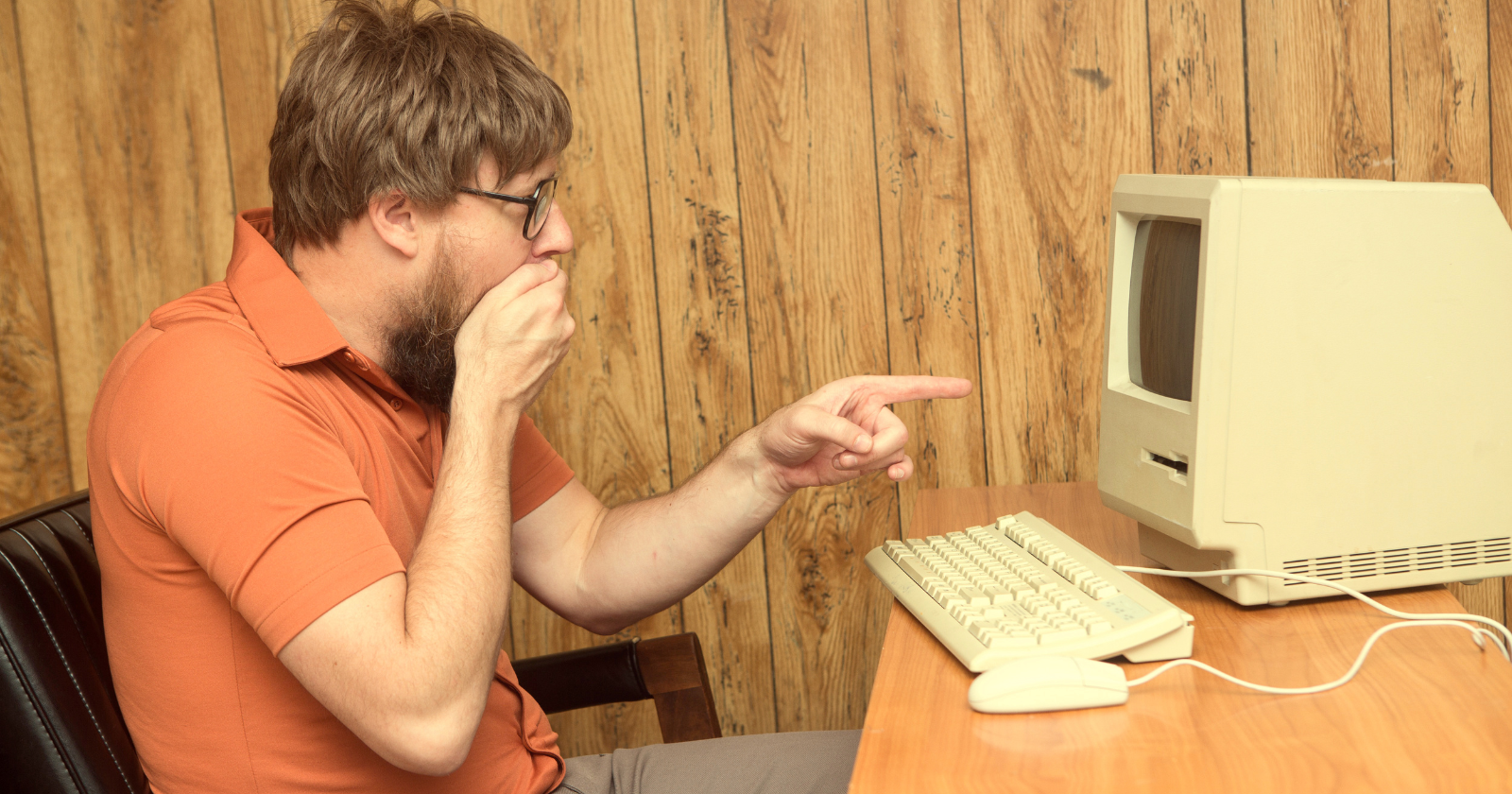

In 1980, somewhere in the Netherlands, a radio engineer at the Dutch broadcasting organisation NOS noticed something almost embarrassingly obvious that the entire computer industry had overlooked.
Home computers, at that point, mostly stored their programs on audio cassettes — ordinary compact cassettes, the same blank tapes people used to record music off the radio. When you wanted to load a game, you plugged a cassette player into your computer through a special port, hit play, and the computer would read the squealing audio coming off the tape and translate it back into code.
If a cassette could carry computer code, the engineer realised, then anything that could carry the sound of that cassette could carry the code too.
Including the radio.
Hobbyscoop and the great cassette experiment
The realisation became a show. In 1980, NOS launched a programme called Hobbyscoop, which set aside time in its broadcasts to do something no commercial radio station had ever done. Instead of playing a song, the host would announce that the next few minutes would contain a computer program — and then play the audio of a cassette directly into the airwaves.
What came out of millions of radios was not music. It was a series of high-pitched squeals, buzzes, and tonal warbles that sounded, to anyone unfortunate enough to be listening for entertainment, like a malfunctioning fax machine. Hosts had to warn listeners in advance, so that families wouldn’t think their radios had broken when the songs suddenly turned into electronic shrieking.
But for the small population of home computer enthusiasts across the Netherlands, that noise was the most exciting sound in the world. Press record on a blank cassette tape, capture the broadcast, plug it into your computer, and a few minutes later you had a working game — for free, without buying anything, downloaded out of the sky.
It was the first time anything resembling a software download had reached ordinary people. The internet, in any meaningful consumer sense, was still a decade away.
The problem of incompatible computers
The clever bit — the part where the radio engineers genuinely outdid the computer industry — came next.
The early-1980s home computer market was an absolute mess of incompatible standards. A program written for a Commodore 64 wouldn’t run on a ZX Spectrum, which wouldn’t run on an Acorn BBC Micro, which wouldn’t run on an Apple II. If Hobbyscoop just broadcast a game written for one machine, it would only work for the small subset of listeners who owned that particular computer. Broadcasting separate versions of every program for every popular computer would have made the show impossible.
So the engineers built a workaround. They created a common cassette format called BASICODE, designed to be machine-independent. Any home computer running the BASIC programming language could, with a small translation program installed, read a BASICODE broadcast and convert it into something that would run on the local machine.
It was, in 1980, an early and elegant solution to a problem the computer industry itself would not fully solve for decades.
The craze spreads across Europe
Hobbyscoop’s success quickly attracted imitators across the continent.
In the United Kingdom, Joe Tozer at Radio West began his own version of the experiment in 1983. The first broadcast wasn’t a program — it was a 40-by-80 pixel digital image of Charlie’s Angels star Cheryl Ladd, which listeners could record off the radio and display on their home computers. Tozer later described the night as “quite exciting,” in the understated way of British engineers.
In Yugoslavia, Radio Belgrade launched a programme called Ventilator 202, hosted by Zoran Modli. Between 1983 and 1986, the show broadcast roughly 150 programs over the air — mathematical calculators, mini-encyclopaedias, educational software, simple games, and at one point even a flight simulator. The first time Modli sent a program, he had to brief Radio Belgrade’s technicians not to panic when the audio feed turned into what they later described as “hissing and growling.” The show became popular enough that National TV Belgrade put it on actual television, and for two months in the early 1980s, Yugoslav viewers spent their Sunday afternoons watching their televisions emit ear-splitting digital screeching.
Finland’s YLE radio ran a pilot in 1985 that successfully transmitted a program to a computer 600 kilometres away from the station. Germany, France, and other European countries developed their own versions.
For a few years in the early 1980s, the airwaves of Europe were full of these strange broadcasts — squeals and beeps interrupting the music, the sound of thousands of teenagers across the continent recording them onto cassette tapes, and the quiet hum of home computers turning electronic noise back into working software.
Why it ended
The era didn’t last long. By the late 1980s, two things had killed it.
The first was the arrival of floppy disks as affordable consumer storage. Cassettes were cheap, but slow and unreliable. Once floppy disks dropped in price, the entire infrastructure that made radio broadcasts work — the assumption that computers loaded from audio — simply disappeared. New computers stopped supporting cassette ports. The pipe through which radio could reach a computer was cut at the receiver’s end.
The second was the increase in game complexity. Early-1980s computer games were tiny — often only a few kilobytes — and could be broadcast in a minute or two. As games grew, the broadcast times grew with them. By the late 1980s, downloading a single program off the radio could take half an hour. The economics no longer worked.
The Codemasters game developer Simon Goodwin once calculated that broadcasting a modern PlayStation 3 game in the original 1980s cassette format would take roughly four years of continuous transmission and would require a tape long enough to wrap most of the way around the Earth.
What remained, after the practice ended, was the memory. For a brief window in the early 1980s — before the internet, before the modern download, before software distribution as we now know it — the radio carried games. Teenagers in living rooms across Europe pressed record on their cassette decks, captured the sound of code falling out of the sky, and played it back into machines that translated it into something they could play.
It was the first time anyone had ever downloaded a game from the air. It would not be the last.