
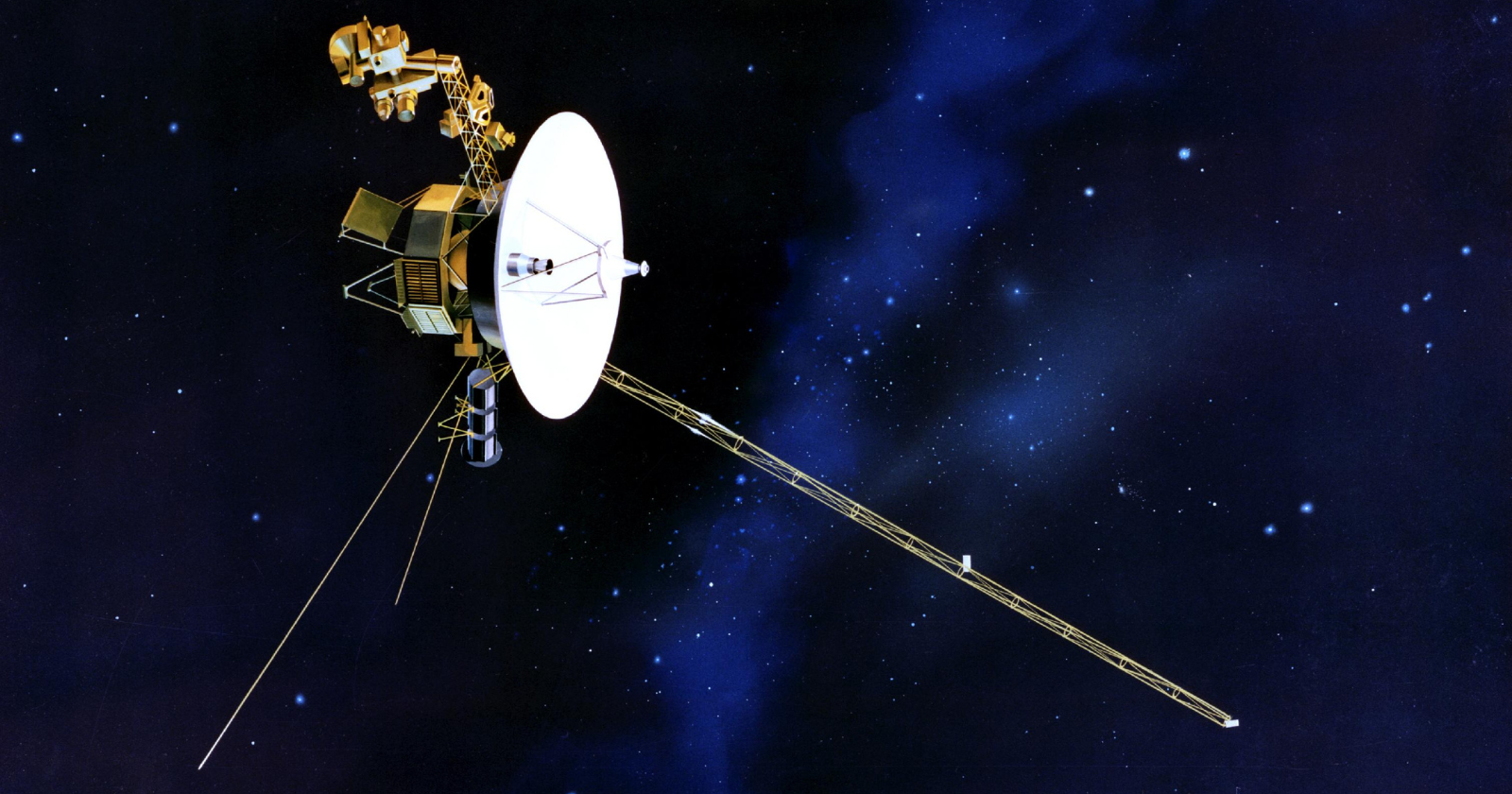

On November 14, 2023, Voyager 1 stopped making sense.
The spacecraft was still there. Its radio signal was still arriving on Earth, faint but steady, after a journey of more than 22 hours at the speed of light. But the data it carried had become meaningless — a repeating pattern of ones and zeroes, the digital equivalent of a dial tone. The most distant human-made object in existence was still talking. It just had nothing intelligible left to say.
The cause, when engineers finally found it months later, was almost absurdly small. A single bit of memory, on a single chip, in a computer designed in the 1970s, had failed. One stuck bit, 24 billion kilometres away, had silenced humanity’s furthest voice.
The spacecraft that’s older than the people fixing it
Voyager 1 launched in 1977. It is, by an enormous margin, the most distant object humans have ever built. It crossed into interstellar space in 2012 — the first spacecraft ever to leave the heliosphere, the bubble of solar wind that surrounds our sun.
It runs on three onboard computers, all of them designed and built before the personal computer existed. The one at the centre of this story is called the flight data subsystem, or FDS. Its job is to gather the spacecraft’s science and engineering data and package it for transmission home. Each of Voyager’s computers has, in total, about 70 kilobytes of memory. A single modern phone photo is hundreds of times larger.
This creates a very specific problem. The engineers who designed these systems are mostly retired. Some have died. The programming languages are archaic. The technical documentation is decades old, scattered, and in some cases was never fully digitised. Almost nobody alive fully understands how Voyager’s computers actually work at the deepest level.
So when Voyager 1 started speaking gibberish, NASA’s Jet Propulsion Laboratory did something telling. They called the retirees back.
The detective work
The team couldn’t simply look inside the spacecraft. Every command they sent took about 22 and a half hours to arrive. Every response took another 22 and a half hours to come back. A single question-and-answer cycle with Voyager 1 took nearly two full days.
In March 2024, the engineers sent a command they nicknamed a “poke” — an instruction telling the FDS to send back a complete readout of its own memory. When the readout arrived, an engineer with NASA’s Deep Space Network managed to decode it, even though it wasn’t in the usual format.
That readout was the breakthrough. By studying it, the team determined that about 3% of the FDS memory had been corrupted. They traced the fault to a single chip — one that stored 256 words of memory, including a portion of the computer’s own operating code. With that code gone, the computer could no longer package data properly. Everything downstream turned to static.
The cause of the chip’s failure was never confirmed. It may have been struck by a cosmic ray — a high-energy particle from deep space. Or it may simply have worn out after 46 years of continuous operation. It didn’t matter much either way. The chip could not be replaced. Nobody was going to fly 24 billion kilometres with a soldering iron.
The fix: surgery by radio
The solution the JPL team devised was, in effect, a piece of remote surgery.
If the broken chip couldn’t be repaired, then the code it had been holding needed to live somewhere else. The team would relocate it — move the affected software into healthy, unused corners of the FDS memory.
But there was a catch. The displaced code was too big to fit in any single empty space. Voyager’s memory is so tiny that no one unused block was large enough to hold it all.
So the engineers did something genuinely ingenious. They sliced the code into fragments and tucked the pieces into whatever scraps of free memory they could find, scattered across the system. To make room, they went hunting for software the spacecraft no longer needed — and deleted routines left over from Voyager 1’s flyby of Jupiter in 1979, programs that had sat unused in memory for forty-five years.
Then they wrote the patch, beamed it into interstellar space, and waited.
The two-day wait
On April 18, 2024, JPL transmitted the relocated code toward Voyager 1.
The command travelled for about 22 and a half hours before it reached the spacecraft. Then Voyager had to process it and send a reply, which took another 22 and a half hours to cross the same distance.
The team waited out the full forty-five-hour round trip. And on April 20, 2024, the answer arrived.
It worked.
For the first time in five months, Voyager 1 sent back data that made sense — clean, readable engineering telemetry, properly packaged by a computer that had just had part of its mind carefully rearranged from 24 billion kilometres away. Over the following weeks, the science instruments came back online too.
Why this story matters
It’s tempting to file this under impressive-but-niche space news. But there’s something in it worth holding onto.
A spacecraft built by people, many of whom are no longer alive, was rescued by people who had retired — called back specifically because the knowledge of how Voyager works had become rare enough to be precious. The fix required no new hardware, no rocket, no rescue mission. It required old engineers, deep institutional memory, two days of patience, and an extraordinarily careful understanding of a computer designed before most of the modern world existed.
Voyager 1 is now so far away that its signal, travelling at the speed of light, takes most of a day to reach us. In November 2026 it will cross a strange threshold — it will be a full light-day from Earth.
It is still going. Still sending data. Still, against every reasonable expectation, intelligible.
A single stuck bit nearly ended that. A handful of people who refused to let a 1970s spacecraft die quietly made sure it didn’t.
The most distant voice humanity has ever sent into the dark is still, just barely, saying something. That is not an accident. It is the work of people who understood the machine well enough to reach back across 24 billion kilometres and fix it.