
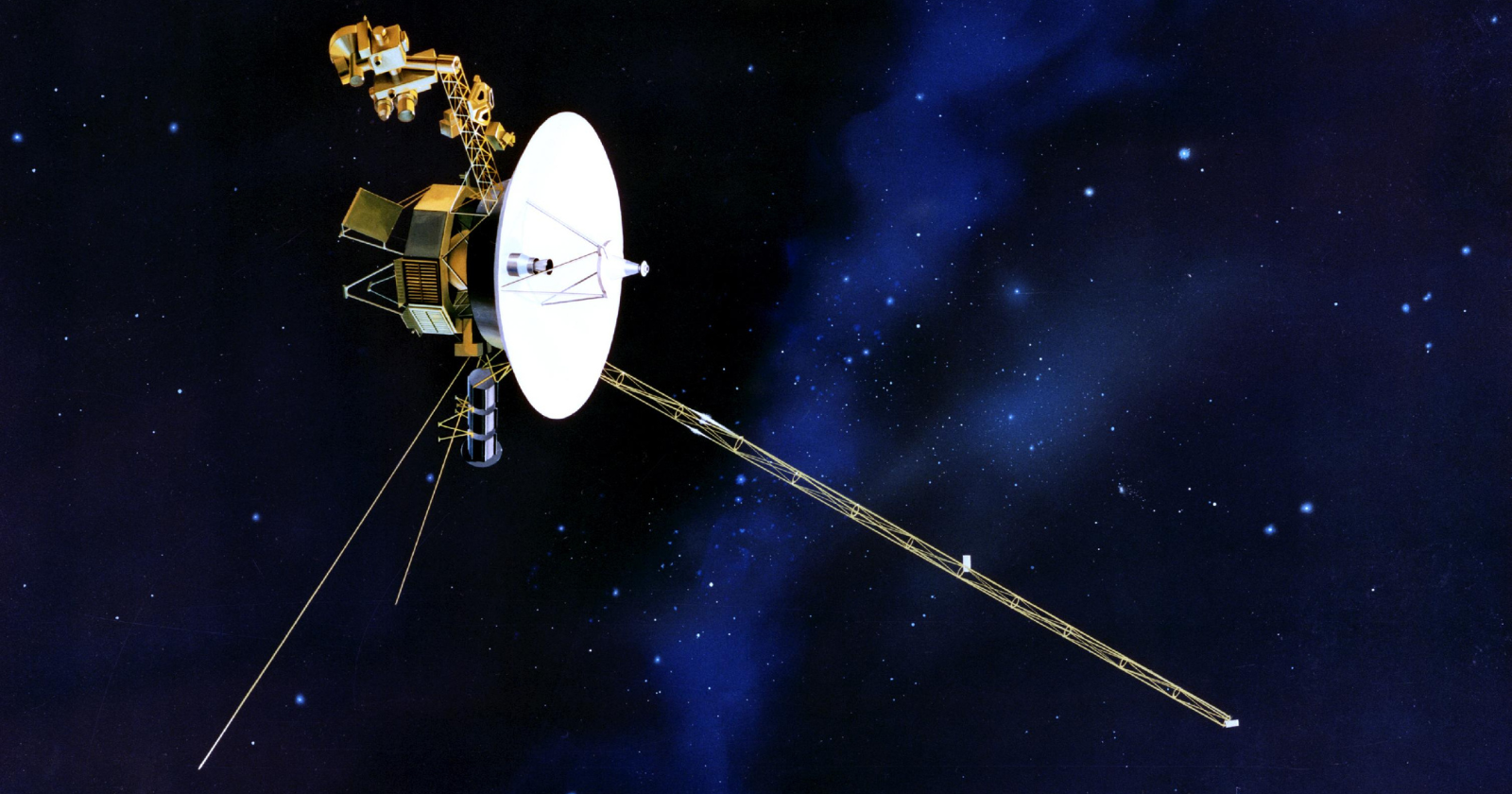

On September 5, 1977, NASA launched a spacecraft that nobody expected to ever come back.
Voyager 1 was built to fly past Jupiter and Saturn, beam home some pictures, and then keep going forever. Once the planetary work was done, the probe would slip out of the Solar System into the great cold dark between the stars, drifting at roughly 38,000 miles per hour with nothing to slow it down. The engineers who built it knew it would, in time, become the most distant object humanity had ever made — and that it would almost certainly outlive Earth itself.
So they did something poetic. They bolted a message to the side of it.
It was a gold-plated copper disc — the Voyager Golden Record — carrying sounds and images of Earth: greetings in 55 languages, music from Bach to Chuck Berry, the sound of a baby crying, of waves on a beach, of a human heartbeat. And etched into the record’s protective cover, just below the playback instructions, was something more remarkable still. A map.
A map showing exactly where in the Milky Way the spacecraft had come from.
How to write directions to Earth
The problem the map’s designers were trying to solve is genuinely fascinating. How do you give directions to a place when you don’t know who’s reading, what they look like, what they can see, or even when they’ll find your note?
Carl Sagan, his wife Linda Salzman Sagan, and the astronomer Frank Drake worked on the puzzle in the early 1970s, and they came up with a brilliant solution. They would use pulsars.
A pulsar is the rapidly spinning core of a dead star — a small, dense, ferociously magnetic object that flashes a beam of radiation across space the way a lighthouse sweeps its beam across the sea. Each pulsar has its own unique pulse rate. Some flash hundreds of times per second; others, more slowly. Crucially, those pulse rates are stable enough to be used as cosmic fingerprints. If you know a pulsar’s pulse rate, you can identify it. And if you can identify it, you can measure its direction and distance.
The map etched onto the Voyager record uses fourteen pulsars in exactly this way. From a central point — our Sun — fourteen lines radiate outward, each pointing toward a different pulsar, with the pulsar’s pulse rate encoded in binary along the line. Find the pulsars, match the rates, measure the directions, and there is only one point in the entire galaxy where all fourteen lines meet at the right angles.
That point is here.
It is, by any honest description, a road sign. Made for travellers who do not yet exist, in a language built from the constants of physics rather than any human tongue.
The hidden cleverness
There is one more layer of cleverness buried in the design that is worth pausing on.
The pulse rates of pulsars are not perfectly stable forever. They slow very gradually, over millions of years, as the spinning core sheds energy. The designers of the map knew this. So the pulse rates etched onto the cover are the rates as measured in the 1970s — which means that any alien civilization sophisticated enough to read pulsars at all could also calculate how much the rates have changed since then, and from that figure out roughly when the spacecraft was launched.
The map, in other words, doesn’t just say we are here. It also says, with no spoken words at all, and we sent this from here, at this point in history.
It is one of the most elegant pieces of communication ever attempted by human beings.
The debate that came later
When Sagan, Drake and their colleagues designed the pulsar map in the early 1970s, the question of whether telling aliens where we live was a good idea was barely on the scientific radar. The dominant mood was hopeful. The map was a gesture of welcome to whoever might find it.
Decades later, the conversation looked different.
Stephen Hawking became one of the most prominent voices warning that humanity should be far more cautious about announcing itself to the universe. In a 2010 Discovery Channel documentary, he argued that contact with a more technologically advanced civilization might not go well for the less advanced one. “If aliens visit us,” he said, “the outcome would be much as when Columbus landed in America, which didn’t turn out well for the Native Americans.” He returned to this argument repeatedly in interviews and lectures over the following years.
It’s worth being precise here: Hawking’s specific concerns were about active broadcasts — radio messages aimed at promising star systems, the practice known as METI (Messaging Extraterrestrial Intelligence). He was not crusading specifically against the Voyager record. But the Voyager map is one of the most famous artifacts in the broader conversation his warnings stirred up: a literal, etched-in-metal road sign already out there, drifting toward the rest of the galaxy, carrying directions home.
And here is the part that strikes a lot of people when they think about it for the first time. Even if humanity decided tomorrow that revealing our location was a terrible idea, the Voyager probes cannot be recalled. Voyager 1 is now more than 24 billion kilometers from Earth. Whatever’s etched on its cover is leaving us forever.
The thing that softens the worry
There is one detail that takes some of the edge off, and it’s worth being honest about.
The Voyager spacecraft are travelling, in cosmic terms, incredibly slowly. At their current pace, it would take Voyager 1 about 40,000 years just to come within a few light-years of the next nearest star — and that star is not in any particular direction another civilization might be looking. The probability that the record will ever actually be found by anyone is vanishingly small.
This is partly why even researchers who worry about METI broadcasts tend not to lose much sleep over the Voyager map. Radio waves travel at the speed of light and announce our presence within decades. A gold record bolted to a slow-moving spacecraft is, by comparison, a message in a bottle thrown into an ocean the size of the galaxy.
The pulsar map is more symbolic than dangerous. It is a snapshot of a particular moment in human history — the moment we decided, against all the silence of the universe, to write down our address and send it out anyway. Whether that gesture was brave or naive depends on who’s telling the story.
It is, either way, out there. Voyager 1 is still leaving. The map is still on its side. And somewhere, in some direction, the lines on it are still pointing back at us.