

Although battery technology has been evolving incrementally over the last few years, it’s having trouble keeping pace with the demands of modern smartphones. The constraints in space and complications with charge/discharge tolerances currently make the small computers we power with Li-Ion cells a convenience we pay for in the form of short multi-hour battery lives and long charge cycles. Over recent years, however, progress in graphene manufacturing technology has yielded some of the first commercially-available graphene-enhanced power banks, which promise to bring at least some relief to this dilemma.
Also read: Why CPUs Won’t Be Made of Graphene
What Graphene Does
Graphene is a single-atom layer of carbon. Though it’s made of the same stuff as the graphite in pencil cores, because it is so thin as to occupy only around two dimensions of space, it also acts as a superconductor of electricity. This is very valuable because most of the materials we use to conduct electricity have a certain amount of resistance, forcing us to use larger volumes (e.g., making thicker copper cables for running current at higher amperage) or other creative solutions (e.g., planting a large heat sink and air cooling unit on top of a powerful chip) to dissipate heat.

Internal electrical resistance is the reason why all batteries have a certain “drain limit” they cannot surpass. Some more advanced units can drain at up to 20 amps, making them capable of charging and discharging rapidly under pretty hefty amounts of stress, but you will always eventually hit a ceiling that makes it dangerous or impossible to climb over.
Graphene drastically increases this ceiling to impressive levels due to its almost complete lack of internal resistance. Since it generates very little heat and even dissipates whatever heat it receives very quickly, multiple layers of it across a battery can make it much more resilient against intense charge/discharge cycles.
In simpler terms, this means you can theoretically enhance a lithium-ion battery with graphene to make it capable of comfortably charging and discharging at incredible power outputs like 60 watts or so, and do so without severely affecting its longevity. In fact, if current claims are true, graphene may even make batteries capable of undergoing many more charge cycles over their lifespans than they currently do.
What Graphene Cannot Do
Graphene is a very simple one-trick pony. We only really are intrigued by the material because it can conduct electricity much more efficiently than other superconductors we’ve used in the past. It’s made of a very common element found in the universe and doesn’t require intense mining of precious resources. Device battery technology, however, has multiple demands that are currently putting a strain on manufacturers.
For one, most advanced portable devices we use today like smartphones, tablets, and laptops currently suffer from a capacity problem. There’s only so much use you can squeeze from a lithium-ion battery, and graphene does nothing to solve that.
Fortunately, capacity doesn’t become so much of an issue because of graphene’s ability to help batteries soak up tremendous amounts of power, making the charging cycle much shorter and therefore less painful for intense use.
Also read: Molecular Hardware: The Promise and the Challenges
Can You Get Graphene Enhanced Batteries Now?
As of early 2020 when this is being published, a few companies are pioneering graphene-enhanced power banks. Among these are Elecjet’s Apollo Traveler and Real Graphene’s G-Pro or G-Max power banks, boasting from 5,000 to 20,000 mAh of capacity.
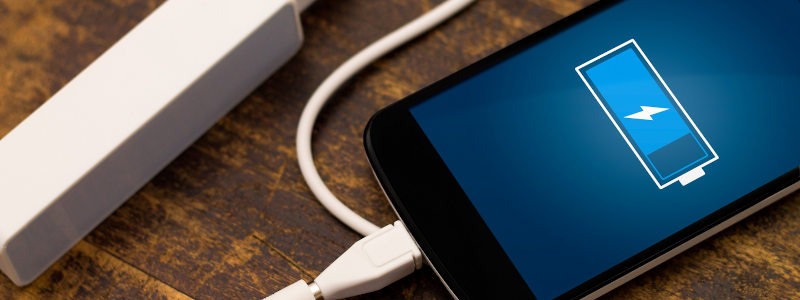
Currently, we can’t find any commercially available smartphones with graphene-enhanced batteries, which means that these power banks are restricted to only charging themselves quickly. However, they will not deliver the same current to smartphones since a normal battery would be damaged by a charging cycle that happens at 60 or so watts. All of these power banks can be charged in less than an hour, which is impressive considering how much capacity they can hold.
In the future, perhaps phone manufacturers will take notice of these products and start making devices that can reach similar levels of current during a charge without resulting in damage. For the moment, they’ll probably be taking baby steps in that direction.