

Is Google Manually Removing Odd AI Overview Answers?

Google Manually Deleting Ai Overview Answers Featured

Google’s AI Overview is barely a few weeks old, and it’s already facing difficulty. Social media has been filling up with odd answers from AI Overview, but it seems Google may be manually deleting those odd answers.

AI Overview, Google’s Newest Feature

Google’s AI Overview is a feature that leverages the power of artificial intelligence to respond to user inquiries. Despite being only a few weeks old, it is already making waves, though not all of them positive.

This new tool, designed to help users quickly find relevant information, has been generating some unexpected and peculiar responses, which have been widely shared and discussed on various social media platforms. The unusual, and at times humorous, responses from AI Overview have raised questions about the capability and readiness of this artificial intelligence feature.
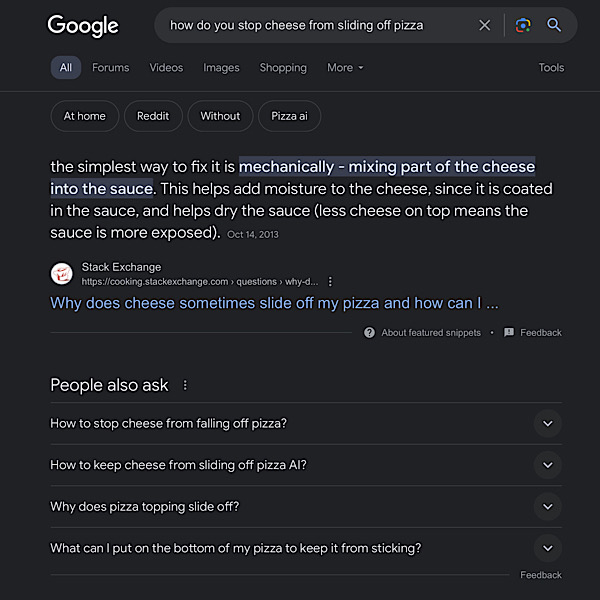
Google Manually Deleting Ai Overview Answers Glue Pizza

The frequent example of the odd answers from AI Overview has been instructions to put glue on pizza to keep the cheese from sliding off. Obviously, that’s a ridiculous answer. Hopefully, there isn’t anyone who would try it just because Google suggested it.

Tip: not comfortable with Google having all your searches in its knowledge base? Learn how to delete your Google search history.

Google Deleting Odd Answers

While AI is generally expected to learn and improve over time, the high volume of odd answers so early in AI Overview’s rollout is notable. Look around social media, and you’ll see plenty of them.

Google Manually Deleting Ai Overview Answers Search
Image source: Unsplash

However, it appears that Google might be taking steps to rectify this. Reports and observations from users suggest that Google may be manually intervening to delete these strange responses. This manual intervention would indicate that Google is actively monitoring the performance of AI Overview and is committed to improving its accuracy and reliability.

Google was quick to defend its new feature. Reportedly, it said that the questions AI Overview is getting wrong are uncommon and don’t represent what people are generally asking Google. It also said it was quickly taking action and would be working on improving the system, with some of those improvements already at play.

While Google’s AI Overview is facing some early challenges, the company appears to be actively working on improving the answers that are produced. How effective Google’s efforts are will depend on multiple factors, but they’re on the right track to be handling it already. Check out these deep web search engines to find what Google can’t.

Image credit: Unsplash. Screenshot by Laura Tucker.

Subscribe to our newsletter!

Our latest tutorials delivered straight to your inbox

Laura Tucker Avatar

Read next

In 2016, archaeologists dated two rings of snapped stalagmites in France’s Bruniquel Cave to 176,500 years ago, evidence that Neanderthals had walked 336 metres into darkness with fire and built architecture deep underground long before modern humans reached Europe
Otto von Bismarck was 74 when Germany adopted the world’s first national old-age social insurance program in 1889, setting the pension age at 70 after years of fighting socialists with bans, laws, and a promise few workers would live long enough to use
When cosmonaut Valeri Polyakov stepped out of his Soyuz capsule in March 1995 after 437 consecutive days aboard Mir, doctors recorded him at several centimetres above his pre-flight height, and his spine had become so unaccustomed to gravity that the recovery team carried him to a chair rather than risk the compression of letting him walk.
When Bell Labs engineer Karl Jansky pointed a rotating antenna at the sky in 1932 looking for sources of transatlantic radio static, he kept picking up a faint hiss that peaked every 23 hours and 56 minutes, and he eventually realized he had become the first human to hear the center of the Milky Way.
When Harvard astronomer Cecilia Payne submitted her 1925 doctoral thesis arguing that the Sun was made almost entirely of hydrogen, the field’s senior figure Henry Norris Russell talked her into adding a line calling the result ‘almost certainly not real,’ and then published the same conclusion himself four years later to widespread acclaim.
When seismic waves from the Chicxulub impact reached what is now North Dakota roughly ten minutes after the asteroid struck, they appear to have triggered a ten-metre standing wave in an inland river that flung fish onto the bank and buried them under glass beads still falling from the sky.
When survivors near Lake Nyos woke on the morning of 22 August 1986, the cattle were dead in the fields, the birds had fallen out of the trees, and 1,746 of their neighbours were lying where they had stood the night before, with no fire, no flood, and no wound to explain it.
In October 2002, a Russian scientist named Dimitri Malashenkov stood up at a space conference in Houston and quietly explained that the dog Laika, whom the Soviet Union had publicly mourned as a heroic week-long orbiter in 1957, had actually died of heat and panic within about five hours of launch.