
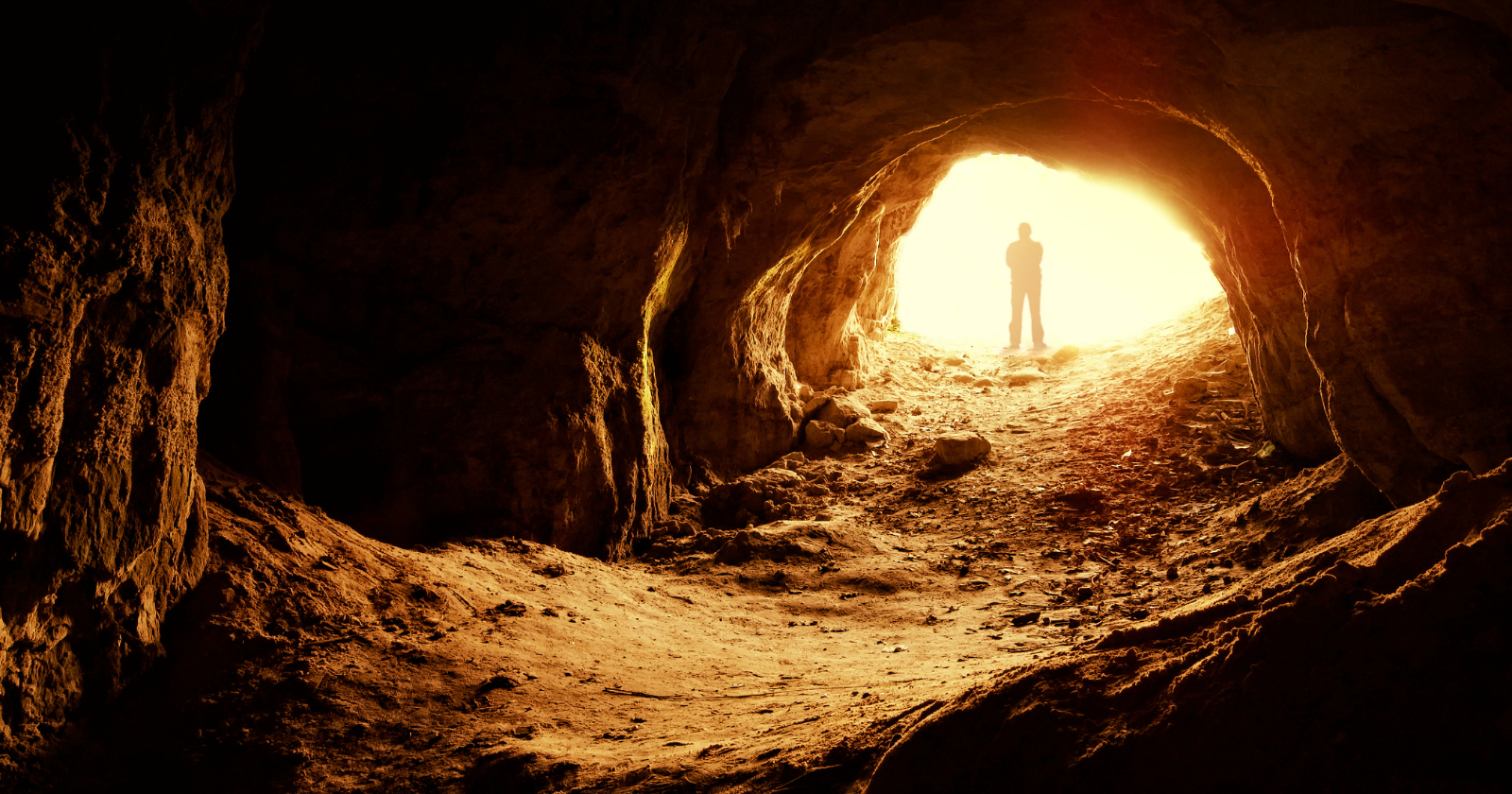

When Michel Siffre’s support team called down to tell him the experiment was finished, he did not believe them. By his own reckoning it was around the twentieth of August. The real date was the fourteenth of September. He had spent about two months alone underground, and he thought he had nearly a month still to go.
Siffre was a 23-year-old French geologist when he climbed down into the Scarasson cavern, a glacial cave in the Ligurian Alps, on 16 July 1962. He went without a clock, a calendar, or any sight of the sun, about 130 metres below the surface, beside an underground glacier. He ate when he felt hungry and slept when he felt tired. A one-way telephone line connected him to a small team at the entrance: he could call up to them, they could not call down to him, and they had been instructed never to mention the time or the date. Each time he woke, ate, or got ready to sleep, he phoned the surface so they could log it against the clock he was not allowed to see.
He had gone down, originally, to study the glacier. The decision to make his own experience of time the real subject came later, and he described it afterwards, in a 2008 interview with the magazine Cabinet, as the idea of his life. Human chronobiology, the study of the body’s internal clocks, did not yet exist as a field. Siffre’s two months in the dark are one of the things that brought it into being.
What the cave actually measured
Two separate things drifted while he was underground, and it is worth keeping them apart.
The first was his sense of elapsed time, which compressed. In tests he ran on himself, he would count slowly to 120, trying to mark off two minutes. By the later part of his stay it was taking him closer to five. His estimate of a short interval had stretched to less than half of real time, the same distortion, scaled up, that left him a month short across two.
The second was his sleep-wake cycle. With nothing to anchor it to the 24-hour day, his body settled into a rhythm of its own, running a little long, somewhere around 24.5 hours at first. He was not choosing this. He simply woke and slept on a schedule that no longer matched the world above, and he had no way of noticing it had come loose.
The qualitative result was the one that mattered, and it has held up completely. Stripped of sunlight, clocks, and social cues, the human body keeps time anyway, on a clock that runs close to, but not exactly on, the solar day. That finding is his.
Why the famous numbers need an asterisk
The specific figures are another matter, and this is where slow reading pays off.
Siffre kept going back, and the picture got stranger. His own cycle in 1962 ran at about 24.5 hours, close to the solar day. But in the experiments he ran afterwards with other volunteers, the cycles lengthened, and many subjects settled into something near a 48-hour rhythm: roughly 36 hours of continuous waking followed by 12 to 14 hours of sleep. Siffre, by his own account, was the exception. He never fell into the 48-hour cycle in 1962, and that was part of why he went back. In 1972 he spent more than six months in Midnight Cave, near Del Rio in Texas, partly to chase it, and he did catch it, in two stretches, though not regularly.
In one earlier experiment, in 1964, the second man Siffre sent underground slept for 33 hours straight, long enough that the surface team briefly feared he had died. Around the same period, a long series of isolation studies in a bunker at Andechs in Germany, led by Jürgen Aschoff and Rütger Wever, was reporting an average human day of roughly 25 hours.
For years those longer figures were read to mean that the human clock naturally runs well over 24 hours. The trouble is that the people in these studies, Siffre’s subjects and the German volunteers alike, could switch their own lights on and off. Artificial light does not only let you see. It resets the body clock, and a subject reaching for the lamp whenever they felt awake was, without intending to, pushing their own rhythm later and later.
When Charles Czeisler and colleagues at Harvard controlled light exposure properly and measured the underlying rhythm directly, the intrinsic human period came out at about 24.2 hours, far closer to the solar day than the long cave and bunker cycles had implied, and close to what Siffre’s own first stay had shown. They reported it in Science in 1999. The drift was real. Its more extreme sizes were partly an artefact of subjects lighting their own caves.
Why NASA paid attention
The interest from the space programme was not incidental. A long mission removes the same cues a cave does: no real sunrise, no outdoor day, a crew sealed in a small volume on an artificial schedule. Siffre said NASA funded mathematical analysis of his 1962 results, and the questions his stay raised are still live for anyone trying to keep people alert and well far from Earth.
Better engineering has not dissolved the problem. A day on Mars runs about 24 hours and 39 minutes, close enough to fool the body and different enough to accumulate over a mission. In ground-based Mars simulations, crews held to a 24-hour schedule have still slid out of alignment, and in one long analogue study a participant drifted into a non-24-hour rhythm despite the fixed timetable. Crews on the International Space Station face the cleaner version of the cave: they see about sixteen sunrises a day, which is to say no usable sunrise at all, and since 2016 have worked under adjustable solid-state lighting designed to brighten and shift toward blue when alertness is needed and dim toward red before sleep, holding their body clocks near 24 hours. The cave was a cheap and punishing version of a question that now costs a great deal to study in orbit: what a human rhythm does when the planet stops supplying the beat.
What it suggests about ordinary time
Set the orbit and the chronobiology aside for a moment, and the human detail is the one that stays. Siffre did not feel the time go missing. He was not confused in the way you are confused when you lose track of an afternoon. He had been keeping careful records, phoning the surface, running his counting tests, and he was still wrong by the better part of a month. The structure we use to know how much life has passed turns out to be almost entirely outside us.
Most people never test this, because the structure is everywhere. The light through the window, the phone on the table, the working week, the meal times, the routines of other people. We assume our sense of duration comes from inside, and that we would surely notice a whole month slipping by. His two months suggest the inside is less reliable than that, and that the steady feeling of time passing is something the world hands to us rather than something we make on our own.
He came up describing himself as a half-crazed, disjointed marionette, his eyes shielded from a sun he had not seen since July. He did not pretend the months had been pleasant. What he had put on the record, though, was difficult to argue with once it was there.
Siffre never lost interest in the question. He ran isolation studies for decades, and rang in the new millennium underground in the Clamouse cave in southern France, a two-month stay he undertook to study how ageing had changed his sense of time. He died in August 2024, at 85. His first two months had already settled the part that counts: in the dark, with nothing to mark the days, the body goes on keeping time, and the person carrying it has no idea what time it is.