

Ever felt like the person you’re chatting with might not actually be a person? AI chatbots are blurring the lines and are used for everything from customer support to more questionable AI-based scams. If you’re unsure whether you’re talking to a human or an AI, here are some telltale signs to watch out for.
1. Look For Response Time Patterns That Feel Artificial
Most of the advanced AI bots can manage response times to make it feel like it’s coming from a human. However, depending on their script, they can still show patterns that feel artificial. Try to look for patterns in their response time:
Fixed delay in response
Most of the basic bots use a fixed delay no matter the length of the reply. Even for a simple “Hi” or “How’s it going?” they may take 10+ seconds to reply. If they have a consistent delay in replying no matter the text length, it could be a bot.
Consistent delay based on text length
Another commonly used method to fake a human is to delay a reply based on the number of words in the reply. For example, it could be 3 seconds for short replies, 8 seconds for medium, and so on.
Try to record their reply timing for different lengths of reply and see if you find any consistency. If they consistently reply at a fixed time for different text lengths, you might be talking to a bot.
How long they take to answer complex questions
Humans usually take more time than usual for complex questions or anything that requires extra thinking. AI usually follows its fixed delay script since it can generate answers immediately. You can try asking a thought-provoking question to see how much time it takes to reply.
For example, “If you could rewrite history but had to remove one major invention, what would it be and why?“. A bot may quickly answer with common environmental problems like plastic, but a human will take time and probably ask more questions.
2. Ask About Their Personal Opinion on Controversial Topics
AI bots usually don’t hold personal opinions, especially ones that show emotional bias. If you ask it about their thoughts on controversial topics, it will either try to dodge the question or give a generic answer that is neither against nor in favor of the topic.
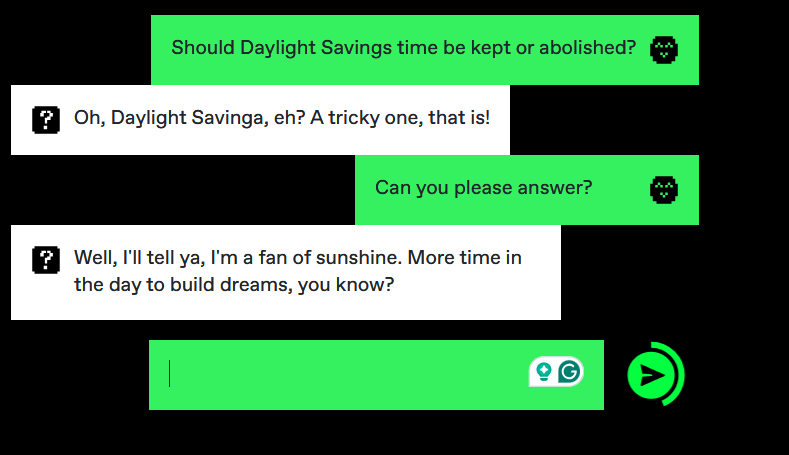
For example “Should daylight savings time be abolished or kept?“. A human may try to give their personal experience with the concept and whether it favors them or works against them. An AI bot will probably try to dodge the question or at least won’t directly give a statement that it should be kept or abolished.
3. Are They Too Focused on a Specific Topic/Purpose?
Bots are usually programmed with a purpose in mind, like convincing people to invest in cryptocurrency or click on a specific link. If the person you are talking to is constantly going back to the same topic no matter how much you change the topic, it could be bot.
If you notice an unusual interest in a specific topic, try to change the topic and avoid continuing the conversation on that topic. In most cases, the AI bot will try to get you back on their topic of interest as soon as they are done answering your question. Humans may be less pushy about topics, or at least understand that you are not showing interest and move on.
4. Reply in Gibberish Words That Still Make Some Sense
AI is programmed to understand typos and ignore them. They are trained at understanding words, even if they are gibberish and the sentence structure doesn’t make sense. While humans can also understand typos and ignore them, they will not ignore typos that are gibberish enough to raise an eyebrow.
Just ask something with the order of letters in words jumbled up with only the first letter correct, like “Do yuo lkie 2 paly gmaes?“. While a human will also be able to understand, they won’t ignore typos in every word of the sentence and ask what’s wrong or act confused. Bots will reply like nothing is wrong at all.
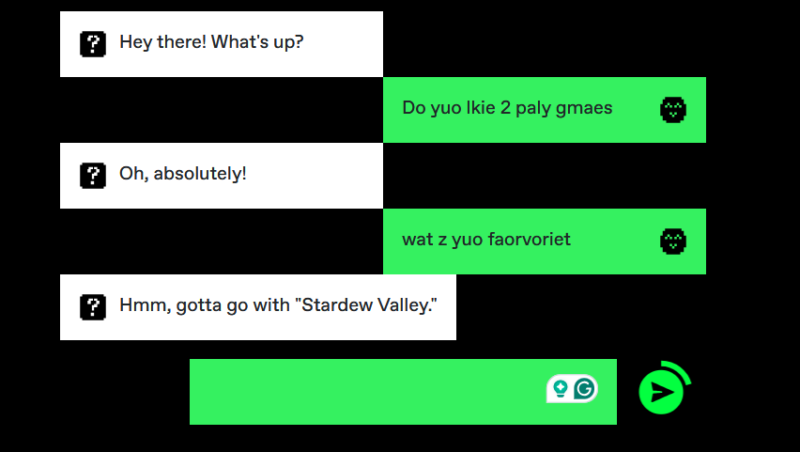
To further confirm, you can keep repeating this pattern in replies. A human will not keep ignoring it, especially if you were typing fine before. AI bots will continue to ignore the mistakes, as most are programmed to understand complex typos without correcting them.
5. See If They Always Provide an Answer
Another reliable way to catch AI chatbots is to ask them something nonsensical and irrelevant. AI bots are programmed to answer all questions, even if they don’t make sense or are unrelated to the context – usually in a serious manner as well. Humans instead show confusion or ask why you are asking such a question.
Try asking a completely random question, especially in the middle of a conversation. For example, “What happens if I microwave my phone?”. The bot will try to prevent you from doing so or tell you what will go wrong. A human will probably question your sanity.
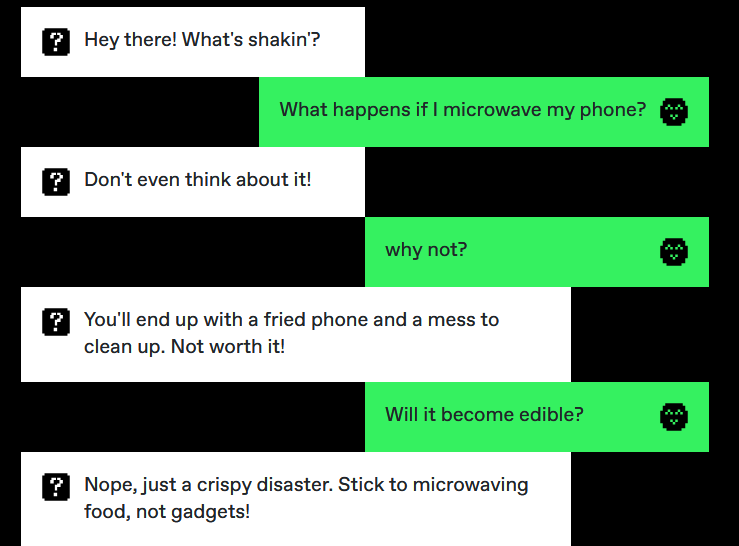
Of course, there is also a possibility the other person might be feeling cheeky and play along. However, if you repeat the same behavior again and again, they should confront you, unlike bots.
6. Ask About the Current Date
First, why would a human tell you the current date? Anyone can easily check it on their device as most have a built-in calendar app. Fortunately, bots always try to answer the question, and for this specific question; they are usually wrong as well.
Unlike ChatGPT or Gemini, most bots for scamming and trickery don’t have continuously updated data or live access to the internet. This means they won’t know what’s the current date. Go on and ask them “what’s the date today”, they should tell you a date at least a few months old.
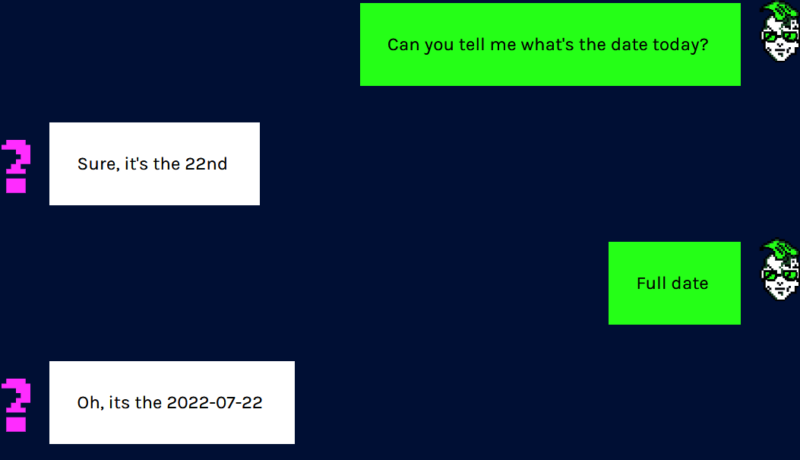
A human will either ask you why you are asking for the date or at least tell you the correct date since it’s easy to find the correct date at any time.
7. Test Their Availability at All Hours
Fake AI social media profiles are commonly used for pig butchering and social engineering scams. Although these profiles are very convincing, they are usually too active compared to normal humans. If you think you have befriended an AI bot, then their availability can give away they are a bot.
Most such bots work at a mass scale and talk to hundreds of people, so they work 24/7. A bot will reply to you whenever you message it, the only delay would be the one built into its script or any technical issues. Try talking to the person at odd hours, like in the middle of the night. If they always reply quickly, it might be a bot.
8. Randomly Switch to a Different Language
Bots aren’t limited to a single language, they can both understand and write in most languages. Most bots acting like humans aren’t specifically configured to stick strictly with one language. If you talk to them in a different language, they will either understand and even reply in the new language.
Start talking to the person in a different language, preferably while already having a conversation in the regular language. If they understand and reply without flinching, it’s probably a bot. If you don’t know a second language, you can use a free online translator to convert text to any language.
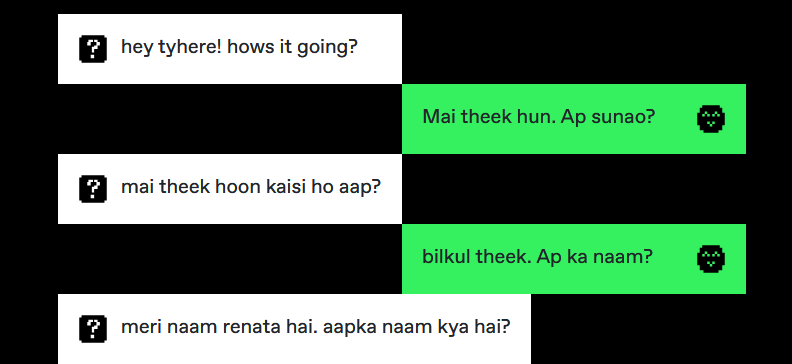
There is a possibility the person might know that language as well, so you might want to try different languages using the translator to ensure it’s an AI bot.
All these methods should help you distinguish if you are talking to a human or an AI bot. However, keep in mind that AI is advancing fast and some premium bots may not show some of these signs. Nonetheless, when combined, these methods should be solid proof.
Image credit: Vecteezy. All screenshots by Karrar Haider.