


Fiber optic internet is a rapidly-growing sector of the telecommunications industry. You probably are reading this article through such a connection. And if you’re not, you’re probably wondering why your internet service provider (ISP) has not taken the steps necessary to facilitate this kind of connection for you. What makes a fiber optic connection so much faster than a copper Ethernet-based network? Is there a limit at all to how much bandwidth can pass through fiber? How come some countries have faster internet than others? I’ll try to answer all of these questions in a way that’s easy to understand!
1: What makes fiber better than copper?
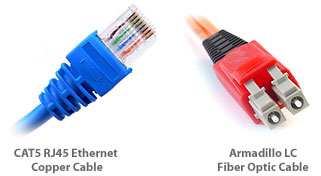
The era of Ethernet is dimming. But why do people prefer fiber optic better than Ethernet? ISPs seem to be in a hurry to upgrade their infrastructures.
First of all, Ethernet isn’t going anywhere. ISPs don’t operate on Ethernet. That’s just the 8-pin copper connection you use to connect to the internet. It’s the end of the connection, where your computer is connected to its wall socket or router. ISPs actually operate on a series of copper cables designed to carry signals at varying frequencies. Some of them have chosen to replace all these cables with optical cables, which for some reason are superior.
Instead of carrying data through electrical currents, which attenuate (diminish) over a certain distance, fiber optic cables carry pulses of light through clear fiberglass or other materials enclosed in shielded material. Here, we see a lack of attenuation, and a much higher potential for shortening the pulses transmitted. Since you can send shorter pulses, you can increase the amount you send per second. Therefore, fiber has a much higher potential bandwidth capacity than copper.
Fiber optic cables don’t flinch when sending a signal over a distance of 200 kilometers (~120 miles). Copper struggles to send signals at distances of even 20 km (~12 miles). With copper, you also have to measure changes in the electromagnetic field of each wire, while with fiber, you only have to translate pulses of light into electric signals. In other words, it’s much more efficient with long-distance high-speed communication. What’s not to like?
2: What is the maximum amount of bandwidth a fiber cable can carry?
This question is difficult. Usually, fiber cables carry an average of a few terabytes of data per second. Some can go up to hundreds of terabytes per second. You can theoretically send one pulse per femtosecond, or 0.000000000000001 seconds, or so.
3: What is stopping my country’s ISPs from adopting fiber?

For one, it’s very difficult to change to fiber. If the whole investment was in the cables, ISPs would be in on it without a hitch. But there are a lot of other things to consider. The hardware that routes signals to their destinations, the processing units, and lots of other equipment has to be replaced. The old copper equipment will have to be scrapped. Copper cables have to be disposed of properly. There are many things that can present roadblocks in the adoption of fiber optics.
But perhaps the biggest potential obstacles to fiber adoption (especially in the US) are government and public/private bureaucracies. It’s no coincidence that countries with the freest telecommunications markets – such as Hong Kong, Japan, Romania, Singapore, Switzerland, and Latvia – also have the greatest surpluses in bandwidth. In these countries, it’s not uncommon to see someone with a $50 plan using a line that’s faster than what their computers can handle; something in the order of 500 Mbps or higher.
Needless to say, each country has unique obstacles and different terrain to overcome. There’s no cookie-cutter model for what a country must do to quickly adopt fiber internet. For example, some countries have freed-up telecom markets, but their operators are too poor to take the leap.
Fiber Is Fun!
Nothing spoils you more than downloading a massive 6 GB database in a few minutes. This will perhaps one day become a reality for most of the world. But, for now, we patiently wait while we navigate the stormy territory of red tape and financial burdens. For those of us who are lucky enough to look at this text from behind a fiber-connected computer, it’s time to take a moment and appreciate what we have.
If you’d like to ask more questions about fiber, give it a shot in the comments section below!