

There is no doubt that Facebook has a problem with misinformation being spread on the social network. It’s especially true now during a presidential election year for the United States and in the midst of the coronavirus pandemic, a topic that many have a thirst for. Facebook is trying to solve that by providing website information about the news stories before they are shared.
Initial Facebook Changes for News Stories
This is a work in progress for Facebook. Initially, it made changes in June. It rolled out a notification screen that would let people know if the news article they were able to share was more than 90 days old.
We’ve all been there. When reading Facebook news stories, there are immediate reactions of disgust, joy, shock, etc., only to find out they are old stories, news that’s been floating around for a few years. So people would know initially that it’s old news, a change was added in June that warns people if the news they are about to share was released more than 90 days earlier.
Recent Changes to Sharing News Stories on Facebook
This caused Facebook to make more changes, specifically to the stories that are posted about the coronavirus pandemic. There is no doubt much misinformation about COVID-19 as far as how it’s spread, possible cures, how many have been affected, etc.
It’s easy to see how it happens. There are so many times we read something so incredulous that we want to share it to our own account right away. Without a thought, the “Share” button is accessed, and it immediately shows up on our page. Unknowingly, we’ve just shared misinformation.
For this reason, Facebook will be pushing out a new notification screen for times when COVID-19 information is being shared. When a user is about to share a coronavirus story to the social network, they will receive a notification screen alerting them to information about the website.
When you share the information, you’ll get a pop-up window that will tell you the link’s source, when the website was first registered, and when the news story was first shared on Facebook. Additionally, there will be a link to an official COVID-19 information page that the social network created.
At the same time, Facebook wants news stories about COVID-19 from authentic sources to be widely available to as many people as possible. Content that was created by government health authorities and recognized global health organizations, such as the World Health Organization, will not have that notification screen. This will hopefully provide enough assurances to the validity of the information.
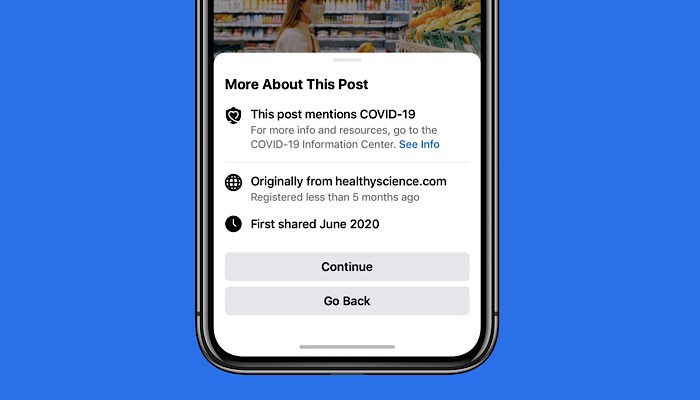
A designer at Facebook, David Gillis, tweeted that this change would be rolling out soon and also included the screenshot above of what this notification will look like. You may have already seen it, as the change has already started rolling out.
This all, of course, goes along with our own common sense. If the story doesn’t cite a source for the news, you should be questioning it. Also, if the story has multiple grammar and punctuation errors, it’s probably not a credible source. Facebook offers tips for this reason on how to spot a fake news story.
Read on to learn about suggestions that A.I. could help determine if a news story is real or fake.
Image Credit: Dave Gillis’s Twitter and pubic domain