


Artificial intelligence, specifically AI Overview, may be forcing you out of Google Search, looking for other search engines. But if you decided to flee to DuckDuckGo, know that AI is there, too, though it won’t train on your data.
Privacy Concerns with Google AI Overview
Google AI Overview, as part of its functioning, involves the collection and processing of a significant amount of personal data. This includes user search histories, location data, viewed content, and other kinds of user behavior. Google uses this data to train and improve its AI systems, aiming to deliver more personalized and accurate search results.

Understandably, this has raised privacy concerns among some users, as it means that their personal information is being stored and used by the company. For them, DuckDuckGo emerges as a preferable alternative, as it places a high emphasis on user privacy. Unlike Google, DuckDuckGo does not track its users or store their personal information.
In addition to privacy issues, AI Overview has completely revamped Google Search. It aggregates one larger answer from various websites and no longer provides the familiar list of links until much further down the page. This is particularly hurtful to websites that depend on Google placement, and their advertisers. Additionally, social media is filling up with strange answers in AI Overview, such as stopping the cheese from sliding off your pizza by adding glue.
DuckDuckGo Introduces Embedded AI Chat
DuckDuckGo has now incorporated AI into its technology as well. While it may seem counterintuitive for a privacy-focused search engine to use an AI chatbot, It has found a way to balance user privacy with the benefits of AI.
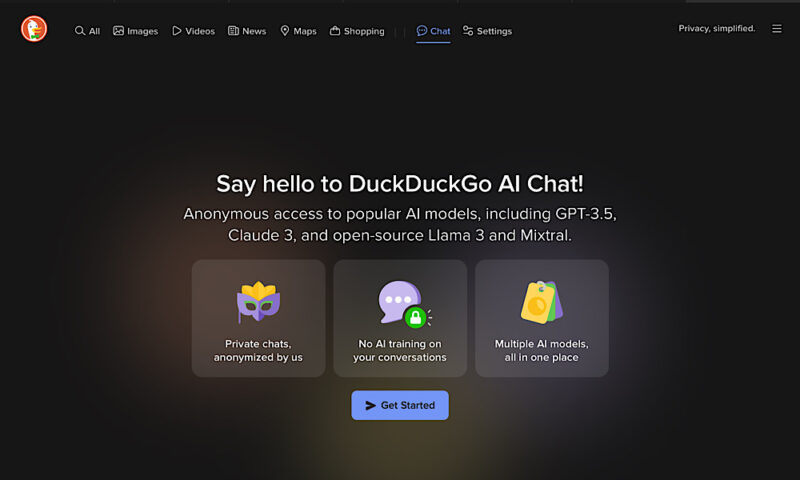
Unlike Google and similar search engines, DuckDuckGo’s AI implementation doesn’t compromise users’ privacy. The AI is embedded within the search engine and doesn’t store or learn from individual user data. This allows users to still enjoy the advantages of AI, such as improved search accuracy and efficiency, without sacrificing their privacy.
DuckDuckGo AI Chat accomplishes this by using other AI chatbots. In essence, it’s letting these other options do all the training, to leave its users’ privacy alone. It uses chatbots by OpenAI, Anthropic, Meta Llama 3, and Mistral AI. You get to choose which one you want to use and can even bounce back and forth, as they may give you different responses.
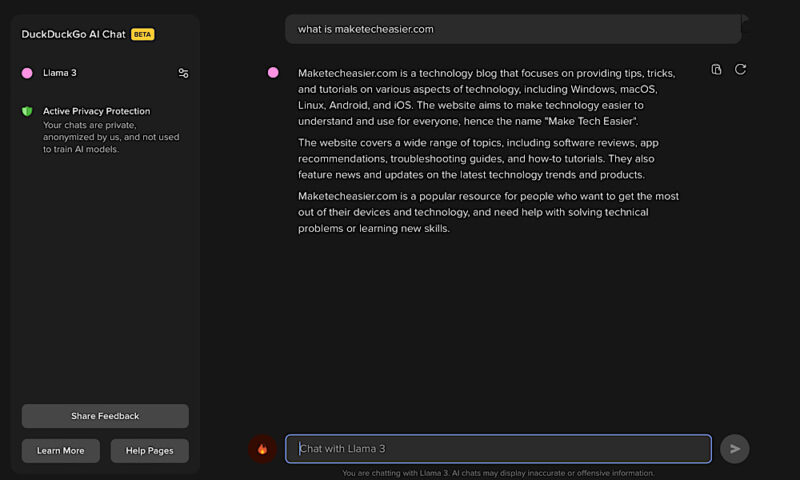
I asked the same question, “What is maketecheasier.com,” to all four chatbots and received three different responses, while Claude 3 Haiku by Anthropic couldn’t provide any answer.
It’s unknown how many users will hear that DuckDuckGo is now implementing AI and run for the hills without learning how it’s being used. But it appears that it’s safe, without jeopardizing your privacy and personal data. If your privacy is important to you, you may want to look into these dark web scanners to check for personal data breaches.
Image credit: Unsplash. All screenshots by Laura Tucker.