


“Bone conduction” sounds a little creepy, and that’s a fair first impression given that it works by sending sound vibrations through the bones in your head. Weird as the thought is, though, it’s being applied in ways that are cool enough that any residual hyperawareness of your own bones won’t last for too long.
While bone conduction technology has been around for a while, mostly in hearing aids and specialized industrial technologies, headphones based on it (bonephones!) are also starting to take off, and, in case it wasn’t sci-fi enough already, you can also get devices that turn your finger into a phone speaker.
Good to know: bone conduction headphones have unique pros and cons. Read our full discussion of whether they’re safe.
How does bone conduction work?
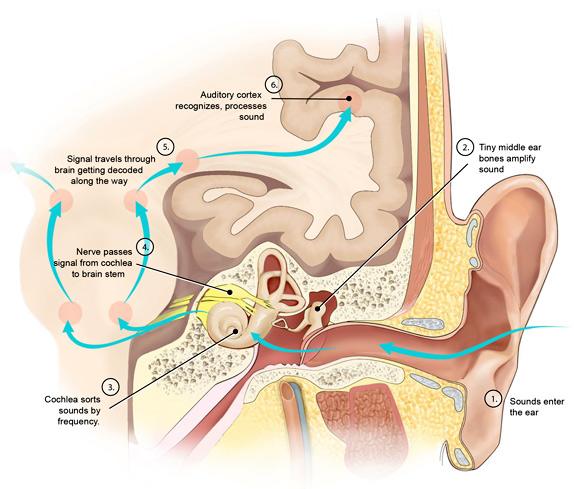
Humans typically get their sound waves from the air. The journey of a sound from the air to your brain looks like this:
- The sound hits your outer ear, which collects it and channels it to your middle ear.
- Your eardrum takes the sound wave vibrations and amplifies them.
- Connected to the eardrum are three small bones, called ossicles. These send the vibrations to a spiral-shaped portion of the inner ear called the cochlea.
- The cochlea is where the real magic happens: it converts the vibrations into electrical signals — a format our brain can understand.
- These nerve impulses are sent along the auditory nerve for brain processing.
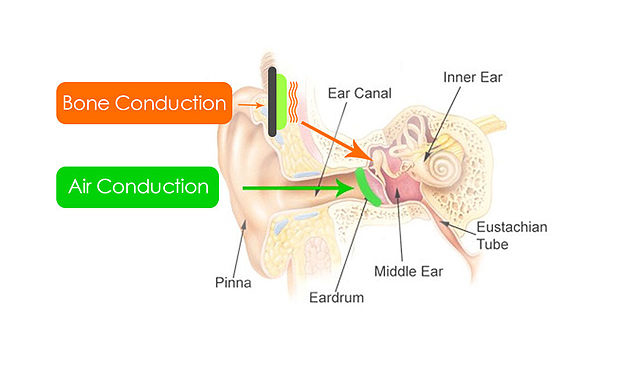
Bone conduction just skips the first three steps and goes directly to your cochlea. Because the vibrations are already in your bones, they don’t go through the outer and middle ear at all. Nonetheless, your cochlea can still pick them up and convert them, sending off a similar (but not identical!) sequence of nerve impulses. It’s like cooking dried pasta from a box instead of making your own from scratch – you skip a few steps, but get a fairly similar result.
Current bone conduction applications

While most of the press is going to the new consumer applications, bone conduction got its start as a medical technology. Ludwig von Beethoven may have been the first person to try this: he experimented with different ways to run a metal rod from his piano to his head, and though the sound probably wasn’t great, it is reported to have been fairly helpful. Since then, bone conduction has been used to treat several different types of hearing loss, probably with better results.
Consumer tech is where the exciting stuff is happening, though. Normal headphones can sometimes feel a little isolating since you’re in a completely different sound dimension than the world around you. Bone conduction doesn’t block out external noise, though, so if you need to pay attention to the environment around you, a set of bonephones will let you turn up your music and hear what your boss is saying.
This is especially handy for runners, cyclists, and other outdoor athletes who need to know what’s going on around them. Even SCUBA divers, race car crews, and military teams have found bone conduction to be a big help, and it was the main audio output for Google Glass. From a social perspective, it might also be a good thing for the world in general to have most people tuned into the same base layer of sound rather than in their own headphone bubbles.
Those crazy new bone conduction gadgets

If you’re disappointed with this version of the future (no flying cars? The hoverboards have wheels?), it might cheer you up to hear that you can now make phone calls by pressing your finger against your jawbone to hear sound from your phone.
Currently, the two companies producing these devices are Orii (Hong Kong) and Sgnl (South Korea). While they come in different styles (as a ring and a wristband, respectively), the basic function is the same: pair the device with your smartphone and you can call, text, interact with voice assistants, and more just by pressing your finger up against the bone near your ear for sound. The sound from your phone travels over Bluetooth to the device, which then relays the sounds in the form of vibrations that get carried through your finger-bone to your jawbone.
Both products have hit the market and performed quite well. Voices don’t make for very complex waveforms, so even running the vibrations through multiple bones doesn’t really degrade the quality. Too noisy? Just use your finger to block excess outdoor noise from entering your ear. Yes, in many ways it’s just another weird smartphone extension thing, but aside from just being insanely cool, it’s a very interesting step towards a more organic human-technology interface.
The future
Bone conduction isn’t likely to replace traditional sound hardware completely, especially since some people use headphones specifically to escape noisy environments, and because the sound quality you get from bone conduction just isn’t great. The bass doesn’t do so well and bonephones can easily get drowned out in environments where there’s a lot of external noise.
The added situational awareness is a big plus for many, though, and the smartphone connection presents a very interesting possible future for how we interact with our technology. Smartwatches didn’t really offer enough added value for most people to bother picking one up, and the same might be true of things like the Orii and Sgnl. However, there’s definitely a version of the future where bone conduction wearables take off to the point where talking into your empty hand doesn’t get you a second glance on the street.
Image credits: Bone Conduction Headset, Orii Lifestyle Photo, Biological Fact