


Apple talked about its new iPads being great for AI last week, but there was no specific information about what was coming. Yet, the stories and rumors about AI in upcoming iPadOS, macOS, and more are inundating the news.
New Apple iPad Pro and iPad Air Built for AI
There were many expectations of what the new iPad Pro and iPad Air, announced last week, would include. It was expected that the Pro would have an OLED screen and an M3 or M4 chip. The Air was expected to reach the abilities of the last Pro that was released. All of those expectations were reached.

It was also expected that the new Apple tablets would be built with AI in mind. In fact, it was mentioned in the announcement how powerful both the iPad Pro and iPad Air would be for AI.
The iPad Pro with M4 has a powerful Neural Engine that is capable of 38 trillion operations per second. This is 60 times faster than Apple’s first Neural Engine. Added to that is next-generation ML accelerators in the CPU, a high-performance GPU, more memory bandwidth, and other features in iPadOS to make it work well with AI.
The iPad Air with M2 has a 16-core Neural Engine, ML accelerators in the CPU, a powerful GPU, and Apple silicon’s unified memory architecture to deliver performance suitable for AI.
Rumors About AI and Apple
Apple’s iPad announcement did nothing to quiet the AI rumors. It seems to have only pushed them further.
It’s rumored that there is a deal in the works between Apple and OpenAI, as well as one with Google AI. The Google deal was to include the Gemini AI chatbot, but not until iOS 18, so it wouldn’t make sense to insert the features in iPads now. It’s believed that OpenAI is close to finalizing its deal with Apple, to once again incorporate AI in iOS 18.
Two years ahead of iOS 18, Apple will host it’s Worldwide Developers Conference on June 10, where iOS 16 features will be announced. It’s expected that CEO Tim Cook and others will be announcing the partnership with OpenAI. But with the newest iPads’ AI features, it’s hard to believe Apple is releasing that power two years ahead of putting it to use.
OpenAI Event with GPT-4o
OpenAI didn’t completely lay rumors to rest when it held its own event. What the event did do was showcase a new voice assistant, the GPT-4o, that has reasoning capabilities through voice, vision, and text. Also announced was the desktop version of ChatGPT.
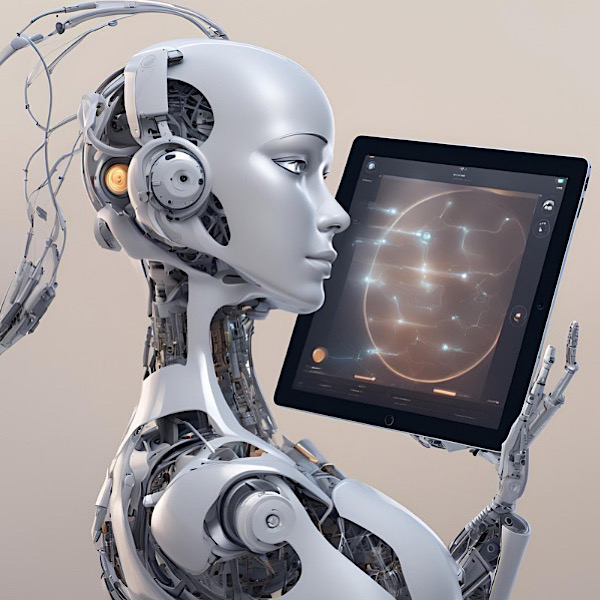
GPT-4o (GPT-4 Omni) has a female voice that sounds much more lifelike than other voice assistants, including Amazon’s Alexa and Apple’s Siri. It can even show emotion in the voice, such as excitement. It can also determine emotion in a user’s voice, with a true back-and-forth conversation. GPT-4o will be a macOS application.
Most certainly, Apple will be mentioning the GPT-4o chatbot macOS app at the WWDC event in June. But with the iPads getting all those great AI features, there has to be something great coming to iPadOS as well.
Image credit: Canvas