
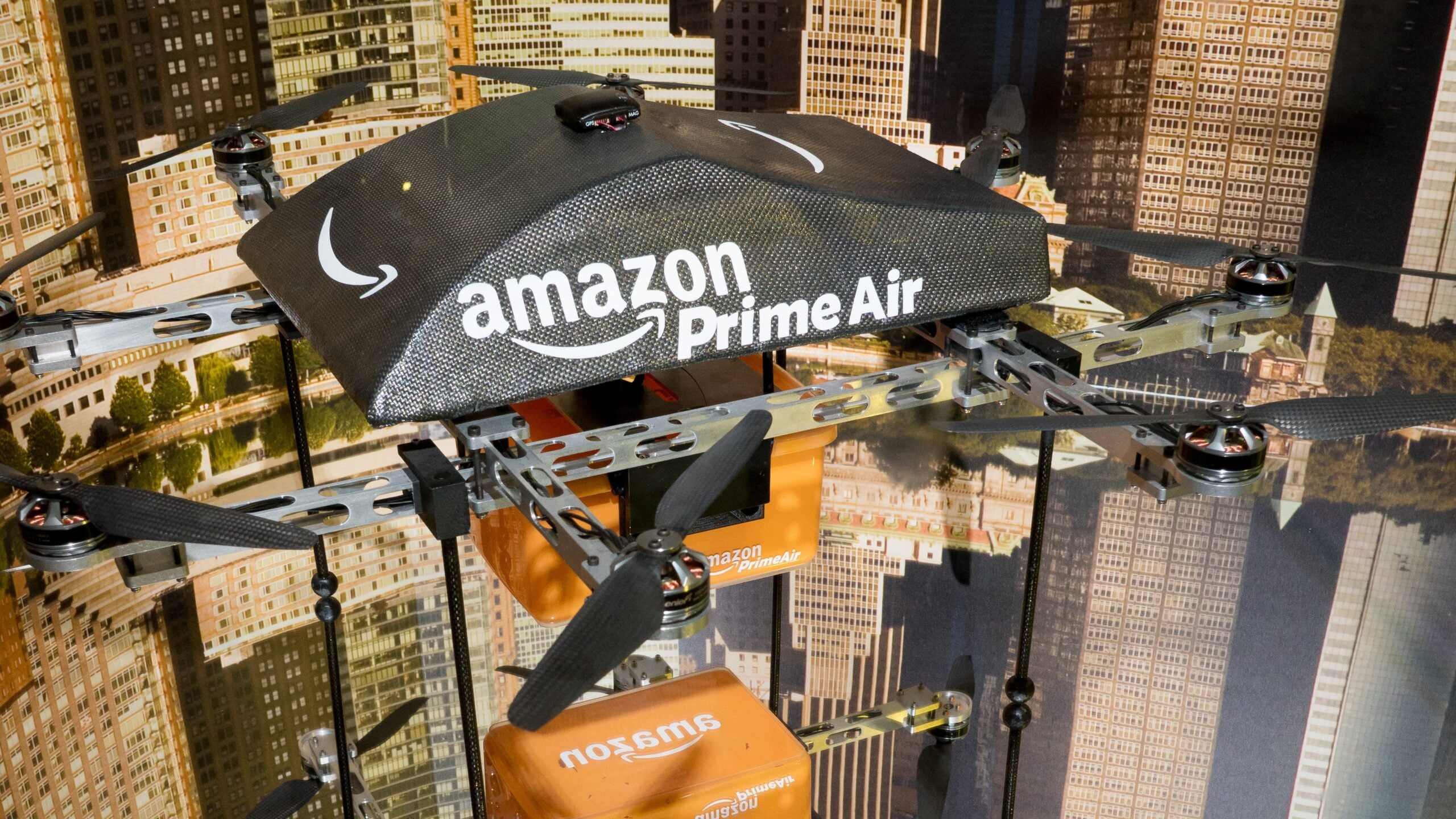


Amazon’s Prime Air drone delivery service expanded from about 600 customers to about 8,000 households around Darlington on Tuesday 10 November, after the company secured a SAIL 4 operating authorisation and flightworthiness validation from the UK Civil Aviation Authority, The Independent reported.
The authorisation allows the drones to fly further and across urban areas. Prime Air had been running under a separate CAA authorisation covering beyond-visual-line-of-sight flights in less densely populated areas.
In its UK announcement, Amazon said Prime Air was the first operator in the world to obtain a SAIL 4 Operating Authorisation and SAIL 4 Flightworthiness Validation from the CAA, and called the work behind it the most thorough safety assessment of any drone system in the UK. The company said the approval enables flights over more of Darlington and lays the foundation for future expansion across the UK, and that the CAA is the first regulator in the world to assess and approve an operation at this level.
Theunis Scheepers, Amazon’s director for Prime Air in Europe, said it was the “world’s first Sail 4 approval from the UK CAA, a standard that sets a new benchmark for safety in drone aviation”. He said the approval was “the foundation for the future of delivery, and for customers it means getting the things they need quickly, safely and reliably”, and added: “This is just the beginning for Prime Air in the UK.”
What SAIL 4 covers
SAIL stands for Specific Assurance and Integrity Level, a risk scoring system used for advanced drone operations within UK SORA, the Specific Operational Risk Assessment framework. SORA sets the safety standard, and a technical assessment establishes whether a particular drone and operator meet the requirements of a given SAIL level.
A SAIL 4 operation is treated as medium to high-risk and is the point at which the CAA expects significant technical and organisational safety assurance, according to Amazon’s account of the framework. Operators have to demonstrate technical controls, system integrity and safety management processes, and the assessment is what unlocks services such as drone deliveries and other beyond-visual-line-of-sight operations. To grant the authorisation, the CAA assessed Prime Air’s operation, aircraft, organisation and approach to risk.
Sophie O’Sullivan, director of future safety and innovation at the CAA, said the regulator was “helping to create conditions that allow innovation to thrive, while maintaining the high safety standards that underpin UK aviation”. She said the approval was “another important step towards safely integrating new technologies into UK airspace” and “reflects the wider progress being made as the aviation sector evolves and new technologies become part of everyday operations”.
Amazon says Prime Air launched in Darlington in early 2026. The BBC reported that drones have been operating in the town since May. Uncrewed aircraft are being put to other work in British airspace, including drones flown from the carrier HMS Queen Elizabeth.
What the drones carry, and how fast
Prime Air in Darlington is open to customers with a garden, yard or driveway. Eligible items weigh less than 5lb and fit into a large shoebox, according to The Independent and the BBC. Amazon’s own description sets the limit at items weighing up to 5lb (2.2kg), covering everyday goods such as baby products and household essentials. Qualifying items are marked on the site and at the checkout, where customers confirm their delivery point.
Delivery is included in Amazon Prime membership, with no additional delivery fee for members. Prime Air is one part of Amazon’s UK consumer line-up, which also covers home devices such as the Echo Dot that doubles as a smart home hub with eero built in.
The Independent and the BBC both said eligible orders arrive in under an hour. Amazon’s release, issued on 10 November, says deliveries reach customers in under two hours.
Amazon’s announcement sets out no timetable for taking the service to other parts of the UK.
The MK30 and a crash in July
Flights in Darlington use the MK30, the all-electric aircraft Amazon describes as its most advanced drone and which holds CAA approval to conduct operations. Its detect-and-avoid system uses machine-learning models that monitor the surrounding airspace during each flight, recognising other aircraft, people, animals and physical obstacles, and determining whether corrective action is needed.
As the drone descends to deliver, Amazon says the same systems “identify and steer clear of hazards such as clotheslines and trampolines that would not appear on a satellite map”. An independent monitoring computer oversees the main flight-control system and, if it detects an irregularity in flight, can hand control to a secondary system and start an automated return to base or a safe, controlled landing. The aircraft also carries six motors and a three-cell battery. The drones are designed to be quieter than a typical delivery, according to Amazon.
Amazon says Prime Air has created skilled local jobs in drone operations, maintenance and ground handling, part of its £40 billion UK investment and a £300 million contribution to the Teesside economy in 2024. The company also says the all-electric drone produces no emissions in flight, and that each delivery made directly to a customer’s door can mean one fewer car journey.
Flights have not always been successful, the BBC reported. The Air Accidents Investigation Branch opened an investigation in July after a drone crashed into a garden in Darlington. No one was injured, and Amazon said the drone “responded as designed”.