
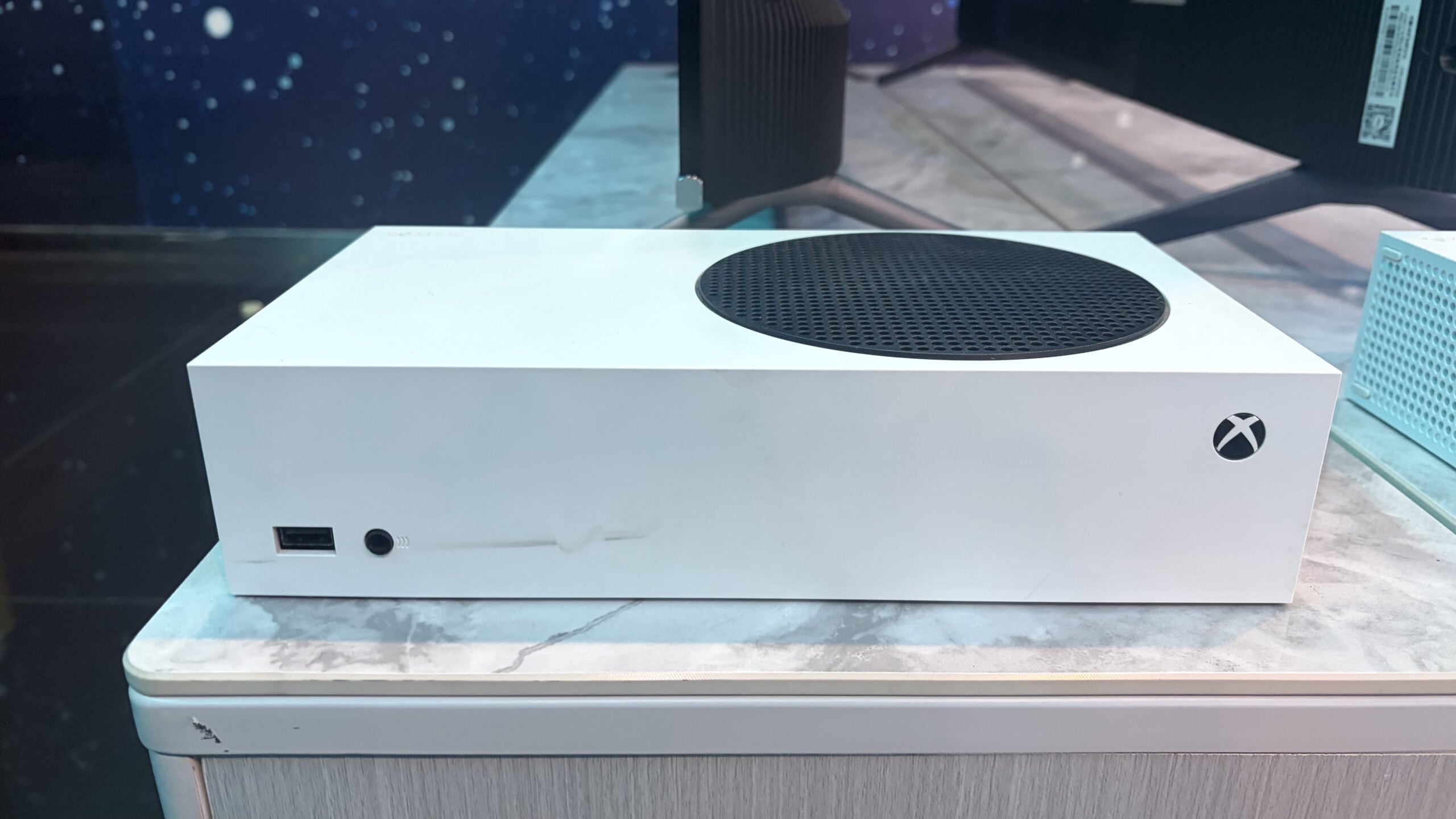

Grand Theft Auto 6 arrived on 19 November 2026 on PlayStation 5, PlayStation 5 Pro, Xbox Series X and Xbox Series S, and not one of those four versions draws its world at the resolution that reaches the television. Rockstar Games has said the Xbox Series S build renders at a 720p base resolution and is scaled up to 1080p using AMD FSR Upscaling 4. The other three versions are reconstructed too, just by different means. PlayStation 5 and Xbox Series X start at 1440p and reach 4K through Rockstar’s in-house temporal anti-aliasing solution, while PlayStation 5 Pro starts at 1440p and reaches 4K through PSSR2. On every console, the finished image is then composited with a 4K user interface before it is presented.
The target across this generation of consoles is 30 frames per second. The resolution numbers describe how much of the picture is rendered natively rather than how much of it is displayed.
What each console renders, and how the picture is assembled
The breakdown comes from a technical statement Rockstar provided to Wccftech during the review period, published on 18 November 2026 and credited to Jonathon Ashcroft, Chris Oat and Marc Chambers on Rockstar’s technology team. The studio said the scale of the team’s ambition made it clear early on that it would be targeting 30fps on this generation of hardware, and that it put effort into balancing presentation, simulation and gameplay, as well as improving input latency relative to Grand Theft Auto V and Red Dead Redemption 2. Choosing a base resolution and an upscaling method for each console was part of that process.
The resulting arrangement, as VideoCardz laid it out in table form, pairs PlayStation 5 and Xbox Series X with Rockstar’s TAA at 1440p to 4K, PlayStation 5 Pro with PSSR2 at 1440p to 4K, and Xbox Series S with AMD FSR 4 at 720p to 1080p. VideoCardz described the Series S build as “the only console version confirmed to use AMD’s machine-learning upscaler.” Rockstar’s own closing line on the subject was blunt about the last step in the chain. “On all platforms, the picture is then composited with a 4K UI and presented.” That is why the user interface stays crisp on a Series S even though the world behind it began life at 720p. Tom’s Hardware summarized the same split.
Two caveats belong next to the FSR 4 line. Wccftech framed the game as apparently the first Xbox Series S title to support AMD FSR 4, which is that outlet’s framing rather than a Rockstar claim, and it noted in an editor’s aside that the technology had arrived on Xbox Series only weeks earlier. VideoCardz, meanwhile, reported that AMD introduced FSR Upscaling 4.1.2 for Xbox Series X and Series S developers earlier that month through the October 2026 Xbox Game Development Kit, and added that “Rockstar has not specified which model GTA VI uses on Series S.” Video Games Chronicle went further and treated the game as seemingly the first on the console to use FSR 4.1 upscaling, but that is an inference drawn by VGC. Rockstar’s published wording is “AMD FSR Upscaling 4” and nothing more granular.
What FSR 4 is actually doing on the Series S
FSR 4 is a machine-learning upscaler. VideoCardz says the Xbox implementation uses INT8 models optimized for RDNA 2 hardware, with Full and Lite variants, and that Rockstar has not specified which model Grand Theft Auto 6 uses on Series S. Rockstar’s statement makes clear that this is a deliberate pairing of base resolution and reconstruction method per machine rather than a single pipeline applied everywhere.
Digital Foundry’s Oliver Mackenzie, in a video analysis of the Xbox versions covered by VGC, described exactly that gap between the count and the look. “Series S operates at 720p internally in my counts, down from 1440p on Series X. The final output looks considerably better than the internal resolution suggests, however, with a more minor difference in image sharpness and detail compared to Series X.” He also noted that processor-intensive techniques such as character hair strands and ray-traced reflections had not been cut on Series S, and that “The game genuinely looks quite close in broad strokes to Series X.” The downgrades he catalogued were smaller ones, including less precise lighting, softer reflections and messier shadows in VGC’s paraphrase.
The lighting model is the other half of the story. Rockstar said the focus on lighting made it vital to use the same lighting solution on every console, including the Xbox Series S, “where memory pressure posed a bit of a challenge.” The studio added that there are differences between implementations per console as the ray-traced global illumination features are rebalanced for each platform’s capabilities, and that tuning happens on a given piece of hardware because there is no single solution. Readers who want the background on why a Series S build runs into memory pressure can consult this site’s explainer on the Xbox Series S memory limit.
What upscaling does not fix
Reconstruction buys pixels, not frames, and the Digital Foundry analysis separates the two cleanly. On Series X, Mackenzie found the game “does a reasonable job of hitting and holding 30fps during typical play, maintaining a 33 millisecond frame time through busy combat and traversal,” with cutscenes running without animation stutter and dropped frames limited mostly to especially busy chases or firefights. VGC says the Series X version holds a relatively fixed internal resolution of 1440p and aims for 30fps, with dips in busier scenes.
The Series S picture is different. Mackenzie said that version “has serious frame rate problems” and that “the game slips beneath this target during much of typical play.” He reported that basic traversal in slow cars causes the game to hang in the mid to upper 20s for long periods, that typical combat encounters hold in the mid-20s basically indefinitely, and that the most demanding encounters can push frame rates down to about 20fps at worst. He allowed that the game probably renders at 30fps more often than it dips below, and said he admired the translation of the 30fps PlayStation 5 and Series X game to weaker hardware, but he called the Series S version quite a bit harder to recommend and advised players to play on other console platforms for now. VGC also noted that there was no indication in that 18 November analysis of a later FSR 4.1 patch aimed at frame rate, so the upscaler should not be read as a pending performance fix.
Treating a base resolution as the whole image quality story is the mistake worth avoiding here. This site has covered other reconstruction tools in the same generation, including Sony’s QSSR upscaling on the base PlayStation 5 in Marvel’s Spider-Man 2 and Microsoft’s Auto SR on the ROG Xbox Ally. Neither of those technologies is used in Grand Theft Auto 6, which relies on Rockstar’s own TAA on PlayStation 5 and Xbox Series X, PSSR2 on PlayStation 5 Pro, and FSR 4 on Xbox Series S.