
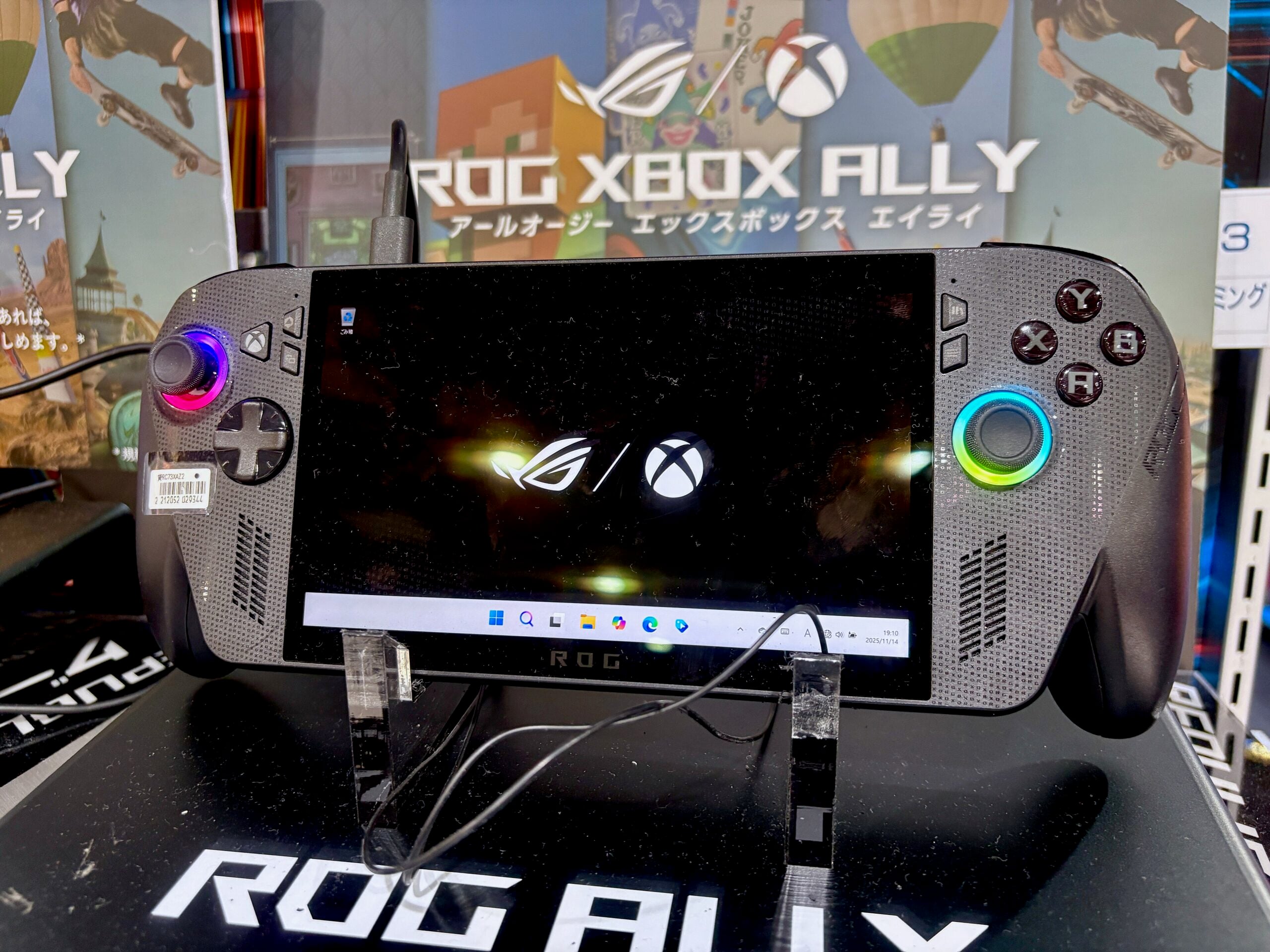


Automatic Super Resolution has left preview on the ROG Xbox Ally X and ROG Xbox Ally X20 and now runs on the handhelds’ built-in screens with games rendering at 1080p, according to a 10 November 2026 post on Microsoft’s DirectX Developer Blog by Stefan Bojanic, Product Manager II. A new Performance Mode that lifts Auto SR’s frame rate ceiling to 120fps is rolling out with Windows updates rather than switching on everywhere at once.
Auto SR is the upscaler built into Windows 11. A game renders at a lower resolution and Windows scales the image back up, with the device’s neural processing unit doing that work locally. Microsoft’s support documentation says the point is to avoid the usual trade between image quality and frame rate.
During the Xbox Insider preview, the feature worked only while the handheld was docked. “Auto SR now also works in handheld mode, right on your device’s built-in screen, even when you’re unplugged and playing on battery,” the blog post says. Microsoft said it started with docked play because that is where Auto SR made the biggest difference, giving 1440p-like detail on a larger screen.
What is live now and what is still rolling out
Three things are available immediately: handheld play while undocked and on battery, support for games running at a 1080p base resolution, and Auto SR on select Windows Copilot+ PCs powered by AMD Ryzen. Performance Mode and compatibility with Auto HDR are a separate case. Those “will be rolling out with Windows updates so they may take a little time to reach your device,” the post says, so owners of a qualifying handheld may not see either option yet.
The 1080p change removes a step that caught players out. In the preview, a game had to be dropped to a lower resolution before Auto SR would engage, which Microsoft said was a common reason the feature never turned on. Many handheld games default to 1080p to match the internal panel. Auto SR now works at that base resolution, and when the handheld is docked to a higher-resolution TV or monitor it can upscale a game up to 1440p.
Microsoft attached a caveat to the handheld case. “When using 1080p in handheld mode (internal screen), performance may not be as optimal as other configurations,” the post says, while adding that players will still see visual quality improvements, “especially in older games.” Auto HDR, which adds brighter highlights and richer colors to games without native HDR support, previously could not run at the same time as Auto SR. The two now work together on an HDR TV, monitor or the ROG Xbox Ally X20.
Performance Mode raises Auto SR’s ceiling to 120fps
Until this release, Auto SR “topped out around 60 to 75 FPS,” the blog post says. Performance Mode “raises the limit to up to 120 FPS, almost double what was possible before.” That figure describes the ceiling the upscaler will work up to, not a promise that a given game’s frame rate will double.
Microsoft published screenshots and frame rate figures from Rocket League running on a ROG Xbox Ally X at 720p with a high in-game graphics setting. Auto SR in Quality Mode averaged 70fps in that test, and Performance Mode averaged 115fps. The support documentation lists Quality mode at up to 75fps, described in its FAQ as 70 to 75fps, and Performance mode at up to 120fps, and says results vary by game and device settings.
The modes are switched in the Display widget in Game Bar, which applies the change to the running game so the frame rate shift is visible in real time. The same widget carries an in-game status indicator with a different icon for each mode, an advanced option for a vertical split-screen view that puts the unprocessed image beside the upscaled one, and a maximum display resolution setting that can force a game to launch at an Auto SR-capable resolution and restore the original on exit.
Which handhelds and PCs qualify
Auto SR needs an NPU. Microsoft’s requirements list names Copilot+ PCs with an AMD Ryzen AI processor, “including ROG XBOX Ally X & X20 gaming handhelds”; Intel Core Ultra Series 3 or Arc G3 chips with an AI Boost NPU, including the MSI Claw 8 EX AI+ handheld; and Snapdragon X or X2 Series parts with a Hexagon NPU. The base ROG Xbox Ally is not on that list. The other requirements are Windows 11 version 24H2 or later, current graphics and neural processor drivers, and a display at 1080p or higher.
Game support is narrower than the hardware list suggests. Titles must use DirectX 10 or later and run natively on x64, under x64 emulation, or on Arm64. Games built on x86, or on DirectX 9, Vulkan or OpenGL, are not supported, and the feature is opt-in rather than on by default. For AMD Ryzen-based machines, Microsoft recommends an input resolution between 1280 x 720 and 1920 x 1080, with the display mode set to fullscreen or exclusive fullscreen. All processing runs on the integrated GPU and NPU, and the documentation says game details are not sent to the cloud or to Microsoft.
The Verge called Auto SR a competitor to Nvidia’s DLSS, a framing Microsoft’s own post does not use. Windows Central, in a report published on 11 November 2026, set it alongside both DLSS and AMD’s FSR, and said beta drivers for FSR 4.1 are also available on Ally X hardware. The handheld release is separate from Microsoft’s console news, which has included an Xbox Series X25 restock and a numbered Series X25 console, and from Windows gaming hardware launches such as the Acer Predator Atlas 8.
Microsoft is asking for feedback on the release by email at autosr@microsoft.com and through Feedback Hub under Game Performance, with “Auto SR” in the title.