
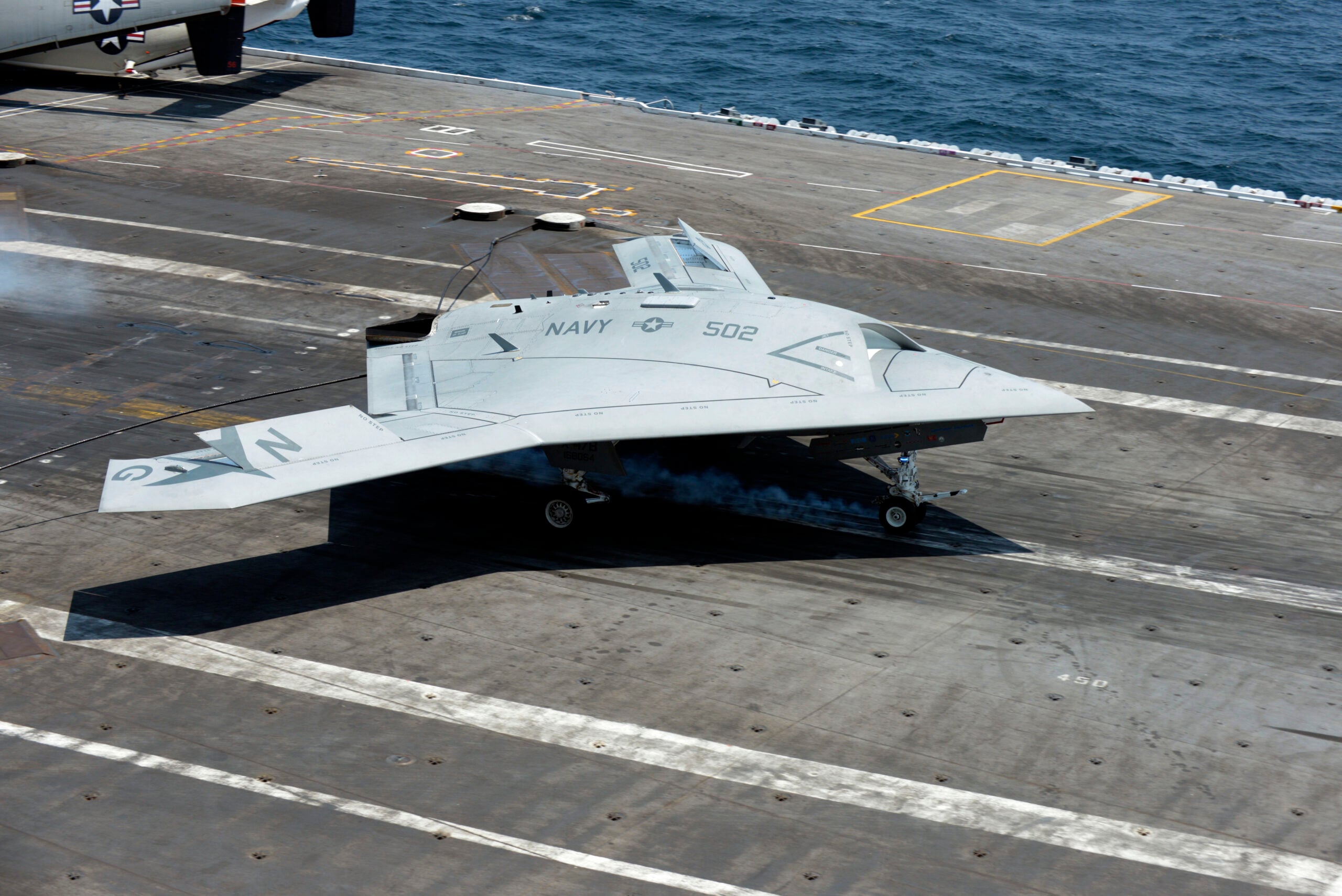


Shortly after noon on July 10, 2013, an X-47B with no one aboard came in over the stern of USS George H.W. Bush off the coast of Virginia and dropped its tailhook onto the flight deck. The hook caught the third arresting wire. According to the Navy’s original announcement, the aircraft went from approximately 145 knots to a stop in less than 350 feet. A later Navy account gave its speed relative to the moving deck as 124 knots. It was the first arrested landing by an unmanned aircraft aboard a modern aircraft carrier.
An arrested landing is how jets land on a carrier, because a flight deck is far too short for a normal runway rollout. A set of steel cables is stretched across the landing area, connected to arresting gear below deck. The aircraft lowers a hook from its tail, and when the hook snags a cable, the arresting gear absorbs the aircraft’s energy and drags it to a halt. The target is a moving ship, pitching with the sea, with the hook needing to touch down in a narrow band of deck.
The X-47B had flown 35 minutes from Naval Air Station Patuxent River in Maryland and completed several planned precision approaches before the landing, according to Northrop Grumman, which built it. Navy Secretary Ray Mabus was on board to watch. Getting the aircraft to that wire took years of work by engineers, test crews and the ship’s own people, and the most revealing moment of the day came later, on an approach that did not end in a landing.
How the aircraft and the ship worked together
The X-47B flew the approach itself. NAVAIR describes the system behind it as a combination of precision relative GPS navigation, advanced flight controls, autonomous vehicle software, high-integrity networks and digitized communications, including digitized air traffic control messages.
Each piece had a specific job. Relative navigation answered the most basic question: where is the aircraft compared with the ship? A carrier is always moving, so the aircraft’s position on a map matters less than its position relative to a landing area that is sailing forward and rolling with the waves. The flight controls and autonomous software turned that information into a stable approach path and corrections all the way to the deck. The digital communications carried instructions between ship and aircraft as data rather than as radio calls to a pilot.
People stayed in charge of the operation. A mission operator aboard the carrier directed the aircraft, and NAVAIR says the X-47B performed its carrier operations autonomously while being directed by that operator. The aircraft did the flying; a person decided what it should be doing.
From simulation to shore to sea
None of this was tried on a ship first. NAVAIR says the data from the carrier was compared with more than 160 precision approaches and six arrested landings at Patuxent River, along with thousands of high-fidelity simulated landings.
The shore-based arrested landings were a key step. On May 4, 2013, the X-47B made its first one at Patuxent River, catching an MK-7 arresting gear, real carrier equipment installed in the ground there for testing. Matt Funk, the Navy’s test team lead, said shore testing let the Navy and Northrop Grumman team control the test conditions and build up gradually to the maximum loads expected in a carrier landing. Each stage gave the team evidence about how the aircraft behaved before it was trusted with the next, harder task.
The sea phase was itself built up in steps. The X-47B carried out deck operations aboard USS Harry S. Truman in December 2012, then made its first catapult launch from Bush in May 2013. The July landings came in the last of three at-sea test periods in eight months.
The schedule was tight. Before going to sea, the team flew 48 test flights in 90 days, with the flight rate accelerated to as much as four times the original plan to meet carrier timelines. Budget sequestration had removed the chance of additional carrier tests, and program manager Capt. Jaime Engdahl said the team ended up counting its available test time in minutes.
The at-sea testing also rehearsed what happens when a landing should not go ahead. Across the carrier demonstration, the X-47B flew 16 precision approaches to the deck, and five of them were planned wave-offs, where the aircraft is told to abandon the landing and climb away. It also flew nine touch-and-go landings, made three catapult launches and caught the wire twice.
The third approach
After the first landing on July 10, the crew launched the X-47B off the carrier’s catapult and it made a second arrested landing. Then it launched again for a third.
About four miles from the deck, one of the aircraft’s three navigation computers developed a fault. The other two detected the failure, according to Navy officials, and the crew monitoring the flight was alerted. The X-47B performed an autonomous wave-off and then waited for instructions from its mission operator aboard the ship.
The decision then passed to people. Flight testers decided against another carrier landing and directed the aircraft to its alternate airfield at NASA’s Wallops Flight Facility in Virginia. A later Navy account says weather at Patuxent River was below the required minimums. The aircraft landed at Wallops safely. Rear Adm. Mat Winter, who oversaw the Navy’s unmanned aviation programs, said afterward that the X-47B “did everything it was designed to do.”
That episode is arguably as important as the landings. Two clean landings showed the system could do the job when things went right. The third approach showed what happened when something went wrong: the aircraft noticed its own fault, backed away from the ship, reported, and waited for a human decision. For sailors who share a flight deck with landing aircraft, that predictability matters as much as precision.
It also created a small first of its own. Engdahl said it was the first time the X-47B had operated at a divert site, and the team worked with NASA personnel over the following weeks to coordinate its flight back to Patuxent River on August 8.
What the demonstration established
The X-47B was never meant to become an operational aircraft. It was a demonstrator, and its job was to help the Navy develop a concept of operations and test technologies for follow-on unmanned carrier aircraft programs.
The X-47B demonstrated more than an automatic touchdown: it showed how an aircraft flying itself could operate under human direction, including when a fault interrupted the plan.