
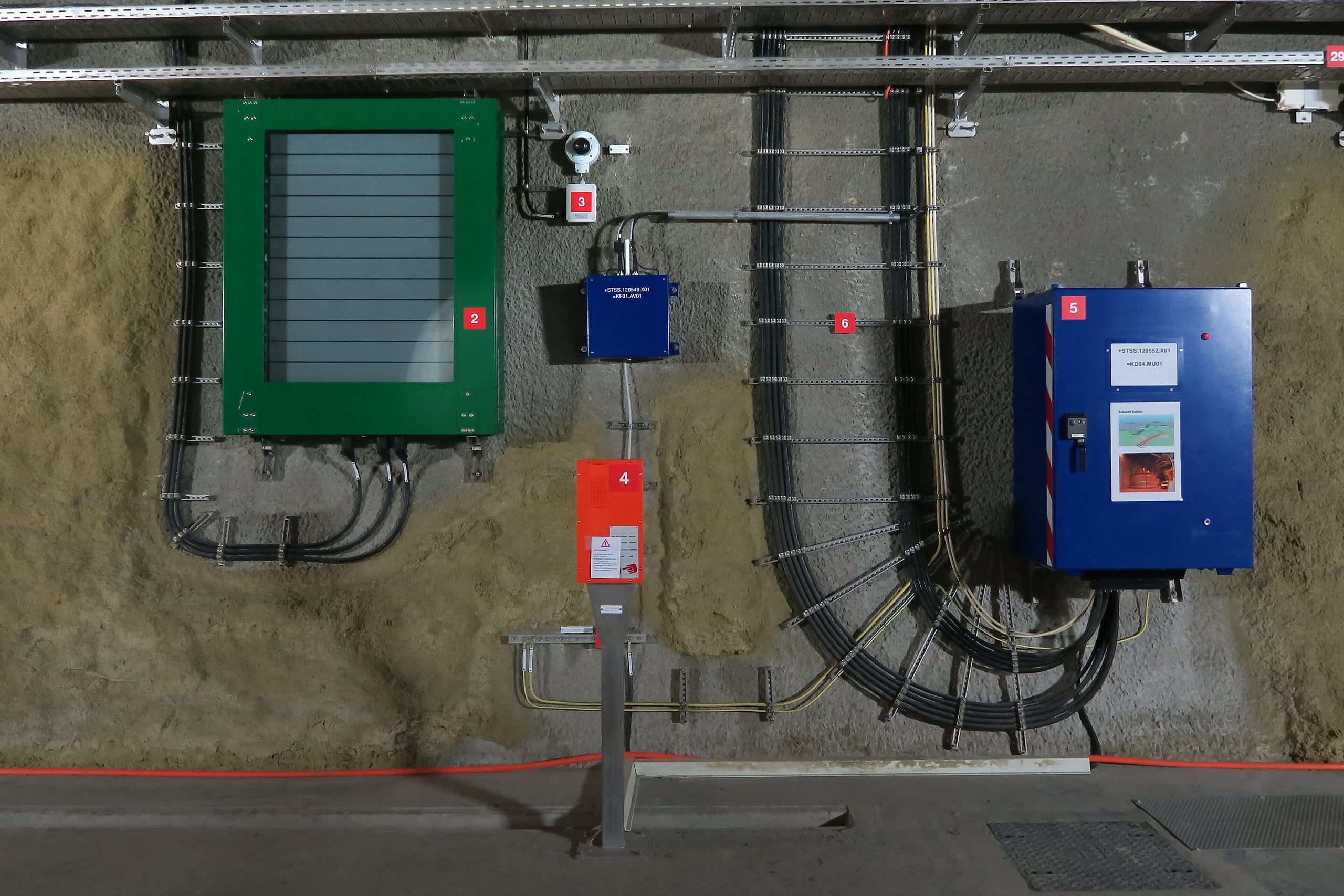


The Gotthard Base Tunnel runs 57 km under the Alps between Erstfeld in canton Uri and Bodio in canton Ticino, took 17 years to build and has carried trains since 2016, according to the Swiss Federal Department of the Environment, Transport, Energy and Communications. Its highest point sits 550 metres above sea level.
Crews began excavating the main tube in November 2002, and the tunnel was commissioned in 2016. UVEK describes the wider New Rail Link through the Alps, of which the tunnel is part, as the largest construction project in the history of the Swiss railways.
UVEK lists the length as 57.1 km and calls it the world’s longest railway tunnel. Construction cost CHF 12.2 billion in real terms, or CHF 9.4 billion at 1998 prices. The entire New Rail Link, with three base tunnels, expansion work in nine cantons and around 70 separate construction sites, cost about CHF 22.8 billion in real terms.
The workforce was not only Swiss, Federal Councillor Doris Leuthard said at the opening on 1 June 2016.
In remarks published by the Swiss Federal Council, she said: “The Gotthard is also European, if we consider who has participated in the construction of this mammoth feat of engineering: from Scandinavia to Sicily, and from Portugal to Poland, people from more than a dozen countries have helped to build it.”
A flat line through the Alps
The apex of the new Gotthard axis is 550 metres above sea level. The Lötschberg Base Tunnel, opened in 2007, peaks at 828 metres.
UVEK says the gradients and curve radii of the new line are comparable to those of railways in low-lying areas, so trains no longer need to be shunted and maximum speeds can rise. Passenger trains may run at up to 250 km/h in the tunnel and freight trains at 160 km/h, with timetable speeds of 200 km/h and 100 km/h.
UVEK says the Gotthard and Ceneri base tunnels together shorten the original route by 30 km. The 1882 Gotthard tunnel on the old mountain route will continue to be used for local access and tourist traffic.
UVEK lists the Zurich to Lugano journey at 1 hour 53 minutes against 2 hours 38 minutes before, a gain of about 45 minutes, among the time savings from the New Rail Link.
Room for 260 freight trains a day
UVEK puts the tunnel’s capacity at 260 freight trains and 65 passenger trains a day. Those figures are daily capacity. The 34.6 km Lötschberg tunnel is rated for 80 freight and 50 passenger trains a day, and the 15.4 km Ceneri tunnel for 170 freight and 180 passenger trains.
Switzerland built the link to move freight from road to rail and protect the Alps. Leuthard said at the opening that the full benefit of the flat link would come once the Ceneri tunnel was completed in 2020, and UVEK says Ceneri has been fully operational since the end of that year.
The Gotthard axis forms part of the European rail freight corridor between Rotterdam and Genoa.
Sources:
- Swiss Federal Department UVEK, The New Rail Link through the Alps NRLA: https://www.uvek.admin.ch/en/nrla
- Swiss Federal Council, Opening of the Gotthard base tunnel: https://www.admin.ch/en/nsb?id=61955