
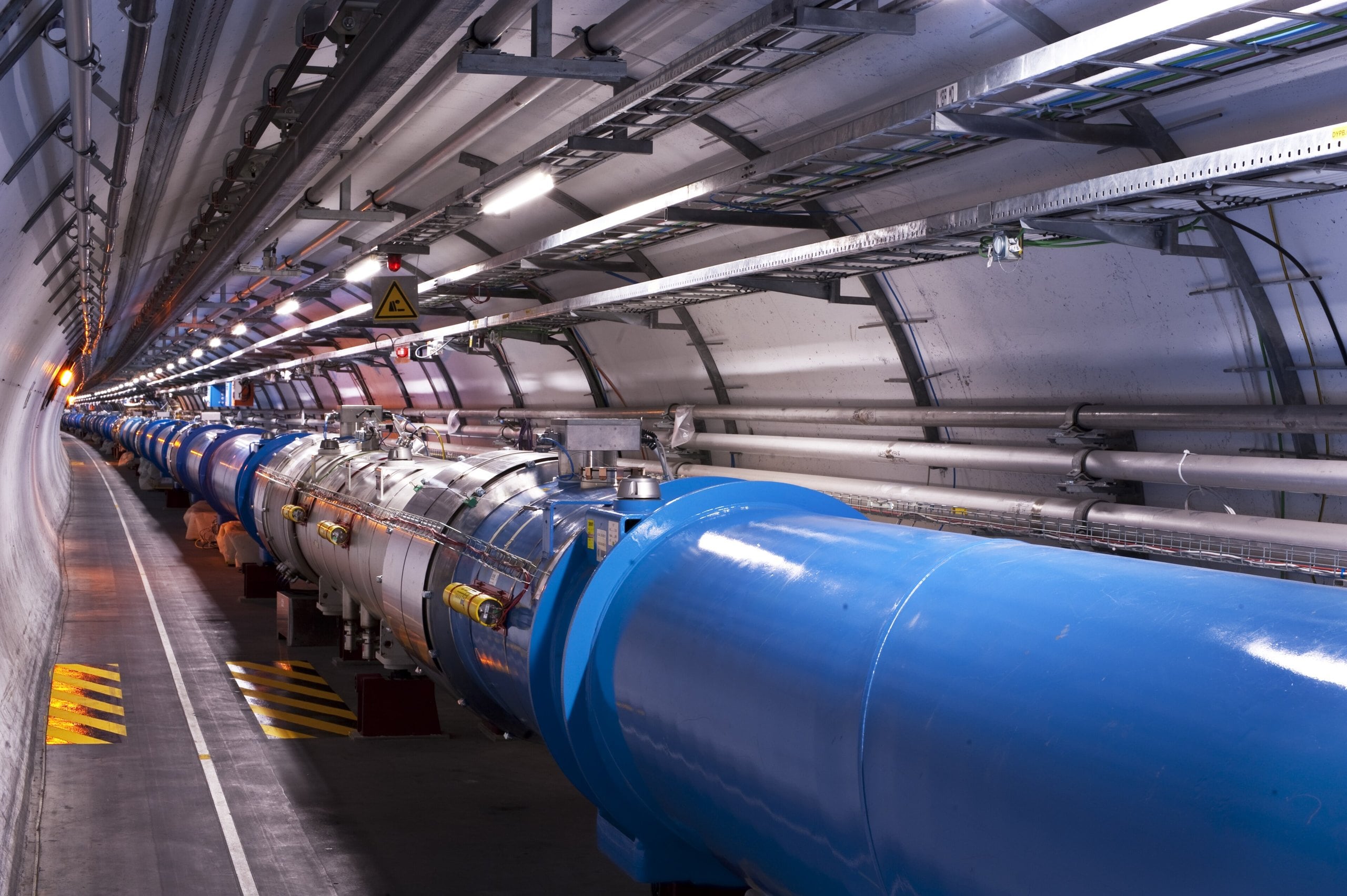


CERN teams cut the first magnet interconnection in the Large Hadron Collider in the week of 17 September 2026, a step in removing the focusing magnets beside the ATLAS and CMS experiments, CERN said. The LHC switched off on 29 June 2026 for Long Shutdown 3, during which 1.2 km of magnets and components will come out.
The collider has a circumference of 27 km and holds thousands of magnets of different types.
The LHC circulated its first beams in September 2008 and delivered its first proton collisions in 2009. On 4 July 2012 the ATLAS and CMS collaborations announced the discovery of the Higgs boson.
Among the magnets are the inner triplets, sets of three quadrupoles on either side of the four main experiments. They squeeze the beams as tightly as possible just before the beams cross inside the detectors, which raises the chance of particles colliding. CERN calls that collision rate luminosity, and the more collisions there are, the more data the experiments collect.
The magnets being replaced
CERN Director-General Mark Thomson visited LHC Point 1, home of the ATLAS experiment, on 17 September 2026 to mark the start of the operation. Teams had been dismantling the sections of the machine on either side of ATLAS and CMS since 7 September 2026 to remove 28 superconducting magnets, including the inner triplets.
Replacing these magnets with the new HiLumi LHC inner triplets is needed for the coming high-luminosity years, said Jean-Philippe Tock, Head of the LS3 Coordination Team.
The magnets coming out are niobium-titanium magnets. Their replacements use niobium-tin superconducting coils and produce magnetic fields of 11.3 tesla, about 40 per cent stronger than the current magnets. They will be installed around ATLAS and CMS only.
ALICE and LHCb keep their current inner triplets, with improvements, because they have different physics programmes and modes of operation and do not require the same increase in instantaneous luminosity.
The schedule to 2030
The first quadrupole of the new triplets should arrive in the tunnel at the start of 2029, Tock said. In total, 16 cryostats and 28 cryo-assemblies will be installed. The accelerator complex returns to operation in stages from 2028, and the HiLumi LHC is scheduled to restart in mid-2030, the last machine in the complex to do so.
The upgraded collider is designed to deliver up to 10 times the luminosity of the LHC’s original design.
ATLAS and CMS are being rebuilt to match. According to CERN’s shutdown announcement, the two experiments will need to handle between 140 and 200 proton-proton collisions in every bunch crossing, against around 60 in the last run, and select the most useful events from more than five billion interactions every second. Both experiments will replace their trigger systems.
Across the whole shutdown, thousands of specialists from CERN and partner institutes will work on the LHC, its injectors and the experiments, CERN said. Dozens of projects are planned across the whole accelerator complex, Tock said.
Markus Zerlauth, the HiLumi LHC Project Leader, said the inner triplets being removed were installed in the machine between 2005 and 2007.
Sources:
- CERN, The disconnection of the LHC has begun: https://home.cern/the-disconnection-of-the-lhc-has-begun/
- CERN, CERN bids farewell to the LHC and enters Long Shutdown 3: https://home.cern/cern-bids-farewell-to-the-lhc-and-enters-long-shutdown-3/
- CERN, All CERN accelerators now on the road to HiLumi: https://home.cern/all-cern-accelerators-now-on-the-road-to-hilumi/