


The two main cables of the Golden Gate Bridge hold 80,000 miles (129,000 km) of galvanized steel wire, according to the Golden Gate Bridge, Highway and Transportation District. Each cable carries 27,572 wires grouped in 61 strands, and a loom-type shuttle spun the wire in six months and nine days.
Each wire is 0.192 inch in diameter. Bundled and wrapped, one cable measures 36 3/8 inches (0.92 m) across.
How the shuttle laid the wire
The wire was laid by spinning. A loom-type shuttle moved back and forth, laying the wire in place as it went, until the 61 strands had formed each cable. The cables then pass over the tops of the two towers and are secured at either end in anchorages, each weighing 60,000 tons.
On top of each tower the cable rests in a steel casting called a saddle.
The 61 strands in each cable hold an average of 452 wires apiece. Each finished cable runs 7,650 feet (2,332 m). Both main cables, with the suspender cables and accessories, weigh 24,500 tons (22,200,000 kg), and each tower, which stands 746 feet above the water, carries a load of 61,500 tons from the cables.
The wire is carbon steel. Tests of the wire gave a tensile strength of 235,600 psi against a specified minimum of 220,000 psi, and a yield strength of 182,600 psi against a minimum of 160,000 psi.
A 10 inch length stretched 6.3 per cent before breaking, where the specification asked for at least 4 per cent.
Hanging the deck
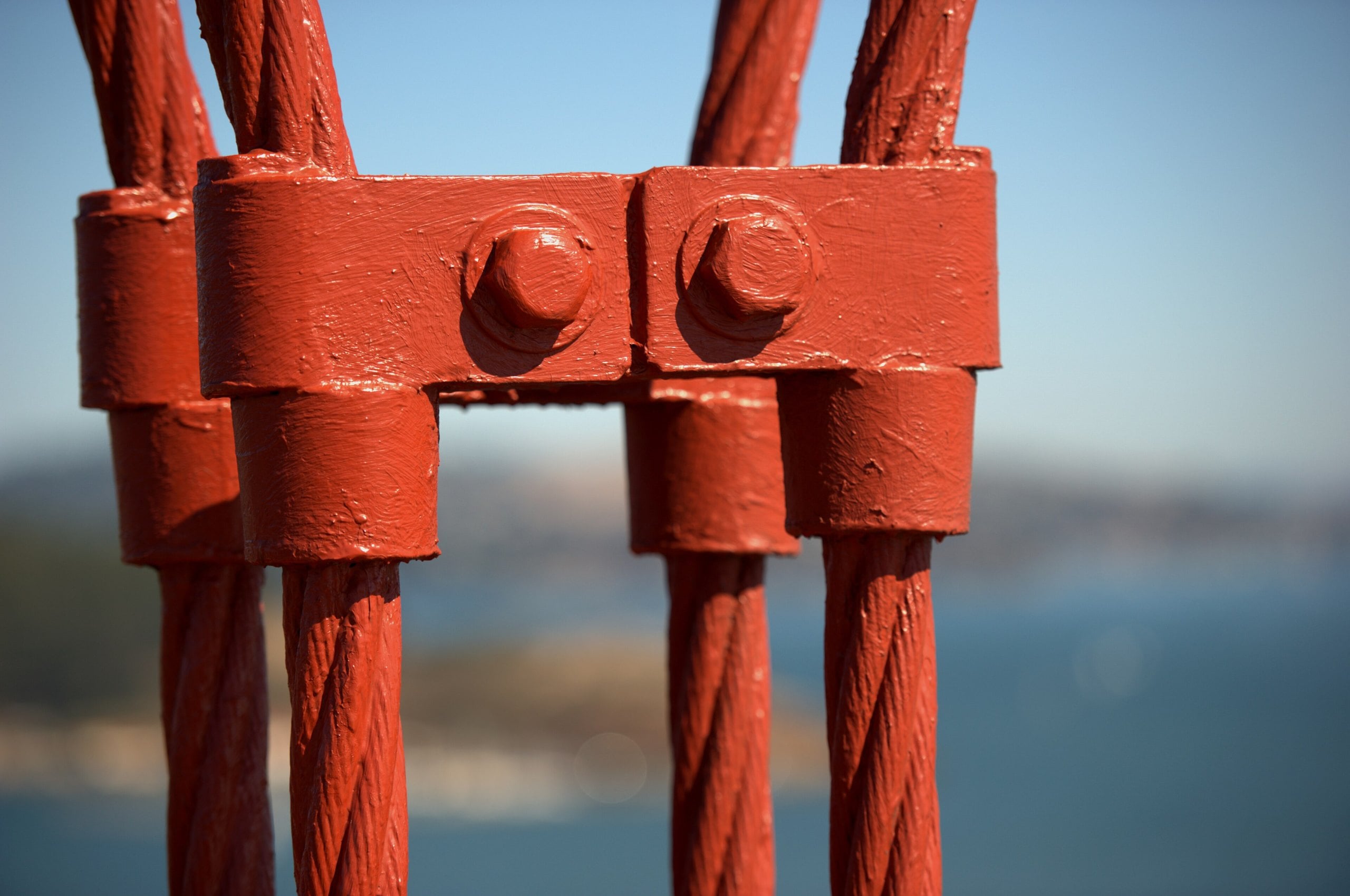
Cable bands clamp the main cables every 50 feet, and the vertical suspender ropes hang from those bands. The bridge has 250 pairs of suspender ropes, each 2 11/16 inches in diameter. All of them were replaced between 1972 and 1976, with the last rope fitted on 4 May 1976.
The bolts that hold the cable bands need checking from time to time.
After a lower lateral bracing system was added in 1953 and 1954, the district says, the bolts had lost as much as 50 per cent of their specified tension. J. H. Pomeroy & Co. retightened them in 1954, the first use of calibrated impact wrenches on cable band bolts.
During the suspender rope replacement in the 1970s the bolts were tensioned again, to 90,000 pounds, using a Biach hydraulic bolt tensioner.
Changes in temperature and load alter the cable diameter by minute amounts, and the bolts lose tension as a result. Steinman Boynton Gronquist & Birdsall of New York tested a random sample of bolts in 1999 and found that a full retightening was not required at that time.
District crews retensioned the 256 bolts on the main cable tie-downs to 92,000 pounds in 2000 and 2001, the first time since the bridge was completed in 1937.
The main span between the towers is 4,200 feet (1,280 m), and the deck was built to move. At midspan it can deflect as much as 10.8 feet downward and 5.8 feet upward, and a sustained transverse wind can push it as much as 27.7 feet sideways.
During the winter storms of 1982 the main span bowed about six to seven feet.
Sources:
- Golden Gate Bridge, Highway and Transportation District: https://www.goldengate.org/bridge/history-research/statistics-data/design-construction-stats/