
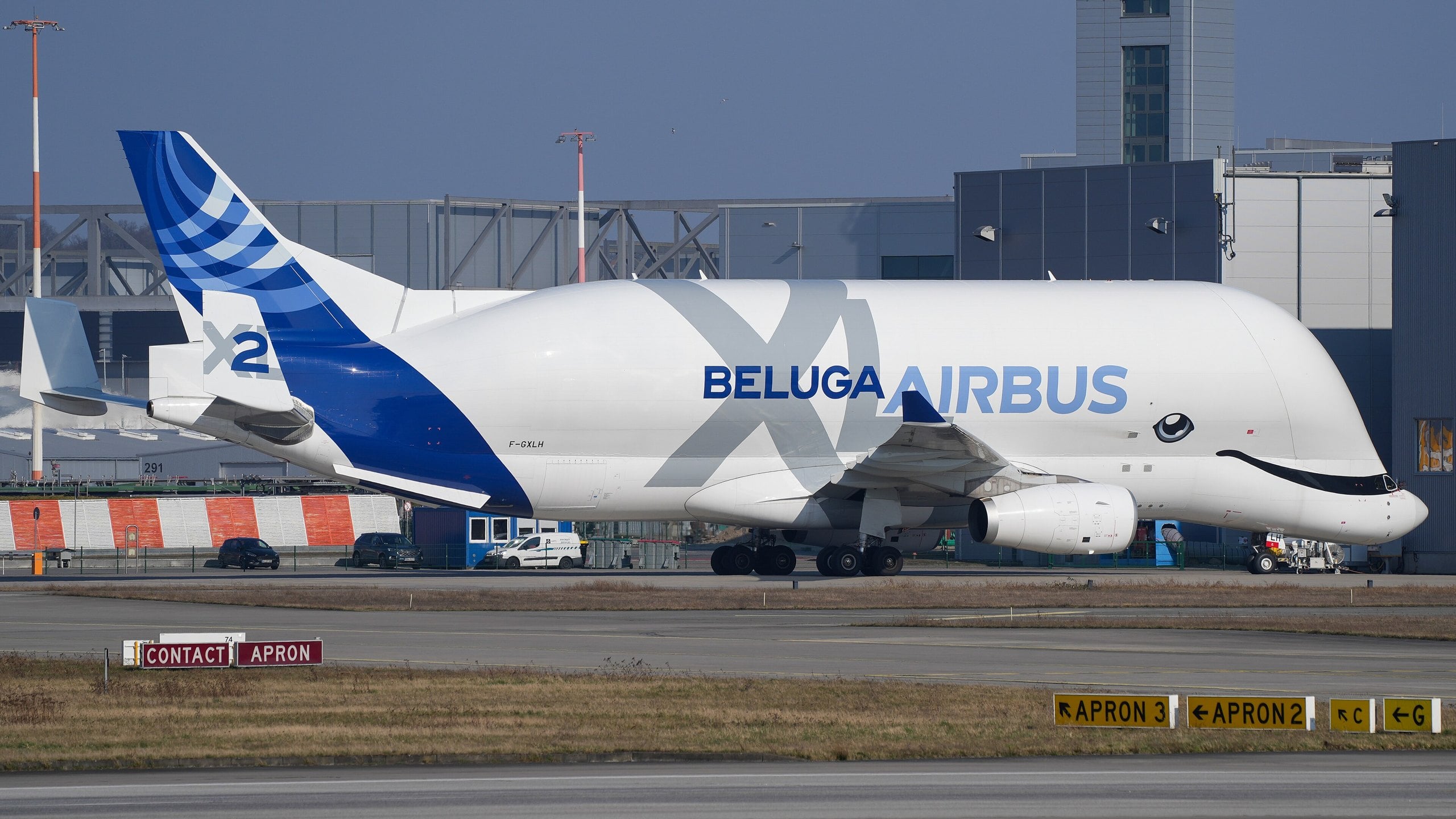


The first of Airbus’s older BelugaST transporters to be repositioned, BelugaST 5, arrived at the company’s Broughton site in January 2026 to become a STEM facility, and the six BelugaXL aircraft taking over its routes carry 30 per cent more than the jets they replace, Airbus says.
The handover runs into 2027. From 2027 the BelugaXL takes over as the primary transporter for Airbus’s internal logistics.
The BelugaXL is derived from the A330-200. It is 63.1 m long, which Airbus describes as the length of two blue whales, and carries a payload of 51 tonnes. The cargo bay can hold two 30-metre A350 wings at once, or the largest A350 fuselage section.
The BelugaST, based on the A300-600, carries 47 tonnes and up to 30 metres of cargo length. The XL handles cargo up to 63 metres long.
The Beluga loads through the front. The nose lifts to a near vertical position, opening the hold to parts that would not fit through the side doors of other cargo planes. Airbus lists wings, fuselage sections and tailplanes among the loads.
From Super Guppy to whale
In the 1970s Airbus needed an aircraft to link production sites in France, Germany, Great Britain and Spain. It used the Boeing Super Guppy, an airlifter designed for NASA and built under licence in France.
By the mid 1990s the Super Guppy could not keep pace, and Airbus commissioned the A300-600 Super Transporter, nicknamed the BelugaST after the white whale it resembles.
Airbus says the BelugaST connected its European sites for 30 years.
The BelugaXL programme was launched in 2014 to support rising production rates, and the aircraft made its maiden flight in 2018. Its “smiley” livery was chosen by Airbus employees in a vote with almost 21,000 participants. The XL has a lowered cockpit, an enlarged cargo bay structure, a modified rear and tail section, and cargo loading systems.
The airlifters are assembled in Toulouse, France.
Airbus Transport International, the company’s internal airline since 1996, operates the fleet. The aircraft fly between 11 destinations in Europe, among them Toulouse, Hamburg, Bremen, St Nazaire and Broughton, with a range of 1,650 to 4,000 km.
What happens to the old fleet
Between 2022 and 2024 the BelugaST fleet also flew for outside freighter customers under a newly created operator, Airbus Beluga Transport, carrying outsize cargo around the world. Airbus says the retiring jets will move into education, technical training and heritage preservation.
BelugaST 5 at Broughton is the first to take up one of those roles.
Airbus says the STEM facility will give students a direct view of the scale of an aircraft and teach flight physics, design and engineering across the UK national curriculum. The company has not given an opening date for the facility on its Beluga page.
The XL fleet, meanwhile, has already replaced the ST on internal transport runs between the manufacturing sites, and from 2027 it takes over as the primary transporter as Airbus moves to using the XL fleet alone.
Broughton builds wings for the A320, A330 and A350.
Sources: