
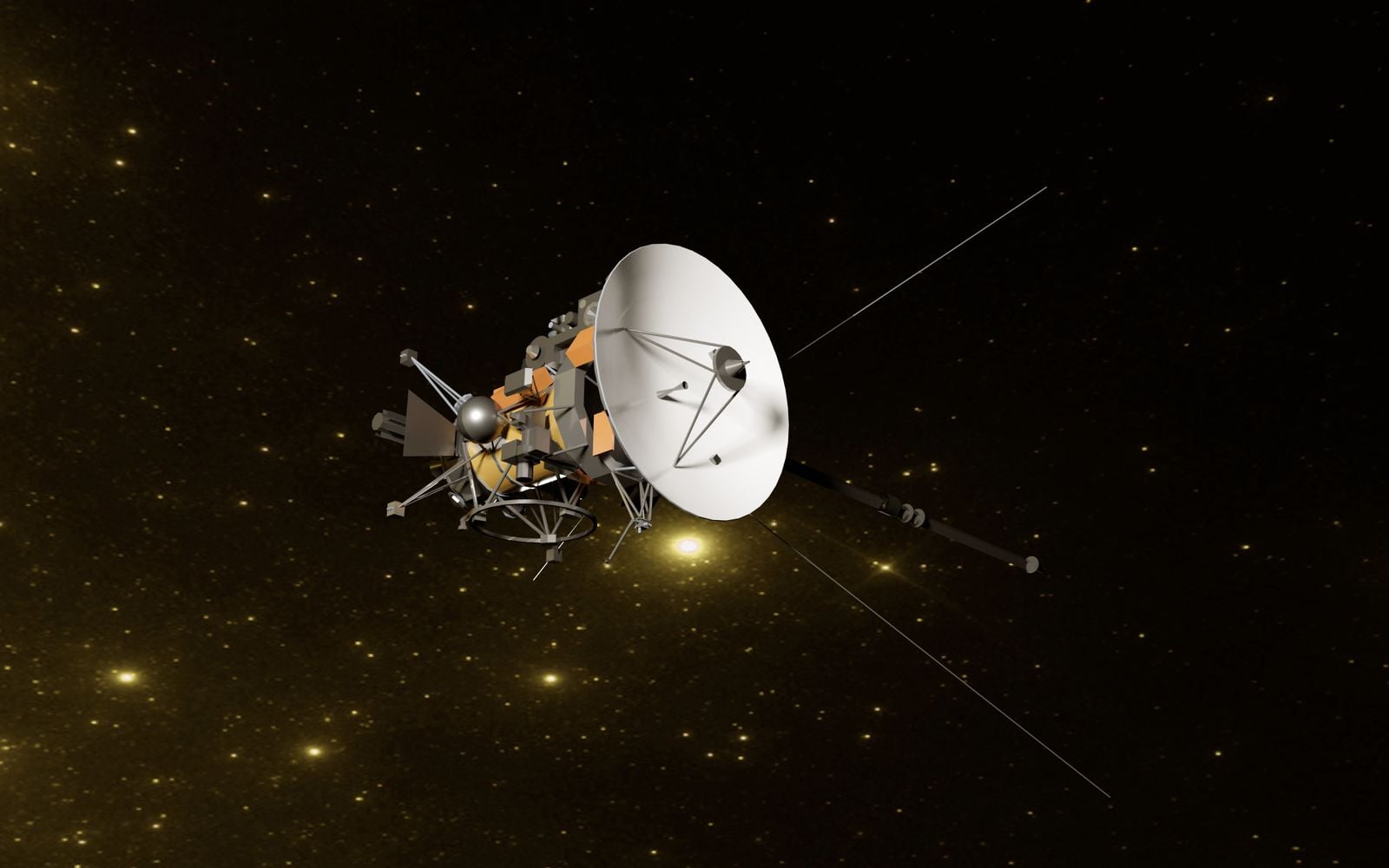

On 25 August 2012, at 121.7 times the Earth–Sun distance, the particle counters aboard a spacecraft the size of a subcompact car went abruptly quiet. The charged particles streaming out from the Sun, which Voyager 1 had been swimming in for 35 years, fell away and stayed away, and galactic cosmic rays from beyond the Sun’s reach jumped in the same instant. It looked like a crossing. Proving it took another year. Not until April 2013, when a burst of solar activity set the surrounding plasma ringing, did Voyager 1’s plasma wave instrument return the number that settled the argument, and NASA announced in September 2013 that Voyager 1 had entered interstellar space.
It is still out there. Still transmitting. Still, by any reasonable engineering standard, impossible.
What crossing the heliopause actually meant
The heliopause is not a wall. It is the region where the solar wind — charged particles streaming outward from the Sun — slows and stalls against the pressure of the interstellar medium. Inside the heliopause, the Sun’s magnetic field dominates. Outside, the galaxy’s does. Voyager 1’s Plasma Wave Subsystem detected oscillations in the surrounding plasma that let the team calculate its density. The density outside worked out at about 0.08 electrons per cubic centimetre, roughly 40 times the density inside the heliosphere and close to what models had predicted for the interstellar medium.
The paper describing this, led by Don Gurnett of the University of Iowa, was published in Science in September 2013. It remains the primary reference for the crossing.
The crossing itself was not a single moment. In May 2012, galactic cosmic ray counts made their first significant jump while particles from inside the heliosphere first dipped. On 28 July the change accelerated hard, then reversed within days. It happened again in mid-August, and reversed again. Only on 25 August did both trends lock in place and stay there. The plasma density measurement, when it finally arrived, settled what the particle data alone could not, and NASA now dates the crossing to 25 August 2012.
Twenty-two watts, and why that is the astonishing number
Voyager 1’s radio transmitter radiates about 22 watts — a figure NASA has compared to a ham radio or a refrigerator light bulb. A standard fridge bulb is 25 to 40 watts. A modern LED bulb producing the light of an old 60-watt incandescent draws about 9. The spacecraft’s entire radio output, aimed at Earth from more than 25 billion kilometres away, is comparable to the bulb that comes on when someone opens the fridge for milk.
By the time that signal arrives it has thinned almost to nothing. A NASA technical account of deep-space antenna design put the power density reaching Earth at less than 10⁻¹⁹ watts per square metre when the Voyagers were at Saturn, around 1.5 billion kilometres out. Voyager 1 is now roughly seventeen times further away, and signal strength falls with the square of distance. What is left is heard by the 70-metre dishes of the Deep Space Network at Goldstone in California, Madrid, and Canberra, which can lock onto carriers that are, by any everyday measure, indistinguishable from noise.
What makes this possible is not any single trick but a stack of them: a highly directional high-gain antenna on the spacecraft, deep-space-quality dishes on the ground, cryogenically cooled receivers, and the coding schemes NASA has refined since the 1960s to pull faint signals out of thermal background.
The same physics has been described in more familiar terrestrial terms in Make Tech Easier’s earlier look at how the Deep Space Network still hears Voyager whisper.
The plutonium clock inside the spacecraft
Voyager 1 does not run on solar panels. At its current distance, sunlight is far too weak. It runs on three radioisotope thermoelectric generators, each converting the heat of decaying plutonium-238 into electricity. Plutonium-238 has a half-life of 87.7 years, which sounds generous, but the thermocouples that turn heat into current also degrade. When Voyager 1 launched on 5 September 1977, its RTGs produced about 470 watts. They now produce less than half that, and the total falls by about four watts every year.
This is why the mission’s long, quiet drama has been about shutting things off. Heaters went first — Voyager 1’s cosmic ray instrument lost its heater in May 2022 and kept working in the cold anyway. Then the instruments themselves. Engineers switched off Voyager 1’s cosmic ray subsystem on 25 February 2025, and its low-energy charged particles experiment on 17 April 2026. NASA’s own projection is that the power conservation plan buys enough electricity to keep at least one science instrument running into the 2030s.
The 22-hour conversation
Voyager 1’s signal, moving at the speed of light, now takes more than 23 hours to reach Earth. On 18 November 2026 the spacecraft will be one full light-day out — 25.902 billion kilometres, the distance light covers in a day — the first human-made object to reach that mark. A round-trip command-and-acknowledgement is nearly two days. When engineers uplink a command, they are talking to where the spacecraft will be, and reading a reply from where it was.
This became painfully visible in November 2023, when Voyager 1 began sending back unreadable telemetry — repeating patterns of ones and zeros instead of usable data. The problem was traced to a single chip in the flight data subsystem that had failed, corrupting a section of memory holding some of that computer’s software code. Fixing it meant relocating the affected code to other parts of memory, splitting it up because no single free block was large enough, and updating every reference that pointed at it. Each test cycle took 45 hours of light travel plus processing. By April 2024, engineering data was flowing again. By June, science data followed.
The engineers who wrote the original software in the 1970s are, in many cases, retired or dead. The team maintaining Voyager today is working with paper documentation, assembly-language code, and institutional memory passed down across generations of the flight team at JPL.
What the record shows, and what it doesn’t
Voyager 1 is the most distant human-made object, and the first to enter interstellar space, but a few things about the mission are commonly overstated.
It has not left the Solar System in the gravitational sense. The Sun’s gravitational influence extends out through the Oort Cloud, an estimated one to two light-years away. Voyager 1 will not clear that region for tens of thousands of years. Crossing the heliopause is a boundary in plasma and magnetic field, not in gravity.
The Golden Record bolted to the side — the gold-plated copper phonograph disc carrying greetings in 55 languages, whale song, and a selection of music curated by a team led by Carl Sagan — is often described as a message to aliens. Sagan himself was more careful. In the team’s own account, the record was as much a message from humanity to itself as a serious expectation of extraterrestrial contact. The odds of any intelligence intercepting a small, cold object drifting through interstellar space are, by any honest calculation, extremely poor.
And Voyager 1 is not headed toward a specific star. Its trajectory will bring it within about 1.6 light-years of a star called Gliese 445 in roughly 40,000 years. That is a passing distance in the same rough range as the distances between neighbouring stars generally, not an encounter.
What the mission still measures
Two instruments are still returning data: the magnetometer and the plasma wave subsystem. Between them they give physicists something no other mission has provided — direct, in-place measurement of the interstellar magnetic field and of the plasma Voyager 1 is moving through, at the boundary where the Sun’s field mixes with the galaxy’s.
Results have already reshaped textbook assumptions. The interstellar magnetic field near Voyager 1 turned out to be aligned with the Sun’s in a way models had not clearly predicted. Density fluctuations recorded by the plasma wave instrument have let researchers map turbulence in a medium no probe had ever sampled directly.
Voyager 2, which crossed the heliopause in November 2018 at a different location and with a working plasma science instrument, returned complementary measurements for years afterward. The two spacecraft give physicists a two-point sample of a boundary they had previously only inferred from a distance.
The end of the mission is a matter of power, not distance. When the RTGs can no longer support the transmitter and a minimum set of instruments, Voyager 1 will fall silent. It will keep moving, at about 17 kilometres per second relative to the Sun, indefinitely.
The Deep Space Network will keep listening for a while after that, on the chance of a carrier signal. Eventually the listening will stop too.
What remains after that is a small, cold spacecraft carrying a gold-plated record, drifting through the galactic disc on the momentum imparted by a Titan IIIE rocket in September 1977.