
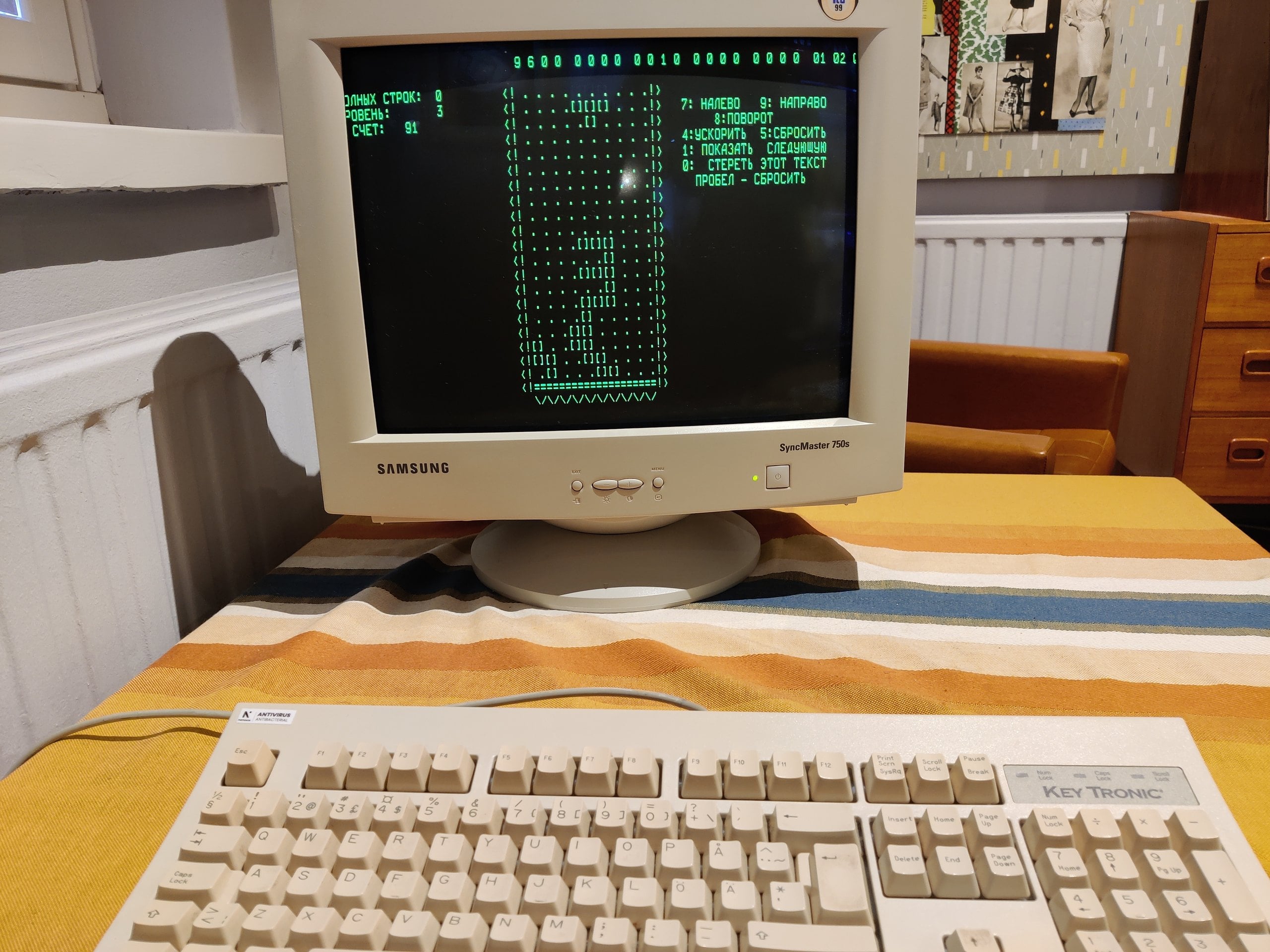


The Electronika 60, on which Alexey Pajitnov first wrote Tetris, “didn’t have proper graphics, just a monitor that could display text”, he told The Guardian in a first-person account published on 2 June 2014, so he used letters to form the playing pieces. The Tetris Company’s corporate bios say he created it in June 1984, in his spare time.
The bios say he worked for the Moscow Academy of Sciences as a computer programmer in the 1980s. Pajitnov himself described his workplace as “the computing lab for the Academy of Science of the USSR, researching artificial intelligence”.
The lab was one of the few Soviet institutes able to communicate with the rest of the world, he said, so people occasionally sent it new hardware. Staff judged how capable each machine was by writing a simple program for it. Pajitnov said that routine became his excuse for making games.
Pieces made of letters
The starting point was pentominoes, a puzzle he had loved since childhood. Three of the geometric games sold for a rouble in Moscow toyshops, and in June 1984 it occurred to him that they might be a good basis for a computer game.
The 12 pentomino pieces rotating in real time “seemed too complicated”, so he scaled down to tetrominoes, of which there are seven.
Tetris.com’s About page says the name combines “tetra”, the Greek word meaning four, and “tennis”, his favourite sport.
Each of the seven pieces is made up of four squares. Pajitnov wrote the procedures for manipulating them, which he summarised as “pick a tile, flip it, rotate it”, and then found that the playfield “filled up in 20 seconds flat”. A completed line was “kind of dead”, he said, so he made each full line disappear, “which was key”.
It took him about three weeks to get “something controllable on screen”.
He pretended to be debugging the program but could not stop playing it, and other people who tried it could not stop either. Pajitnov said the game’s abstractness was its great quality, and that it appealed to everybody.
From seven pieces to Game Boy
Pajitnov said he had no idea how to publish the game and suspected that trying would get him into trouble. A PC version was smuggled to Hungary and western companies started producing unauthorised copies.
With perestroika under way, he granted his rights to the government for 10 years, and Tetris became one of the first pieces of software exported by the Soviet Union.
Spectrum HoloByte, the US company behind one of the earlier versions, had a large influence on how the game was marketed.
The company chose Korobeiniki, a 19th-century Russian folk song, as the music, and Nintendo later added Tchaikovsky’s Nutcracker theme. Pajitnov said he found the matryoshka dolls and churches used in the marketing “a bit tacky”, but added that they helped sales.
A friendship with Henk Rogers, then head of a Japanese software company, helped bring Tetris out of the Soviet Union in 1989, according to The Tetris Company. The licensing agreement with Nintendo that followed put millions of copies of the game on Game Boy and Nintendo consoles. Rogers went on to become President of The Tetris Company.
Pajitnov said he did not make much money at first, but that his main priority was seeing people enjoy the game. He also said Tetris had a role in breaking down ordinary people’s inhibitions in front of computers, which non-professionals used to pen and paper found intimidating.
Shortly before leaving Moscow he founded AnimaTek, a 3D software company, with his friend Dr Vladimir Pokhilko.
Pajitnov relocated to the US in 1991 with Rogers’s help. In 1996 the two formed the business relationship that became part of The Tetris Company, which remains the exclusive source of all Tetris licences.
Sources:
- The Tetris Company, Corporate Bios: https://play.tetris.com/corporate-bios
- Tetris.com, About Tetris: https://tetris.com/about
- The Guardian, How we made Tetris (2 June 2014): https://www.theguardian.com/culture/2014/jun/02/how-we-made-tetris