

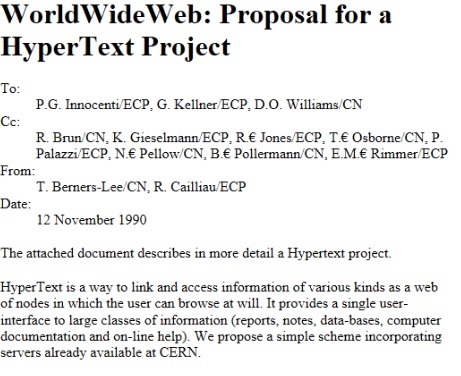
On March 12, 1989, a Brit named Tim Berners-Lee proposed “a large hypertext database with typed links.” He had a few names for this new concept such as “Information Mesh” and “Mine of Information” before finally settling on the “World Wide Web.” Below is a screenshot of that original proposal that you can read online.
As it often happens with great inventions, Tim’s proposal at that time did not impress too many people. In fact, he was thinking of abandoning the project before Mike Sendall, his supervisor at CERN, came to its rescue. Mike encouraged him to work for the global hypertext using an available NeXT machine at CERN in Switzerland. These pioneering efforts eventually led to the world’s first website in 1991.
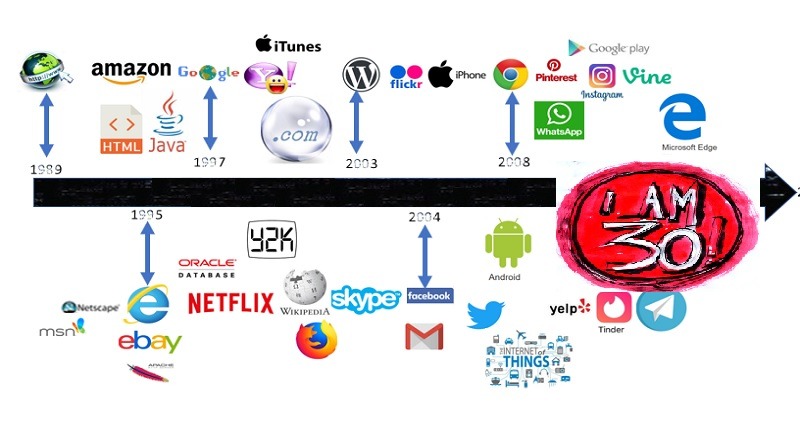
Fast forward to the present era – it is time to pay our tribute to the World Wide Web as it turns a youngish 30.
The Idea Behind the Old Web
As many of us would recall, in the 1990s and even early 00s the World Wide Web was quite serious about openness. Back then it was a given that the Web should allow users to collaborate across geographical and cultural boundaries. Allowing anyone to contribute content to the Web, and making it equally accessible, was the order of the day. The Internet still belongs to one and all according to the rights of “digital equality,” a principle that has been reaffirmed in 2019 by the World Wide Web foundation. It’s not the property of any single government or private body but is the world’s first decentralized asset after oxygen in the atmosphere.

However, in our present era, many countries have started imposing restrictions on Web access. While China’s great firewall gets a bad rap, the situation isn’t any better for most other places. In almost half the countries worldwide, you can’t really enjoy the Internet without VPN. Leading online newspapers now impose paywalls on visitors accessing their content, arguably for survival. However, online piracy is on the rise at the same time, and a few countries even have “Pirate” political organizations in their parliaments.

With the onset of GDPR in the European Union, webmasters in many countries immediately started blocking EU visitors from accessing their websites. The era of data silos and walled gardens is in full swing. Currently, the free and open Web faces serious challenges from companies and governments worldwide. Some countries are even considering the idea of an “Internet Kill Switch” with ISPs falling in line. Clearly, the institutions that held the Web together for this long are unable to arrest the decline in online freedoms.
What’s the Solution to Restricted Web?
To mark a way forward in online freedom, it is worth checking out this article Tim Berners-Lee wrote for the Guardian. There are quite a few good ideas that we should not be ignoring, as they come from the man himself.
- For one, he talks about accountable algorithms. Internet companies often make the excuse that their “algorithms did wrong” when their website violates privacy. With accountable algorithms, there has to be more fairness, audits and social impact measurement.
- He also talks about political ads disclosing their sources of funding. This can prevent one viewpoint from gaining advantage over many others.
- Net neutrality is more than just a political statement. The essential principle is that all websites should be treated the same by ISPs. At a policy level, the UK and many other countries have net neutrality proposals but they are still on paper, while the US had one and then eliminated it. Netherlands has a true net neutrality law which puts restrictions on bandwidth throttling by ISPs and makes it illegal to charge users differently based on the services they access. This is a good model for other countries to follow.
If we value Internet freedom, we must champion ideas like these in letter and spirit.
Conclusion
As we mark an important anniversary of a historical event, it is time to reflect on how the Web has changed our lives. We have to preserve the values of Internet freedom for future generations. The very fact that you are reading this page was born out of a farsighted vision of openness. There are many challenges in our aim to return to the era of the older Web. But, as long as the will remains, anything is possible in future.
What do you think could be a real solution to returning to the Web’s original roots? Please let us know in the comments.