


Windows 11 made quite a splash when it was released last year, but the stats say that it may not have been that big of a splash – more like just a toe dip in the water than a big belly flop. The stats say that while Windows 11 has been publicly available for the past year, only 2.61% of Windows machines are running it. There are even more machines still running Windows 7.
Also read: The Ultimate Guide to Check Windows 11 Compatibility with Your PC
Windows 11’s First Year
There was certainly a lot of fanfare surrounding the release of Windows 11. Even before the public release, Microsoft announced the end-of-life for Windows 10 would be in October 2025. The problem is that many Microsoft devices aren’t able to run Windows 11, and that kind of kills the chances for everyone to run out and download it and possibly disrupt their current tech flow. Data from IT asset management software provider Lansweeeper shows that 43% of Microsoft devices are still not capable of upgrading to Windows 11.
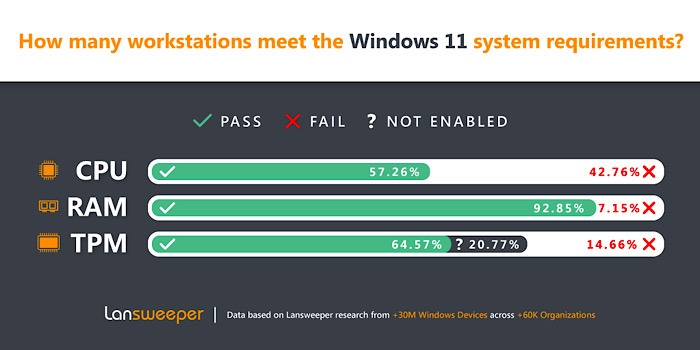
The Lansweeper data was culled from an estimated 27 million Windows devices one year after the initial public launch of Windows 11. Only 7.15% don’t have enough RAM, but 14.66% don’t meet the TPM requirement, and 42.75% don’t have the CPU requirements. That still leads to low numbers for Windows 11. That stat implies that 57% are capable of running Windows 11, yet only 2.61% or approximately 4% of those capable are currently running it.
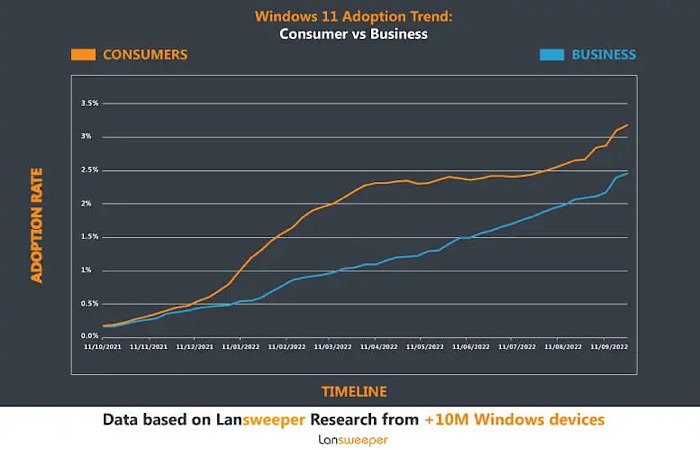
It seems there is a failure of Windows users getting excited enough to upgrade the OS or even their device so that they can upgrade the OS. In January of this year, the adoption rate sat at 0.52%; six months later, it was still only 1.44%. Consumers were more excited than businesses, though, as the stats show that more than 3% of consumers have adopted Windows 11.
What is really surprising among the stats is that the users not upgrading to Windows 11 aren’t all on Windows 10 machines. While Windows 11 is being used on more machines than Windows 8, Windows 7 still outranks it by nearly a whole percentage point, 3.38% to 2.61%.
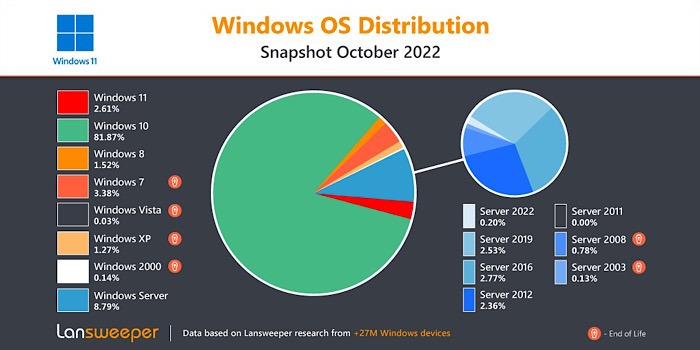
More people are using an OS that reached end-of-life in January 2020. Windows 8 is due to reach end-of-life in January 2023, while Windows 10 is scheduled for October 2025. A total of 4.82% of devices are still running OS that have reached end-of-life.
Does This Spell Trouble for Windows 11?
What does all this mean for the future of Windows 11? Is it doomed to Windows 8 status of being passed over while many wait for a better OS? Roel Decneut, chief strategy officer at Lansweeper, believes that at the pace Windows 11 is being adopted, it will take around four years for devices to meet its minimum requirements. However, Windows 10 will reach end-of-life in just three years.
“We know that those who can’t update to Windows 11- which is most business devices right now – will continue to use Windows 10. But even if organizations were prepared to upgrade their PCs to meet the requirements of Windows 11, there are broader issues affecting adoption that are out of Microsoft’s control,” said Decneut. “Global supply chain disruption has created chip and processor shortages, while many are choosing to stick with what hardware they have at the moment due to global financial uncertainty.”
Decneut realizes businesses just can’t justify the Windows 11 upgrade right now but believes companies should get started doing “a device audit to create an inventory of assets and the software deployed on them to get a clear picture of which parts of the IT estate are in critical need of replacement.”
What does it mean for you as a consumer? There has to be power in numbers. If you’re still using Windows 10, you aren’t alone and are actually in the majority. You have at least three years before your system reaches end-of-life. If you’re still using Windows 7, you’re obviously not bothered by its end-of-life status.
But do realize that end-of-life means you’re not getting security updates, and that’s where you could really fall into trouble. Follow this guide to try Windows 11 without leaving Windows 10.
Image credit: Unsplash