
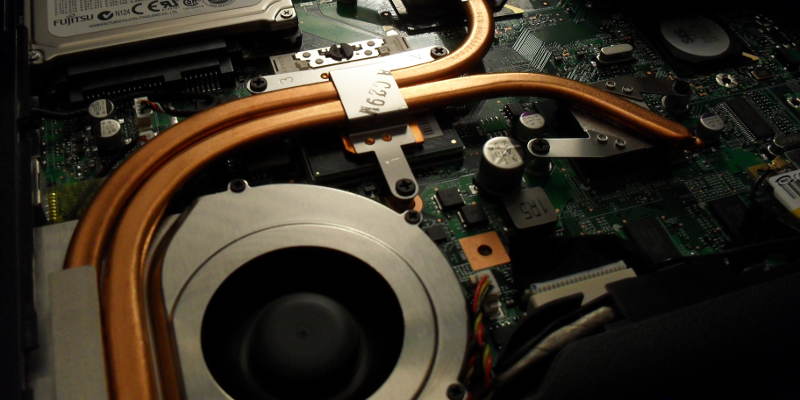

Anyone who has been hunting for high-end laptops or CPU/GPU coolers since 2015 may have noticed that a lot of new products out on the market are throwing around the term “vapor chamber” as a selling point. This word describes a method of cooling that takes heat pipes a step further and either incorporates them or replaces them entirely to multiply cooling power. To fully grasp how and why this is a thing, we need to first understand how vapor chambers work and what advantages they bring to the table.
Computer Cooling Explained
The reason why the CPU on the device you’re reading this from isn’t currently experiencing a Chernobyl-style meltdown is because of the magic of thermal transfer. The transistors on your CPU generate a boatload of heat, and that heat has to go somewhere. If it all stays in one place, it accumulates and makes the chip experience a catastrophic failure. CPU coolers make use of thermal conductivity to dissipate the heat away from the chip as quickly as possible. This is usually done by a series of metal structures with liquid in them working in conjunction with a fan that blows the heat they gather away.
Vapor Chambers vs. Heat Pipes
There are two common ways to dissipate heat from a CPU. You can use the more conventional heat pipe model or opt for the fancier vapor chamber model.
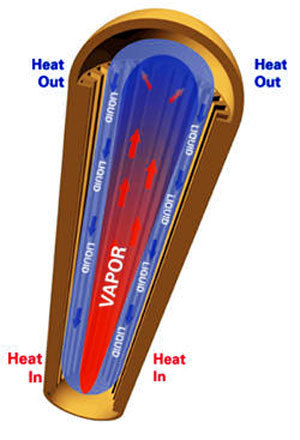
Heat pipes work by having a fluid inside which evaporates into a gas when it gathers enough heat. The rising gas moves the heat far from the CPU and then condenses back into a liquid where it is funneled back to the bottom using capillarity. It’s a simple but efficient concept. Below is an image giving you a visual demonstration of what I’ve just described.
Vapor chambers rely on pretty much the same concept, but they have a different approach to design. Rather than using separate pipes, a vapor chamber uses its entire body to cool the CPU. Its flat structure allows heat to be transferred evenly through a very small amount of space. This is advantageous in situations where you have a massive gas-guzzler of a CPU crammed into a tiny structure such as a laptop. Vapor chambers are much more efficient, dissipating up to 2000 Watts of heat in an area of around four square centimeters.
You can think of a vapor chamber as a “flat” heat pipe:
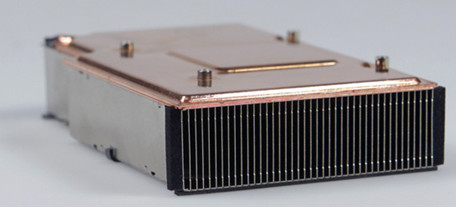
After seeing one for yourself, you can probably tell why high-end laptop manufacturers love this model as opposed to the heat pipe model depicted below:
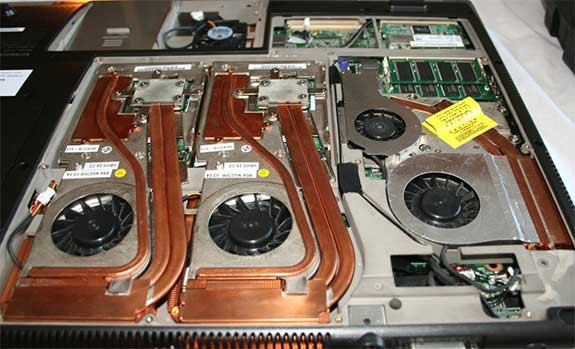
See all that wasted space just for the pipes? Laptops give hardware designers headaches because of their limited space. Anything that could save up real estate while raising thermal transfer efficiency makes their jobs easier.
Inside a vapor chamber is a series of small posts that keep the structure from collapsing under exterior atmospheric pressure. (The whole thing is in a hermetically-sealed vacuum). The posts also serve the purpose of helping the liquid flow to where it is needed.
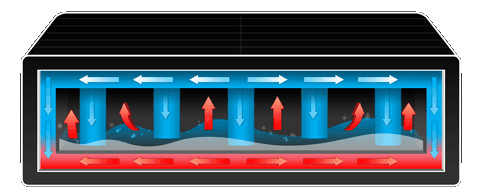
3D Vapor Chambers
The majority of desktop PC vapor chambers have heat pipes welded on top of them to assist in heat transfer, but the 3D vapor chamber technology pioneered by Cooler Master takes this a step further. In a “3D” setup the heat pipes are actually welded into the chamber, streamlining the entire cooling process. Rather than “waiting” for the heat pipes to grab heat from the chamber, the pipes instead pick up the vapor itself and send it further up, significantly increasing cooling capacity.
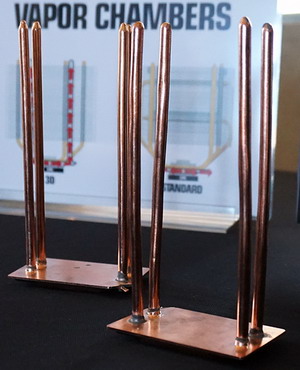
Notice how the pipes are integrated into the body of the chamber rather than sitting on top of it.
Are There Any Disadvantages?
While I often come across as a naysayer, in this particular instance there are no readily conceivable disadvantages to using a vapor chamber compared to using a heat pipe. (And this is even more the case when comparing both to solid metal pipes). The only disadvantage I could muster is the fact that the technology is more expensive. If you’re packing a CPU that doesn’t need such a massive cooling boost, you’re really throwing money at a gimmick. On the other hand, if you don’t want to be bothered with water cooling but still want to go wild with overclocking high-end merchandise, a vapor chamber will help you keep the chip happy.
You should always weigh the demands of your CPU (and any future CPU you may use) when buying a cooler rather than opting for whatever fancy technology has just arrived. If you want to really future-proof your system, though, vapor chambers provide the potential heat transfer you need to make sure you’re ready for anything.
If you have more questions about this technology, pop them in a comment!