
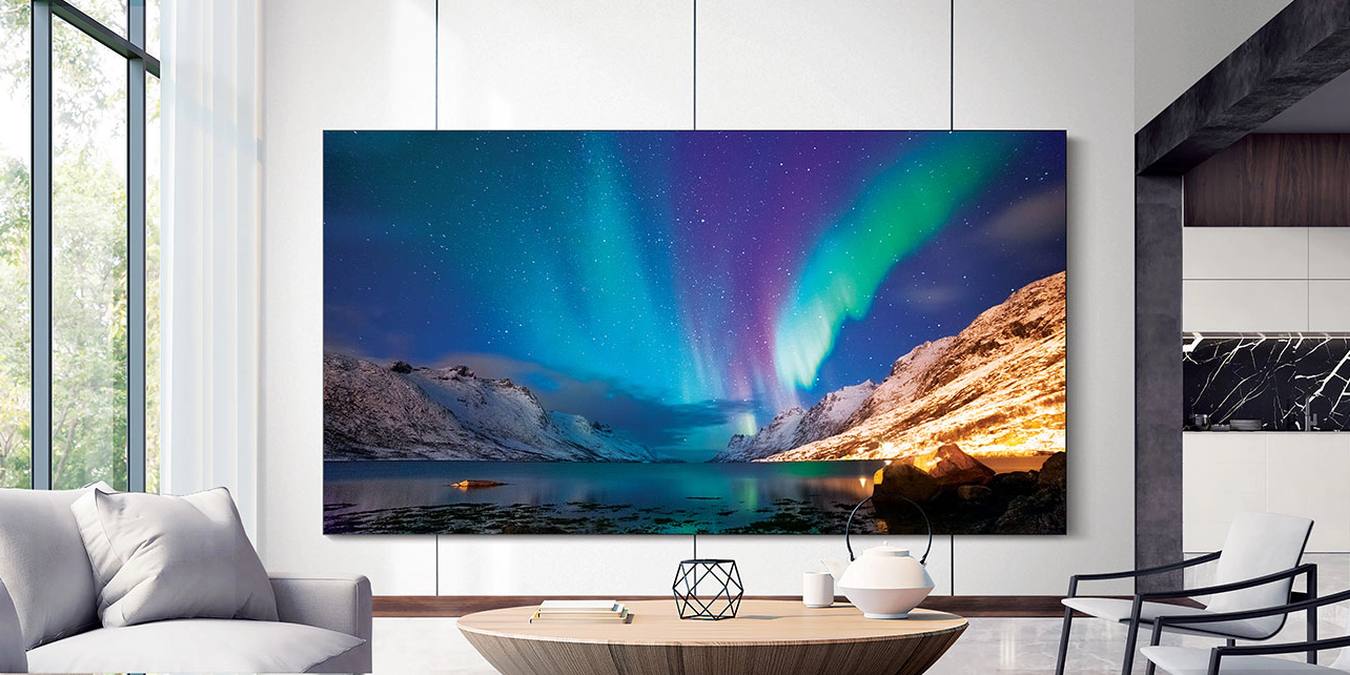

MicroLED display technology entered the spotlight after Samsung showcased its Wall range of MicroLED TVs at CES 2020 earlier this year. Not surprisingly, both Samsung and LG announced plans to end production of LCD panels by the end of this year. The display giants will now focus on quantum dot displays instead.
Demystifying TV Technology
That sounds pretty straightforward, right? What if I told you that LED TVs are nothing but LCDs with improved LED backlighting? These LED TVs, in turn, have nothing in common with OLED TVs. Quantum dot TVs are basically LED TVs equipped with a glorified plastic sheet filled with nanoparticles.
Does that sound confusing? You might want to refer to this TV buyer’s guide to navigate the convoluted world of contemporary display technologies. But here’s the short version: LCD, LED, and quantum-dot televisions collectively represent transmissive displays, with each of these differing primarily in terms of their backlighting technology.
Transmissive vs. Emissive Displays
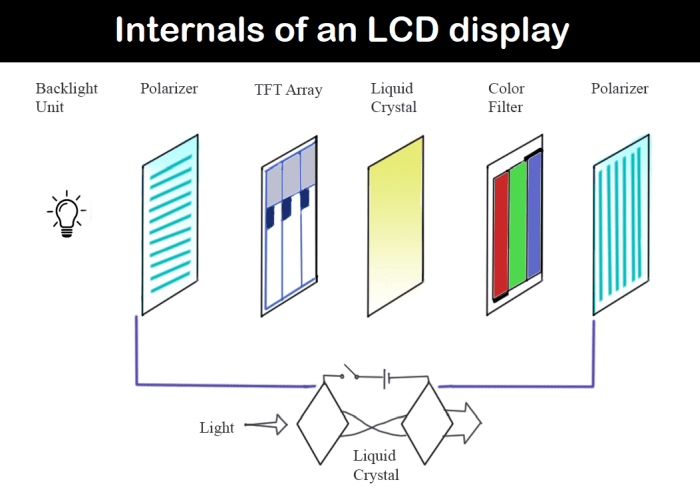
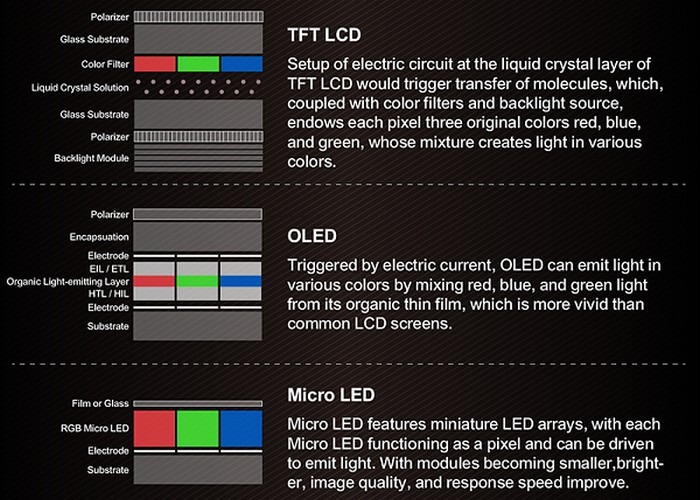
Transmissive display technologies are invariably inferior to their emissive counterparts by design. The fundamental difference being the capability of the individual pixels within emissive displays (such as CRT, OLED, and plasma) to generate light. The pixels within transmissive displays cannot generate light by themselves. These displays instead work by bending and blocking a passive light source (backlight) using liquid crystals controlled by a TFT array that further relies on a complex assembly comprising of polarisers and color filters to generate a picture.
Emissive displays, on the other hand, don’t have to deal with such a complicated and lossy means of creating a usable picture. Contemporary emissive display technologies such as OLEDs instead use tiny red, green, and blue sub-pixels to make up an individual pixel. This pixel is manufactured from organic emissive materials and only needs a transistor to send it relevant display signals. An OLED pixel can do everything from acting as a light source to generating colors and rendering perfect blacks. That’s why OLED displays are thinner, lighter, flexible (if desired), and consume less energy.
Also read: What Are USB LED Lights and What Are Their Uses?
From Organic to Inorganic LEDs
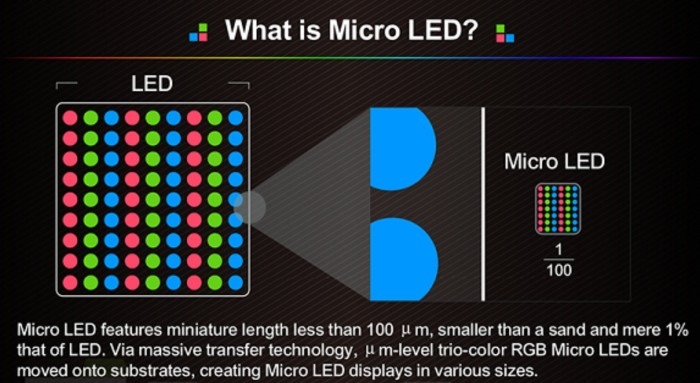
MicroLED display technology is basically the same deal, except the individual pixels aren’t made from organic materials. In fact, the name itself comes from the fact that the individual pixels are tiny enough to be measured in the order of micrometers. The inorganic makeup of MicroLEDs might seem like an insignificant detail on the surface, but it is the veritable magic bullet that solves virtually all the problems associated with OLED technology.
While OLED displays are the best we have right now, the technology isn’t entirely perfect. For starters, the organic nature of the OLED pixels prevents them from matching the maximum brightness capability of regular inorganic LEDs. That’s also why OLED displays lag behind LED-backlit quantum dot TVs (which use the souped-up LCD panels) when it comes to HDR capability. HDR technology is highly dependent on the capability of the display to generate an intensely bright picture, so OLED displays can’t keep up as a consequence.
Outlasting OLED Displays
Furthermore, the organic nature of OLEDs is also instrumental in the accelerated decay of the individual pixels. OLED displays, therefore, tend to fade out and become progressively less bright over time. Samsung claims that its MicroLED displays will be good for 100,000 hours, which is more than 11 years of non-stop operation. To put that into perspective, regular LED TVs are expected to last anywhere between 40,000 and 60,000 hours, or between 4.5 and 6.8 years respectively.
What makes matters worse for OLED displays is the tendency of the blue sub-pixel to wear out more quickly compared to the other two. This leads to a phenomenon known as color shift as the OLED display is put through normal usage.

Goodbye Burn-In
However, this is nothing compared to the single most challenging hurdle that has largely prevented the use of OLED technology in computer displays – their propensity for image burn-in. Burn-in or image retention is a serious issue for OLED displays, where leaving a static image on-screen can cause it to get permanently “burned” into the display. This might not be an issue for OLEDs used as televisions, but computer displays usually involve static elements such as taskbars, menus, and wallpapers that can (and do) cause image retention in OLED displays. That’s also why virtually no one makes mass-market OLED computer monitors.
MicroLED displays face no such burn-in problems because the light-emitting diodes are inorganic in nature, which ensures the absence of phosphor/polymer elements (found in CRT, plasma, and OLED displays) that are notorious for premature image retention. Unlike OLEDs, MicroLED technology combines the high brightness of regular LED-backlit LCD displays with the excellent efficiency of the emissive OLED technology.
The Million Dollar Question
Why haven’t MicroLEDs replaced the significantly inferior OLED and LCD technologies yet? The answer to that question is too complicated to be covered in this primer on MicroLED technology. Keep your eyes peeled for the next installment in our MicroLED series where we will delve deeper into the manufacturing process and why the technology is still years away from prime time.