


You leave the gym and your shirt is soaked through with your sweat. You know you worked hard. You get back from a daily run and your hair is all matted and sweaty and stuck to your head and neck. You know you worked hard.
A new health sensor could be in the next wearables that will use the same type of indication that you worked hard: sweat. Instead of measuring the rise in your pulse and your heart rate, it would measure your sweat.
Sweat Research
Stanford researchers have created a flexible wearable than instead of monitoring your pulse or heart rate checks for the cortisol levels that it detects in your sweat. A stress hormone, cortisol indicates not only your level of working out but potential disease as well. It indicates the activity from our adrenal and pituitary glands.
Traditionally, measuring your cortisol levels wouldn’t have ever been a good indicator to measure your workouts, as it means several days of lab tests, but now researchers have found a way to measure it much more quickly.
The researchers definitely had their work cut out for them because cortisol has no charge, so they couldn’t check for the positive or negative charge of a molecule like a sensor normally would.

Alberto Salleo, a materials scientist created something entirely different than the standard fitness tracker. He created a stretchy sensor around a membrane that only binds to cortisol. When it’s in a patch that is worn on the skin, sweat seeps through small holes on the bottom.
There are other particles such as sodium and potassium that are also found in sweat and those are charged particles that can pass through that membrane in the patch. But if the cortisol is there as well, it will block them, allowing the sensor to detect them, and that’s only if the cortisol is also there and blocks them.
“We are particularly interested in sweat sensing because it offers noninvasive and continuous monitoring of various biomarkers for a range of physiological conditions,” explained a post-doctoral scholar in the Salleo lab, Onur Parlak, who is also the lead author of the team’s report. “This offers a novel approach for the early detection of various diseases and evaluation of sports performance.”
Going Further with this Research
This patch still isn’t perfect yet to where it will give indicators of all workouts. The person wearing it needs to be sweating so much that they’re glistening in order for it to properly work, and then it works quickly. But if the person is sweating too much, it’s not as effective. And ideally people want to gauge their workout with such a device, if they’re working too hard, not working enough, etc.; this patch won’t work if they’re not working out just right.
Because of that, the researchers aren’t resting on their laurels. They’re still working on this. They’re also considering a saliva sensor so that a person doesn’t have to sweat perfectly each time they want to check their cortisol levels during a workout.
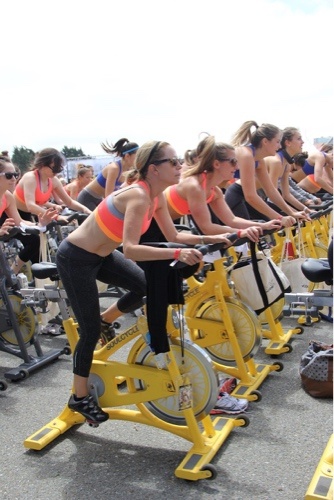
The Stanford researchers hope to eventually create a device that can track multiple biomarkers all at the same time so that people can get an indication of what is happening within their bodies.
Making Strides
Right now if you want to track your fitness, you have to wear one of those very identifiable bands on your wrist. They work at making them attractive, but we all know what they are. Or, sometimes you can track yourself on your phone.
But it would be nice to be able to wear a simple patch under your clothing to monitor your fitness throughout the day, as some people do with their fitness trackers. And certainly you don’t want to have to be sweating for it to work, and sometimes you may be doing something that doesn’t require you to work up much of a sweat like yoga, Pilates, smaller weight work, etc.
But the good news is that they’re working on it. They’re trying to go beyond the current fitness trackers and find something that encompasses several different ways to measure your workout as well as other things in your body such as illness.
Do you currently wear a fitness tracker? Would you wear one on a patch such as this? Or do you not work out to a level where you sweat that much every time? Let us know what you think in the comments below.