
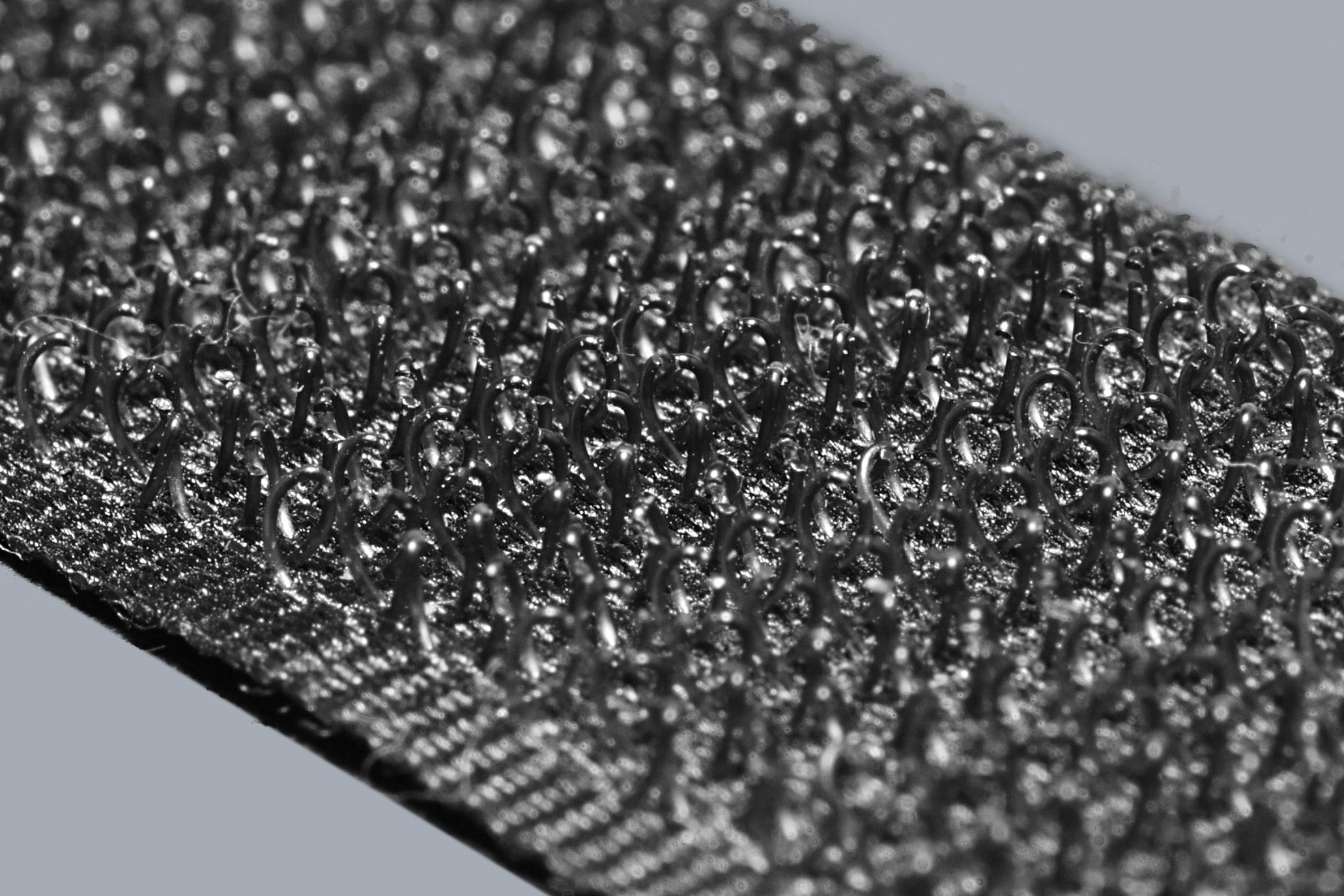


In 1941 Swiss engineer George de Mestral came home from a hunting trip with burdock burrs stuck to his trousers and his dog’s fur, put them under a microscope and saw tiny hooks, according to Velcro’s own history page and the World Intellectual Property Organization.
De Mestral saw a use for them. WIPO, which tells the story in its IP Advantage series, says he set out to build a reusable fastener from two strips of fabric: one carrying thousands of tiny hooks like the burr, the other thousands of soft loops like the fabric of his trousers.
Pressed together, the two strips held fast and could be pulled apart and used again.
From burr to nylon
Turning the idea into a product took nearly eight years of research and development, WIPO says, with a weaver from a textile plant in France helping to reproduce the fastening mechanism of the burrs. Early designs used cotton. Nylon turned out to be stronger, wore down less with regular use and could be produced in threads of various thicknesses.
Velcro’s history page says he found the nylon in Lyon, France, and that its durability and memory suited the design.
The loop side was straightforward to produce. The hook side was not. Velcro says de Mestral built a device, modelled on barbershop clippers, to trim loops into hooks. WIPO says he had to design new looms and hook cutting systems before each strip could be made to the same standard.
WIPO’s account also says that “Many people laughed at his idea, and he ran into various technical challenges.”
The patent
De Mestral filed patent application CH295638 in Switzerland in 1951. The Google Patents record gives the date as 22 October 1951 and records the application as filed by Velcro Sa Soulie. The patent was granted in 1954, and the same record gives a publication date of 15 January 1954. Its English title in the record is “Hanging device.”
The VELCRO trademark also dates from 1954, according to Velcro. The name is made from the first syllables of the French words velours (velvet) and crochet (hook).
Further applications followed as de Mestral worked on the design and the production process, among them CH359670, protected in Switzerland in 1962 and later filed in France, Germany, Great Britain, Spain and the United States.
In 1955 the invention was patented in France and the United States, with registrations across Europe and Canada. In 1957 a licensing agreement with Velok Ltd of Canada gave Velok exclusive rights to produce and sell VELCRO branded fasteners in the Western Hemisphere and the Asia Pacific region.
A 1959 fashion show in New York showed everything from diapers to golf jackets fastened with it.
The biggest boost came in the early 1960s, when NASA used the fasteners in the Apollo moon missions, WIPO says. During Apollo 11 they covered approximately 3,300 square inches of the interior and exterior of the spacecraft.
The patent for de Mestral’s hook and loop fastener expired in 1978.
Sources:
- Velcro, Our Story: https://www.velcro.com/original-thinking/our-story/
- WIPO IP Advantage, The Velcro IP story: https://www.wipo.int/en/web/ip-advantage/w/stories/the-velcro-ip-story
- Google Patents, CH295638A: https://patents.google.com/patent/CH295638A/en