
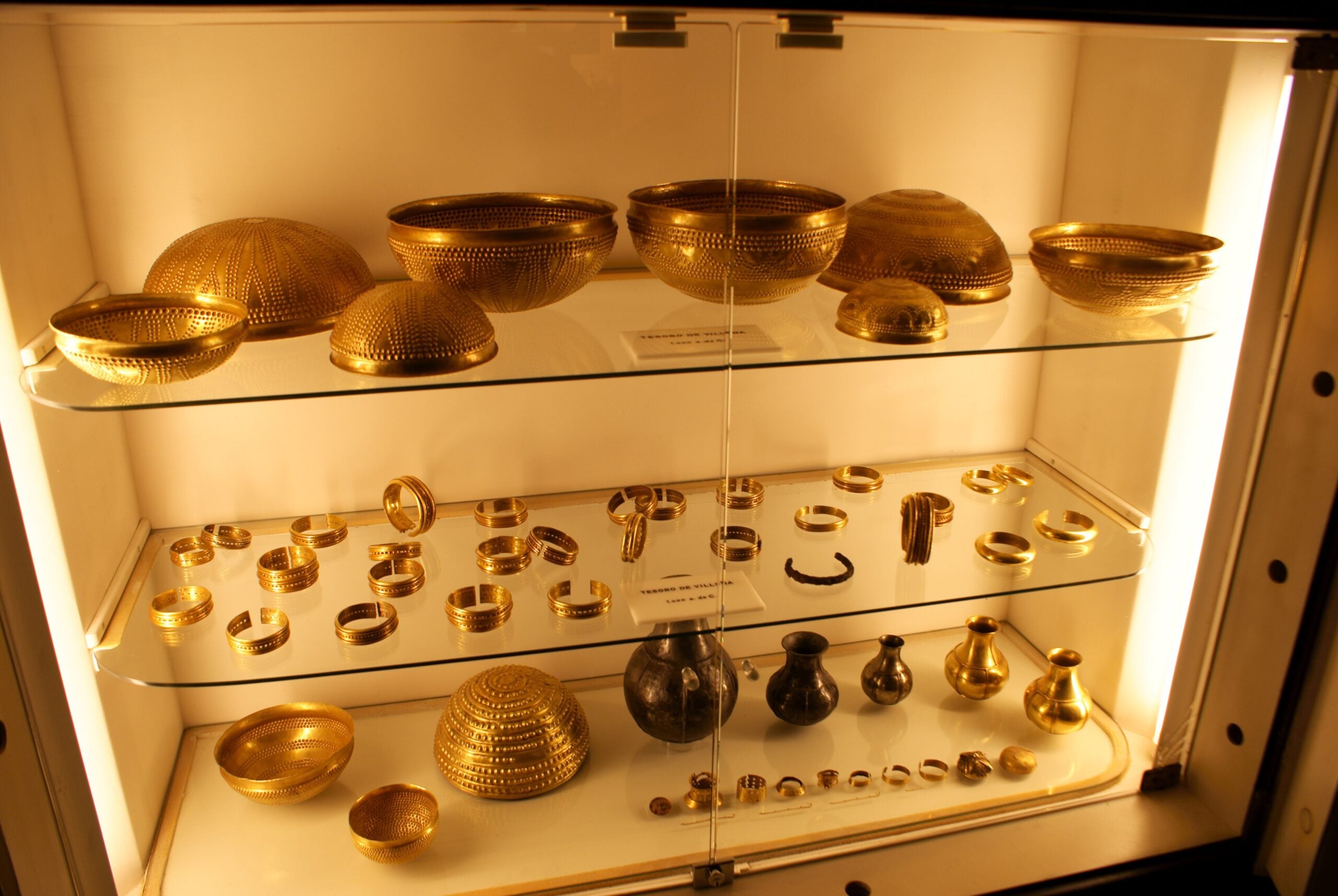

In 1963, a gravel pit in Villena, in the Spanish province of Alicante, yielded a hoard of mostly gold objects that has been known since as the Treasure of Villena. The archaeologist José María Soler García identified the hoard that year after workers found pieces in a gravel pit. Six decades later, the two least glamorous objects in the collection, both of them corroded iron, became the subject of a laboratory study whose authors argue that the metal most likely did not come from terrestrial ore at all.
A 1963 hoard with two pieces that did not fit the date
Accounts of the hoard’s size differ slightly depending on the source. Live Science, in a piece by Jennifer Nalewicki published on 6 February 2024, describes a treasure that “encompasses a total of 59 bottles, bowls and pieces of jewelry” in gold, silver, amber and iron. El País, in Vicente G. Olaya’s article of 5 February 2024, counts 59 gold objects plus some pieces of silver or iron. Smithsonian magazine, writing on 20 February 2024, cites the Villena museum, which puts the figure at 66 items and calls the collection the most important prehistoric treasure in Europe.
What the accounts agree on is the awkward pair. One is an open, C-shaped bracelet, described in the paper as a brazalete o anilla abierta. The other is a hollow hemisphere capped with a sheet of gold, interpreted by some researchers as a sword pommel. Both are iron, and iron is what made the hoard’s date controversial from the start. If the pieces were smelted from terrestrial ore, they would belong after the Late Bronze Age gold work around them. The other possibility, raised since the 1963 discovery, is that the iron was never smelted from terrestrial ore.
What the 2023 analyses point to, and what they leave open
That possibility is the one tested in ¿Hierro meteórico en el Tesoro de Villena?, a study by Salvador Rovira-Llorens, Martina Renzi and Ignacio Montero Ruiz published in the journal Trabajos de Prehistoria and issued on 30 December 2023 (DOI 10.3989/tp.2023.12333). Its title is a question, and its conclusion is carefully hedged. As quoted by El País, the authors write that “the results of the analyses … indicate with a high probability that they are objects made with meteoritic iron.” The Spanish text says the findings abogan en favor of that reading, meaning they argue in favor of it rather than settle it.
Meteoritic iron is an iron-nickel alloy, the study explains as reported by El País, typically carrying more than 5 percent nickel by weight along with traces of elements such as cobalt, while iron produced from terrestrial ores usually shows low or undetectable nickel. The Villena pieces did not give a clean answer. Early analyses detected iron and nickel with very high nickel peaks. A more sensitive mass spectrometry test carried out at the Curt-Engelhorn-Zentrum Archäometrie in Mannheim, Germany, found the hollow hemisphere possibly made of meteoritic iron, with a nickel proportion of 5.5 percent. The bracelet returned only 2.8 percent, which El País summarizes as too little to be meteoritic iron, and the German technicians suggested further analyses.
Corrosion limited the analysis. Both objects are heavily oxidized, and El País describes meteoritic iron as no less prone to that decay, leaving the metal in a delicate state that constrains what instruments can measure. Weighing the full set of results, the authors still argue in favor of a meteoritic origin for both pieces, a reading that would permit a date between roughly 1400 and 1200 B.C. for the hoard, as reported by Live Science, El País and Smithsonian. Live Science, citing a translated version of the study, adds that the iron is thought to have come from a meteorite that fell to Earth around 1 million years ago.
Learning to shape a metal nobody had smelted yet
“Iron was as valuable as gold or silver, and in this case [it was] used for ornaments or decorative purposes,” Ignacio Montero Ruiz told Smithsonian. The presence of an “unusual raw material,” he said, suggests highly skilled metalworkers capable of “developing new technologies.” The makers “probably had access to a fallen meteorite in the area that allowed them to discover the properties of this material and how to shape it.”
Speaking to Live Science, Montero Ruiz said that people who began working meteoritic iron and later terrestrial iron “must [have had to] innovate,” and that “the connection between gold and iron is important, as both elements have a great symbolic and social value.” He also cautioned against reading the hoard as royal property, describing it as “probably hidden treasure that could have belonged to a whole community and not to a single person. There were no kingdoms in the Iberian Peninsula at this historical period.”
Where the metal was worked is unresolved. Montero Ruiz pointed to the eastern Mediterranean, where meteoritic iron objects are known from contexts including the tomb of Tutankhamun, and told Live Science that “we do not have arguments to support a more local production, because other meteoritic iron in Europe has later chronologies (from Poland or Switzerland).” Smithsonian notes that most known examples from this period are linked to eastern Mediterranean cultures. “Who manufactured them and where this material was obtained are still questions that remain to be answered,” Montero Ruiz said.
The same laboratory patience shows up in the dating of presolar grains in the Murchison meteorite, and in Clair Patterson’s work measuring lead in meteorites. The Villena iron sits in that tradition: a probable answer, labeled as probable, still waiting on a cleaner measurement.