


We always bring mixed feelings to the table when new connectors are announced. It means all new cables and connectivity issues. But on the other hand, it also means our devices and machines will be faster. When it comes to USB and Thunderbolt, it also means a bit of confusion. We’ll once again be met with all three as Thunderbolt 4 continues its rollout this year.
Also read: USB C vs. USB 3 vs. Thunderbolt: All You Need to Know
What Is Thunderbolt 4?
It’s hard to imagine that a new connector is being released when we haven’t really sorted out the last releases fully. Yet, it is, and it seems the confusion is only going to continue.
The last connectors to be released were Thunderbolt 3 and USB-C. Yes, there’s a difference, but not much. The connectors and their plugs look the same. They’re sometimes interchangeable. You may be thinking it’s a good thing we’re moving on, but the replacements may not ease our confusion, and we’ll need new connectors, ports, cables, etc. Yet, it will be faster.
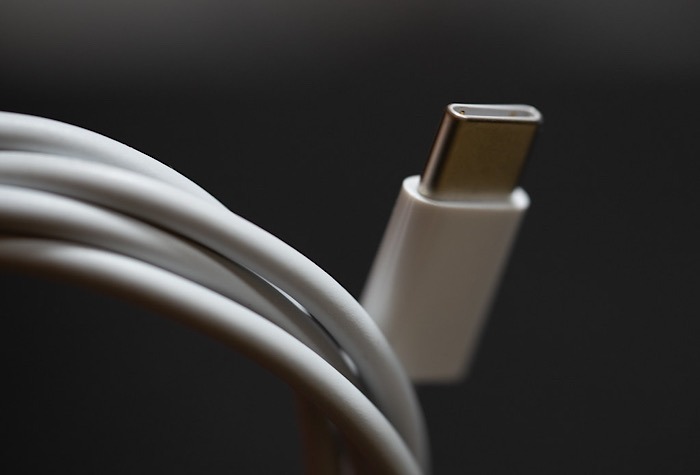
The next connector will be the Thunderbolt 4. A new USB was released recently as well: USB4, which is only going to keep this confusing going.
Intel made the Thunderbolt 3 protocol royalty-free for the development of USB4. But that didn’t stop Intel from continuing Thunderbolt’s development. Thunderbolt 4 was announced at least year’s CES. Consequently, there are now PCs with Thunderbolt 4 being released. These machines have the “Tiger Lake” processors and will also have USB4 connectivity.
Thunderbolt 4 vs. Thunderbolt 3
Aesthetically, Thunderbolt 4 and Thunderbolt 3 appear the same – that is, they both use the physical connector of the USB-C. Thunderbolt 4 still has the same maximum throughput of 400bps, offers between 15 and 100 watts of charging power, and supports 100 bps networking.
However, for Thunderbolt 4, the minimum video and data requirements are double that of its predecessor. It will support sending a video signal to two 4K displays or one 8K display. Thunderbolt 4 doubles the requirement of support of data rate via PCI Express to 32Gbps.
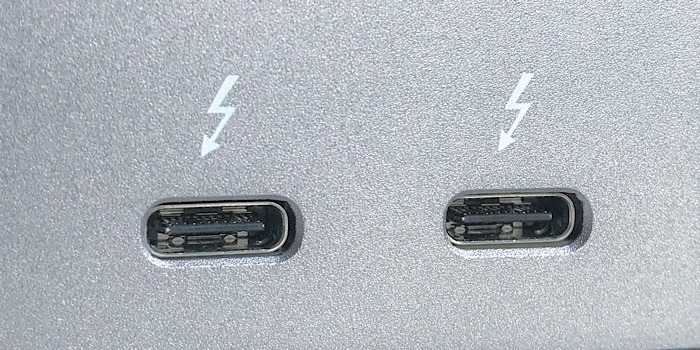
With more devices and accessories expected to carry Thunderbolt 4 capability, there are likely to be more Thunderbolt 4 ports on laptops. The new cables will be improved as well. They’ll support 400bps on a cable up to two meters, while Thunderbolt 3 only supported a 0.5 meter max cable. Additionally, Thunderbolt 4 will allow you to daisy chain up to six devices. With four ports, that means a capability of 24.
Thunderbolt 4 vs. USB4
As with USB-C and Thunderbolt 3, both Thunderbolt 4 and USB4 will use the same USB-C connector. Both will have 400bps, and you’ll be able to plug your USB devices into Thunderbolt 4 ports. The new Thunderbolt is also backward compatible with its predecessor.
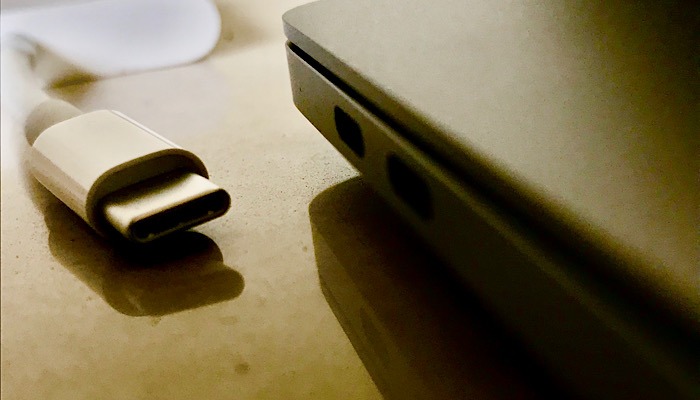
This will only provide the slower speed of Thunderbolt 3 or USB4. However, Thunderbolt 4 is a guarantee of running two 2 4K displays and 32Gbps transfer rate.
T4 Rollout
Laptops with these ports are starting to hit the shelves. You’ll have to read your specs closely, as you won’t know from looking at the ports which version of Thunderbolt it is. All Thunderbolt ports look the same and are marked with the lightning bolt logo, yet not the version.
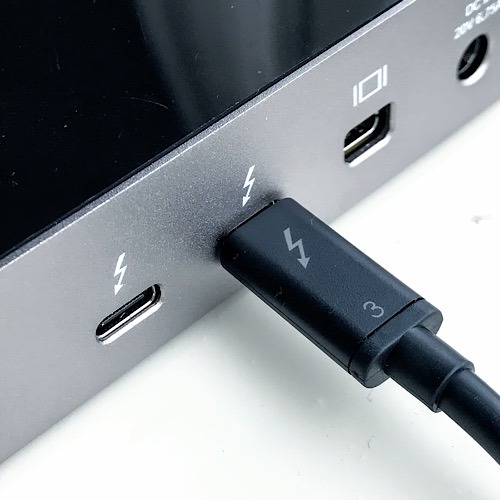
The first Tiger Lake processor laptops with Thunderbolt 4 support were released late last year with the Asus Zenbook 13 and the Dell XPS 13. While you would think the new M-1 processor Macs would have Thunderbolt 4, they do not, but do have USB4. It’s unknown when the first Thunderbolt 4 Macs will hit the shelves. There are also Thunderbolt 4 docks starting to be released, meaning we’ll soon see hubs, external drives, etc.
If speed and running two 4K displays is important to you, keep your eyes peeled for more and more Thunderbolt 4 releases. Read on to learn more about USB4.
Image Credit: File:Thunderbolt 3 Cable connected to OWC Thunderbolt 3 Dock.jpg by Amin, File:Thunderbolt 3 interface USB-C ports.jpg by Amin, Thunderbolt 3 ports on MacBook Pro 2018.jpg by IM3847, USB Type-C Thunderbolt Cable – MacBook Pro USB-C Charger by Tony Webster, public domain