
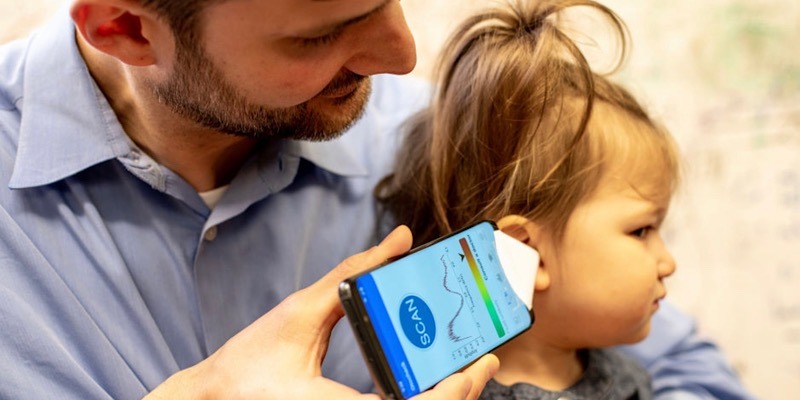

If there’s one illness that every child seems predisposed to, it’s ear infections. The problem comes in when they have several ear infections. This requires lots of doctor visits, meaning money and time spent. You may hate to keep going to the doctor because after a few times, you know the symptoms. But the doctor won’t prescribe antibiotics unless your child has been diagnosed.
There may be another solution very soon. Scientists have developed a smartphone app to diagnose ear infections. It works by listening for fluid in the ears with the addition of a folded piece of paper.
Diagnose Ear Infections with Smartphone App
By the age of 3, most children have had at least one ear infection. Fluid can become built up in the area, and the infection can also cause otitis media with effusion. While many infections or OME go away without the aid of antibiotics, waiting it out can cause pain or severe complications, including permanent hearing loss.
Scientists at the University of Washington have developed an app that works as a simple test. It listens for the fluid in the ears with the aid of the piece of paper. It is said to have the same or greater accuracy as a doctor.
Doctors look for changes in the eardrum, often with a tympanometry test, which is said to be 80 or 90 percent effective and requires a specific tool. The goal of the University of Washington scientists was to create a tool that was easy to use and inexpensive yet would keep that same accuracy.
They developed the EarHealth app that plays chirping sounds through the ear canal via a piece of paper that is folded up and taped to a smartphone that is held up to the outer ear. Sound waves bounce off the middle ear back to the phone, interacting with the sounds from the phone. The reflected noise is picked up and analyzed by the app, which predicts the odds of fluid in the ear based on the fluctuations of the signal.
“It’s a little bit like tapping a wine glass,” explained Justin Chan, a doctoral student at the University of Washington’s Paul Allen School of Computer Science & Engineering, to Gizmodo. “Depending on if the glass is empty or half full, you’ll get a different sound. So it’s the same principle here.”
The app was tested on children 18 months to 17 years old who had been admitted to Seattle Children’s Hospital. Half of them had been scheduled to have tubes inserted in their ear via surgery to treat the fluid buildup, while the other half were getting unrelated procedures.
“It’s not actually easy for existing screening tools to detect middle-ear fluid. Really, the only way you can know, with complete certainty, is to undergo a surgical operation where they make an incision into the eardrum, where it can drain the fluid. So once you make that incision, you can tell for sure if there’s fluid or not,” explained Chan.
The app was able to predict fluid in the ear with 85 percent accuracy and no fluid in the ear with 80 percent accuracy in this initial study.
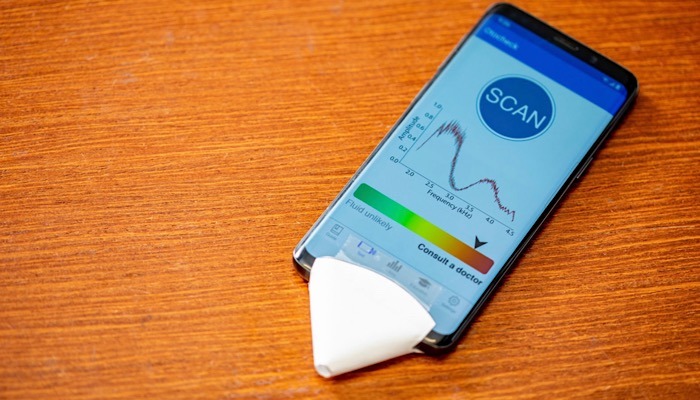
The app was then refined and tested on fifteen babies between the ages of 9 and 18 months old. With 100 percent accuracy, it identified all five babies who had fluid and identified nine of the ten who didn’t have fluid in their ears.
The next test was to see if parents could do this diagnosis on their own after a brief tutorial with the app. The accuracy was the same, showing the scientists that this would be an easy method for parents to utilize.
Additionally, there was no added strain to the children. “The chirps are actually quite soft. And interestingly, when we played into the ears of children in the hospital, we found that they responded with smiles or laughs. It turns out the chirps have a calming effect,” said Chan.
Utilizing EarHealth
The goal is for this app to be an at-home diagnosis tool, but Chan also thinks it could be used by doctors in less-developed areas. The app works on both iPhones and Android phones and works with various types of paper. The hope is for the app to be cleared by the Food and Drug Administration by the end of the year.
Would you trust this diagnosis of the EarHealth app? Would you rather do this at-home test than take your child to a doctor? Add your thoughts and concerns to the comments section below.
Image Credit: University of Washington via Gizmodo and public domain