
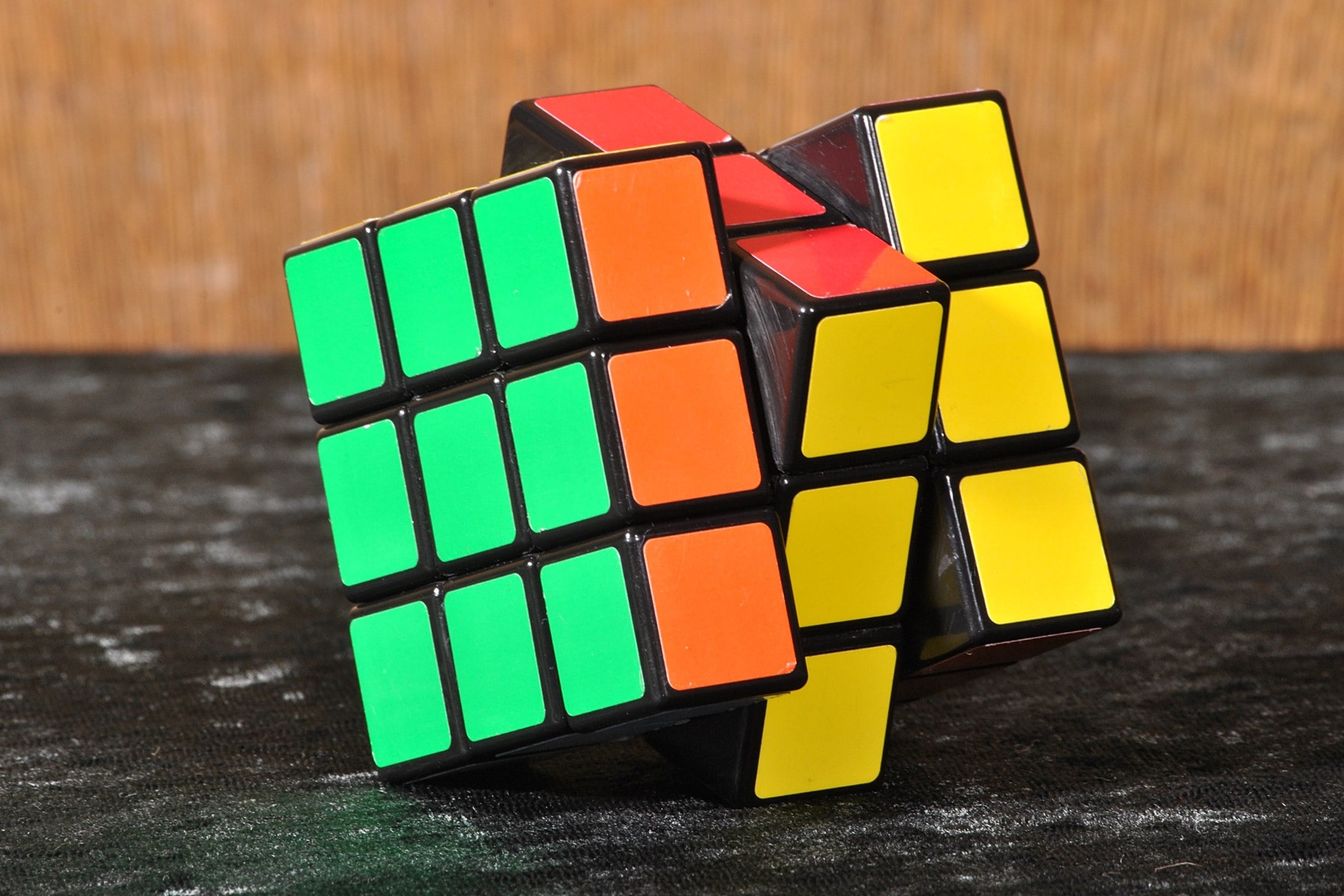


In 1974 Ernő Rubik, an architecture lecturer in Budapest, built his first cube, a painted wooden model, turned it a few times and found he could not get it back to its starting point, according to ETH Zurich. He was aged about 30, and ETH News describes him as a 30-year-old lecturer.
Rubik told ETH News in 2024 that he had not wanted to create a toy.
The BBC reports that in 1974 Rubik was a professor of architecture at the Budapest College of Applied Arts and built the cube as a teaching tool for his students. His prototype was a wooden cube made of smaller cubes, with a solid colour on each side to make the movement visible.
A month with a wooden model
“I was locked in an escape room that I had designed myself, and the rules weren’t written on the wall,” Rubik said, as quoted by ETH Zurich.
ETH Zurich reports that it took him a whole month to restore the cube to its original state. The BBC says the first attempt took the best part of a month, which made him the first person to solve the puzzle. Later, according to ETH, he could do it in a minute.
He tried the prototype on his students and let them work out their own solutions.
In January 1975 he applied for a Hungarian patent for his “Magic Cube”. ETH Zurich says he patented it as a “three-dimensional, logical toy”. The cube first went on sale in Hungarian toy shops in 1977, and companies in the UK and the US later took over distribution abroad.
ETH puts worldwide sales at around 500 million, while the BBC estimates more than 400 million.
Twenty moves
The cube has 43,252,003,274,489,856,000 possible positions, about 43 quintillion, according to cube20.org.
The largest number of moves needed to solve the hardest position is known as God’s number. By 1980 a lower bound of 18 had been established. In July 1981 Morwen Thistlethwaite showed 52 moves suffice, and in January 1995 Michael Reid proved that the superflip position, with corners correct and edges placed but flipped, needs 20 moves.
Superflip was the first position proven to require 20 moves.
In July 2010 Tomas Rokicki, Herbert Kociemba, Morley Davidson and John Dethridge proved that every position can be solved in 20 moves or fewer, counting any twist of any face as one move, a system known as the half-turn metric. The work used about 35 CPU-years of idle computer time donated by Google.
The team did not look for the shortest solution to each position, only a solution of 20 moves or fewer.
They split the positions into 2,217,093,120 sets of 19,508,428,800 positions each and used symmetry and set covering to cut the number of sets that needed solving to 55,882,296. Their program solved one set in about 20 seconds, and the computation ran on computers at Google in a few weeks.
The four authors published the proof in 2013 in the SIAM Journal on Discrete Mathematics as The Diameter of the Rubik’s Cube Group Is Twenty. The paper puts the computer time at about one billion seconds.
Sources:
- ETH Zurich, And it keeps on turning: https://ethz.ch/en/news-and-events/eth-news/news/2024/11/and-it-keeps-on-turning.html
- BBC Culture, Ernő Rubik on his invention: https://www.bbc.com/culture/article/20240126-first-of-all-you-must-be-patient-then-you-need-spatial-memory-ern-rubik-on-his-iconic-invention-the-rubiks-cube
- cube20.org, God’s Number is 20: https://www.cube20.org/
- Rokicki et al., SIAM J. Discrete Math 2013: https://tomas.rokicki.com/rubik20.pdf