

The Brave browser has been promising privacy to its users for a number of years. Now it’s expanding its product line – and its privacy. It was revealed this week that the Brave search engine is now in beta. It’s not relegated to just the Brave browser either – you can use it in other browsers as well.
Introducing Brave Search
Privacy is becoming more and more important in all aspects of the Internet experience. Google has a reputation for not protecting its user base and selling its data. The company is trying to change things up a bit, but so far everything is business as usual.
The Brave browser has been protecting your privacy as you browse the Internet, and now it will do the same as you search for answers. Looking to do one better, or rather three, than Google, the new search enginer promises privacy, independence, and transparency.
According to the official documentation, “Brave Search doesn’t track your queries. Ever.” That itself sets it apart from Google. It promises not to track “you, your searches, or your clicks.” Because it won’t collect any of that data, it can never see it or share it.
The new search engine promises to be “user-first,” stating: “It’s your data, your choices.” Surprisingly, the documentation claims that even the search engines that promise to be neutral or private still get their results from another source. However, Brave uses a “built-from-scratch index.”
Notably, It’s a work in promise, so Brave also asks for patience while they build it in beta. Some results won’t be included yet, so they are relying on a mixture of results with their search engine and a third party, though they are completely transparent about this.
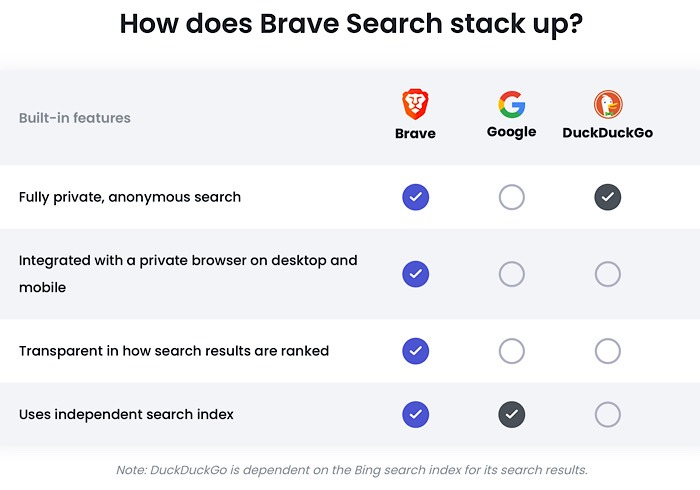
Pushing the transparency angle, the announcement explains, “Brave Search doesn’t use secret methods or algorithms to bias or sensor results.” They refine the results with anonymous community contributions. Diversity is promised as well with the use of “community-created alternative ranking models.”
Availability
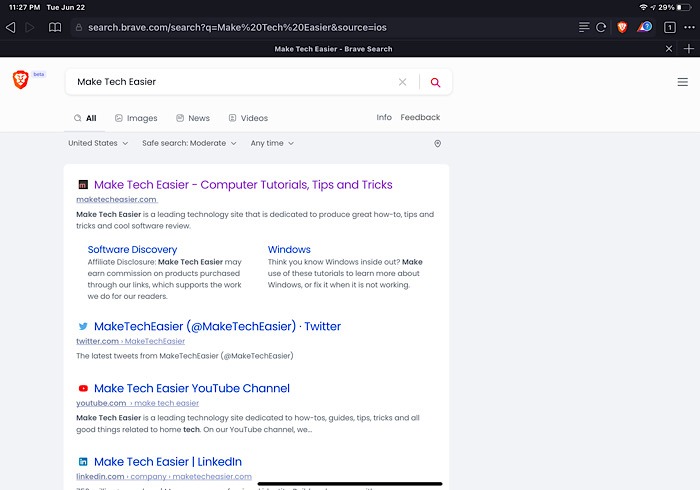
Perhaps the most surprising factor of Brave Search is that it’s not confined to just the Brave browser. You can use the beta on any browser at search.brave.com and can use it on both mobile and desktop. You can also still use other search engines in the Brave browser.
One significant question is if it is ad-supported. Brave answers this by saying, “We’re currently thinking through different search experiences to offer our users. Some want a premium, ad-free search experience. Others want a free, ad-supported model. We think choice is best. Brave Ads with rewards is definitely possible once we’re ready to take on the challenge of privacy-protected search ads.”
While privacy is the selling point of the Brave browser, there’s an additional one as well. Read on to learn how you can earn cryptocurrency browsing the Web on Brave.
Image Credit: Brave Publisher Media Assets