
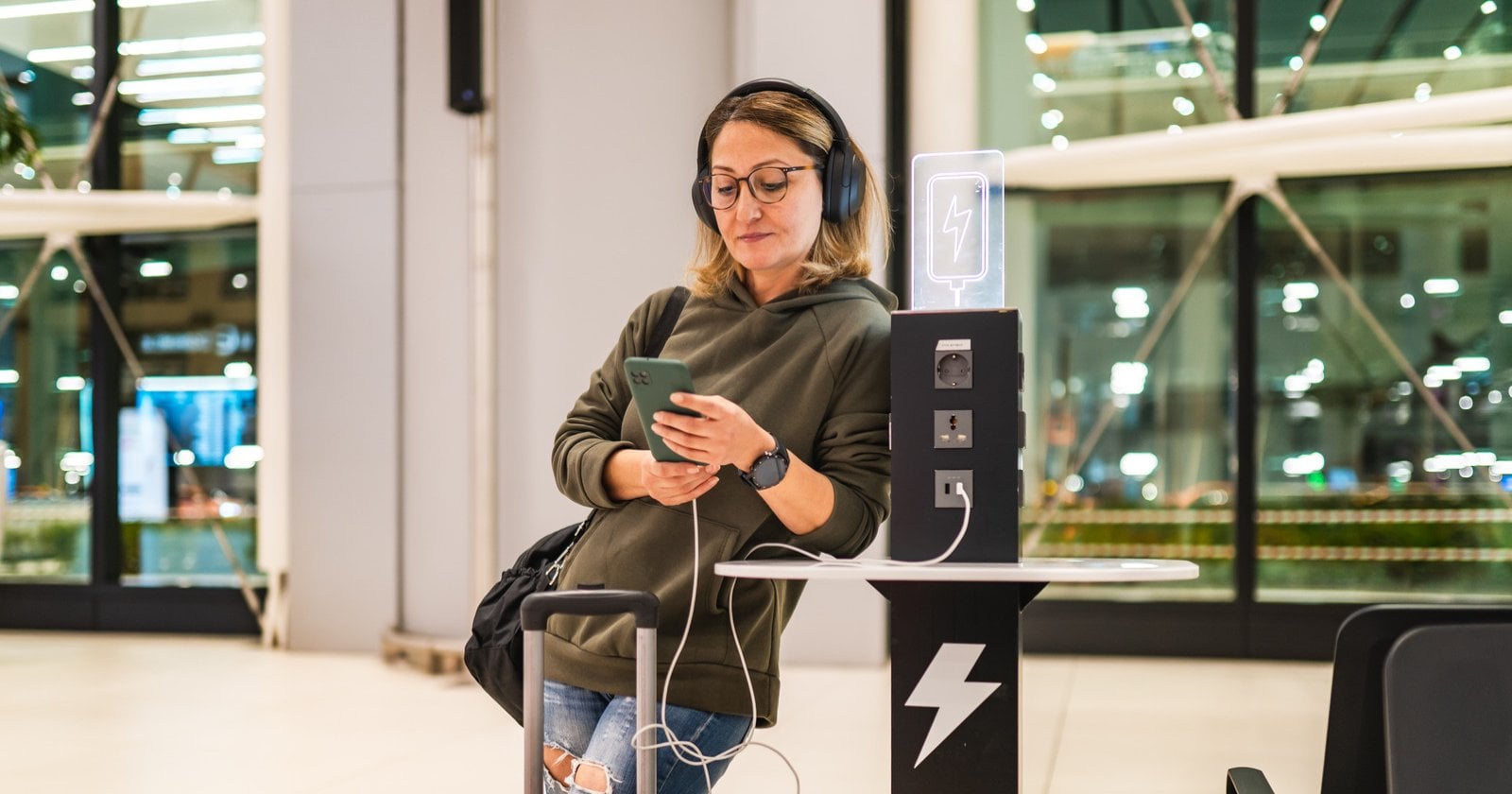

You’re at the gate, your battery is at 8%, and there’s a row of USB ports right there. It feels like a gift.
The FBI’s Denver field office would rather you walked past it.
“Avoid using free charging stations in airports, hotels or shopping centers,” the office wrote in an April 6, 2023 post on X. “Bad actors have figured out ways to use public USB ports to introduce malware and monitoring software onto devices. Carry your own charger and USB cord and use an electrical outlet instead.”
A wall outlet only sends power. A USB port can send power and data down the same cable. That is how your phone syncs with a laptop, and it’s the reason a charging port you don’t control is a potential problem. If someone tampers with a public port, or swaps in a doctored kiosk, the thing your phone is plugged into could, in principle, try to read your files or push software onto the device.
The idea has a name: juice jacking. It goes back at least to 2011, when security journalist Brian Krebs wrote a post titled “Beware of Juice-Jacking.” He described a charging kiosk set up at the DefCon hacker conference in Las Vegas, where “at least 360 attendees plugged their smartphones” into it. The kiosk didn’t steal anything. Once a phone was connected, it displayed a warning instead: “You should not trust public kiosks with your smart phone. Information can be retrieved or downloaded without your consent.”
As Malwarebytes noted, the Denver field office said the message was meant as an advisory and that there was no specific case that prompted it. They added that “there are no known, recent cases of juice jacking.”
So the post was a precaution, not a report of a wave of attacks at airports. Phone makers have also built in defenses since the early demonstrations. On an iPhone, for example, connecting to a new computer brings up a “Trust This Computer” prompt. Apple explains that trusted computers “can sync with your device and access your device’s photos, videos, contacts, and other content,” while choosing not to trust one blocks “its access to content on your device.”
Those prompts were meant to settle the matter but research published in 2025 suggests they don’t always hold. A team from Graz University of Technology in Austria presented a paper at the USENIX Security Symposium describing an attack it called ChoiceJacking. Using what the authors describe as “a custom cheap malicious charger,” they showed that a charger could fake the user’s input to approve its own data connection.
The researchers report that their attacks gained access to files such as photos and documents “on all tested devices from 8 vendors including the top 6 by market share.” For two vendors, they could even pull files from locked phones. The team says it disclosed its findings to the affected companies, and most are adding fixes.
That’s a lab result, not evidence of criminals doing this at airports. But it shows that the basic concern behind the FBI’s advice, that a charging port can be more than a charging port, is still being taken seriously by researchers.
Bring your own charger and plug it into a regular electrical outlet, as the FBI suggests. A wall socket supplies power, not data. If you can’t find a free outlet, a portable battery pack charged at home does the same job.
If you have no choice but to use a public USB port, watch your screen. A “Trust This Computer” prompt or a request to allow file transfer when you’re only trying to charge is a red flag. Decline it. A charging station has no reason to see your photos.
Keep your phone updated. The fixes that came out of research like ChoiceJacking only protect you if your phone has installed them.
If you’ve trusted a computer by mistake, iPhone users can reset that list under Settings, General, Transfer or Reset iPhone, Reset, then Reset Location & Privacy, according to Apple’s instructions.
The chances of your phone being hacked through an airport seat are low. But the protection costs almost nothing: a wall plug in your carry-on, or a charged battery pack. With that in your bag, the free USB port at the gate stops being worth the gamble.