

While the GDPR (General Data Protection Regulation) does much to protect privacy and data in the European Union, it affects everyone worldwide. On thing that has increased with it is cookie notifications. They can be annoying to have to agree to or “X” out of so that you can read the intended content.
But it doesn’t have to be annoying, at least not if you’re using Opera on Android. They have now added a setting that allows you to automatically hide the alert dialog for cookies.
Opera’s New Setting
Sure, it’s great to be notified that a website is collecting cookies on you, but sometimes you know that and are taking it with a grain of salt. You just want to move on with the process. You just want to clear it as soon as possible.
Opera for Android now makes it so you never have to see those notifications if you don’t want to. The browser’s newest version includes a setting that will automatically hide the alert dialogs for cookies.
But you don’t have to block all cookies warnings if you don’t want to, as you get to be in control. It’s your choice whether the browser will accept all cookies, block all of them, or only block all third-party cookies.
Automatically Hiding Cookies in Opera
Android users only need to go to the Settings in the Opera app and tap “Ad Blocking.” This will open a screen with toggles that allows you to set the parameters for the type of control you want.
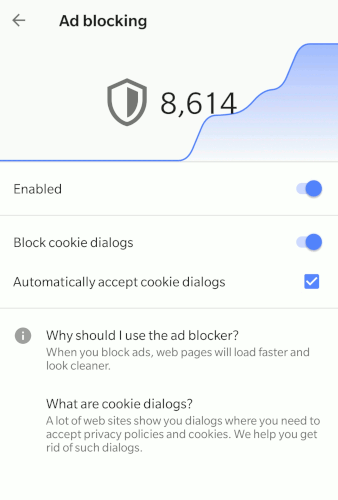
Opera claims it tested this feature on more than 15,000 websites. They were looking to identify as many pop-up dialogs as they could and then suppress them.
With many websites employing ready-to-use tools to handle the GDPR regulations, Opera most likely saw enough of the cookie pop-ups that their system will block nearly all of them. Yet, the fear is that they didn’t catch them all, so they are asking users to report any that appear when they were supposed to be blocked.
Furthermore
There’s no doubt the cookie notification can be annoying. Sure, it’s there to help you so that you know when a website is collecting information on you, yet it’s obtrusive and in your way. It’s too bad there isn’t some way they can let you know they’re using cookies without blocking half your screen.
And that’s where GDPR fails. This is supposed to make everything so much safer and better for the user. But if you’re annoyed using the system, then it’s not doing what was intended.
Especially if you’re employing Opera’s new settings option. If you’re not even seeing any of those cookie notifications, then GDPR is failing at informing you when someone is collecting information.
Are you annoyed by the increase in cookie notification dialog boxes? Do you just automatically exit them, or do you take time to read each one? Have they ever encouraged you to not use a site? Will you use Opera for Android’s setting to automatically hide the cookie notifications? Let us know how you’re dealing with it in the comments.