
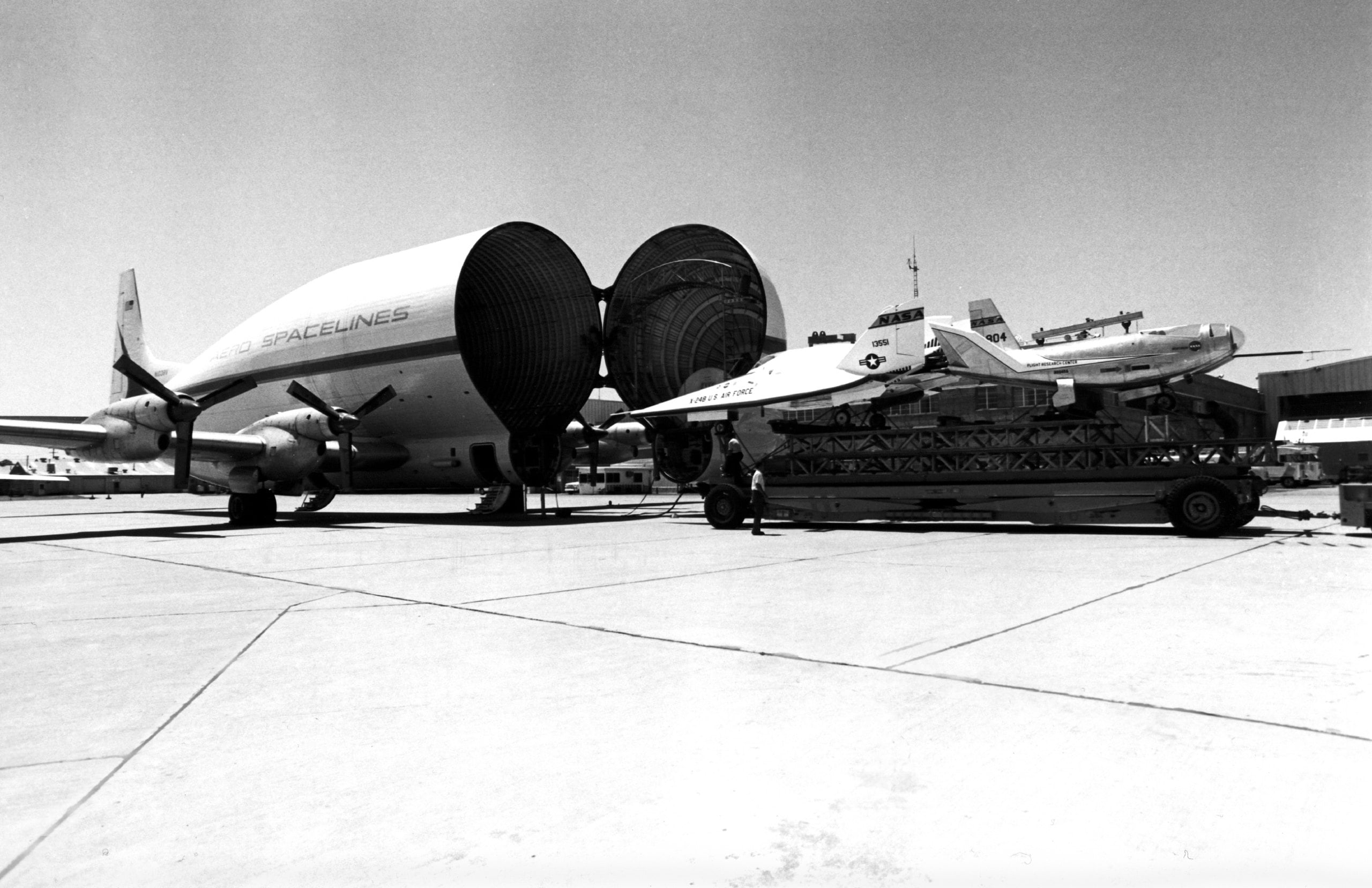


NASA’s Super Guppy Turbine opens its hinged nose 110 degrees to load cargo through the front, onto a hold 25 feet across and 111 feet long, according to NASA’s aircraft operations page. The 1961 Pregnant Guppy that began the line cut a Saturn stage delivery to the Cape from 18 to 25 days by barge to 18 hours.
A control lock and disconnect system at the fuselage break keeps the flight and engine control rigging intact while the nose opens and closes.
Inside, a set of rails runs along the cargo compartment. Loads ride on Super Guppy pallets or on fixtures built for a specific item, with rollers in the rails. An electric winch under the cargo floor pulls them in, and automatic hydraulic lock pins in the rails hold the pallet for flight.
The cargo bay measures 111 ft by 25 ft by 25 ft and the useful load is 45,000 lb.
Other aircraft can carry more weight, NASA says, but few come close to the hold’s internal dimensions. The aircraft itself is 143 ft 10 in long with a wingspan of 156 ft 3 in, and it stands 46 ft 5 in high. Empty, it weighs 101,500 lb, and its maximum takeoff weight is 170,000 lb.
The barge trip that led to the Pregnant Guppy
In the early years of the space race, large rocket parts bound for Cape Kennedy went by barge through the Panama Canal or across the Gulf of Mexico. Railroad tunnels, narrow roads, low bridges and power lines made overland shipment of cargo that size close to impossible.
In 1961 Aero Spaceline Industries of California introduced the first Guppy, built from a heavily modified KC-97 Stratotanker.
The Pregnant Guppy had a cargo compartment just over 19 feet in diameter, designed to carry the second stage of a Saturn rocket for the Apollo program. Cargo that took 18 to 25 days on a barge reached the Cape in 18 hours by air.
ASI followed in 1965 with the Super Guppy, which brought the 25 foot cargo bay, a pressurized cockpit and the hinged nose. ASI owned and ran it until 1979, when NASA bought it. Over 32 years of service it flew more than three million miles for the Apollo, Gemini, Skylab and International Space Station programs.
Only four Super Guppy Turbines were built
The Super Guppy Turbine is the last generation of Guppy aircraft, and only four were made.
NASA says the main difference from the earlier Super Guppy was a switch to Allison T-56 turboprops, which it calls more reliable and easier to obtain. The specification sheet lists four Allison 501-D22C turboprops at 4,600 shaft horsepower each, a cruise speed of 250 mph, a range of 1,700 nautical miles and a service ceiling of 25,000 feet.
Airbus Industries bought the turbine aircraft from ASI and used them to ferry A300 fuselage sections around Europe in the 1970s, 1980s and 1990s. When Airbus retired its fleet to museums in 1997, NASA acquired number 4 under an International Space Station barter agreement to replace its ageing Super Guppy.
The NASA aircraft, NASA 941, started as KC-97 serial number 52-828 and entered service in 1953.
It logged 8,090 flight hours as a C-97 before conversion and was transferred to NASA on 23 October 1997. It flies with a crew of four. In recent years it has moved T-38s for the Air Force and V-22s for the Navy, along with other work for the Department of Defense and government contractors.
Its first flight as a Super Guppy Turbine was on 21 June 1983.
Sources:
- NASA, Super Guppy: https://nasa.gov/specials/jsc-aircraft-ops/guppy.html