
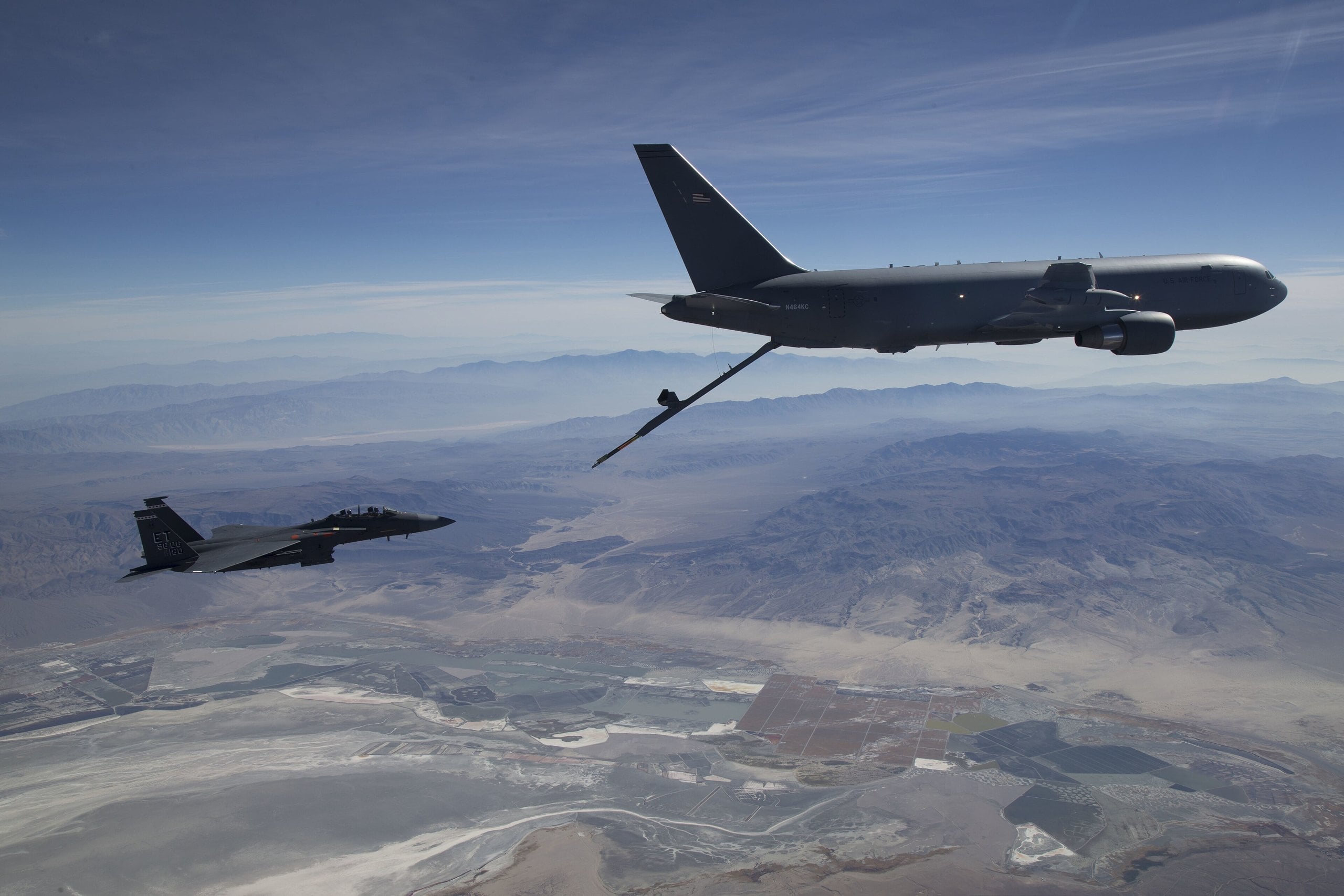


Beacon AI says its Murdock pilot assistant flew aboard three operational US Air Force KC-46A Pegasus tankers over five flights and about 20 hours in August and September 2026, reading the aircraft’s certified avionics buses and advising the crews without taking control. The California company announced the flights on 27 October 2026.
The work was funded under an AFWERX Tactical Funding Increase (TACFI) contract with Air Mobility Command, Beacon said.
The flights began during Emerald Flag at Eglin Air Force Base in Florida and continued at two more airfields, one of them a civil airport, according to Beacon. The company said the aircraft were already assigned to operational units and were flown by fleet aircrews, and that most earlier advances in AI for aviation were made on dedicated test aircraft.
“At every stage, the crew retains authority,” said Matt Cox, Beacon’s co-founder and chief executive, in the announcement. He said the right way to bring such a system into a cockpit is to “put it in the hands of real crews on real missions” and to expand what it does as operational evidence supports it.
Murdock augments the crew rather than replacing or overriding them, Beacon said, with the system advising and the crew deciding.
A box that listens to the avionics
Beacon describes Murdock as a modular compute and crew-interface system. It reads data from the certified avionics buses and offers advice to the crew. It also records every flight and connects over a satellite link to Lighthouse, the company’s cloud-based fleet data platform and web application. Beacon calls Murdock “R2-D2 for pilots”.
The company classes the KC-46 flights as Level 2 assistance in its own framework, where the system advises and the crew decides.
Murdock was used without any change to the tanker’s certified flight-critical systems and connected through an interface the Air Force already fields, Beacon said. The company contrasts that with the first generation of aviation autonomy, which it says borrowed from self-driving cars and relied on heavy hardware retrofits meant to take over flight control.
Beacon uses the term hardware-lite for systems that work through software and data.
Why a tanker
The KC-46 is a military derivative of the Boeing 767, and Beacon says 1,361 767s have been delivered since 1982. The company sees the tanker as a bridge from Air Force mobility aircraft to commercial 767 fleets.
Air Mobility Command operates more than 1,000 airlift and air refuelling aircraft, and the Air Force’s planned KC-46 buy stands at 263 aircraft, Beacon says.
Beacon says the interface Murdock uses is not unique to the tanker.
The company describes the flights as a world first, saying it believes Murdock is the first commercially developed AI pilot assistant to fly aboard multiple operational aircraft. The claim is Beacon’s own.
The AFWERX contract followed a Small Business Innovation Research Phase 2 award with US Special Operations Command, Beacon said.
Tiffany Robinson, AFWERX growth stage investment lead, was quoted in the same release saying the TACFI programme is used “to align Department of the Air Force funding, matching investment and operational needs to advance promising technologies toward operational use”.
The release also cites a House Armed Services Committee report on the Fiscal Year 2027 National Defense Authorization Act, which directed the Secretary of Defense to brief the committee by 1 February 2027 on plans to evaluate and adopt advisory and pilot-assist tools.
Beacon AI is based in San Carlos, California, and says it holds 13 US military contracts and three commercial airline engagements.
Sources: