
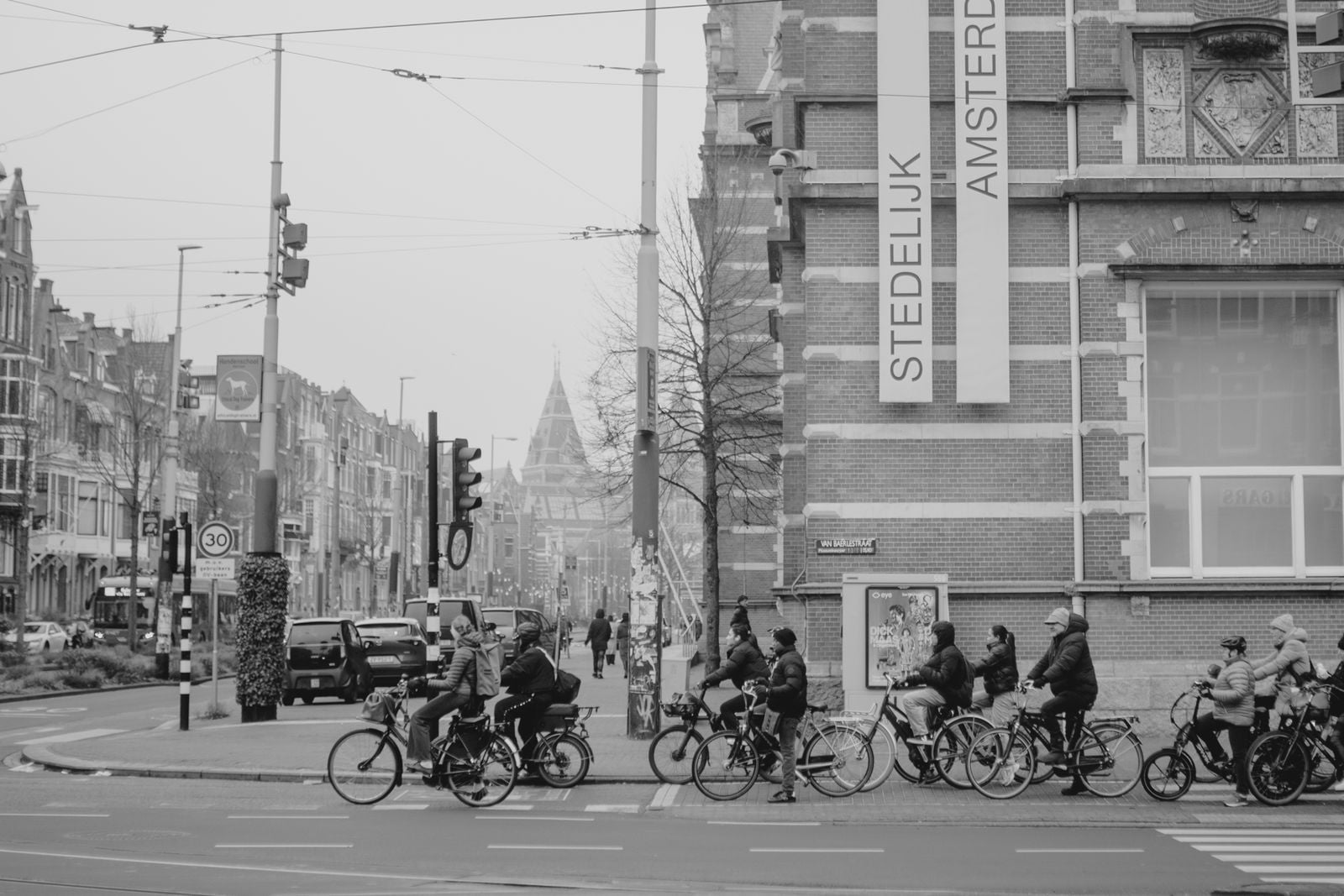

On 4 November 1973, Dutch prime minister Joop den Uyl went on television to tell the country that its highways would be closed to private cars every Sunday until further notice. The Netherlands had been placed under a full oil embargo by the Arab members of OPEC three weeks earlier, in retaliation for Dutch support of Israel during the Yom Kippur War. Petrol reserves were projected to last only weeks. Within days, Dutch families were walking, roller-skating and picnicking on the A12 motorway between The Hague and Utrecht. Photographs from that autumn show children playing football on empty asphalt where, six days a week, traffic had been nose-to-tail.
The Sunday driving ban lasted only from 4 November 1973 to 6 January 1974 — nine Sundays in total, according to the International Institute of Social History’s archive of the crisis. It did not, on its own, turn the Netherlands into a cycling country. But it did something subtler and more lasting: it gave an entire generation of Dutch citizens a vivid, physical memory of what their streets felt like without cars. That memory arrived at exactly the moment a separate, angrier movement was demanding the government stop killing children with traffic.
The number that shocked the country
In 1971, motor vehicles in the Netherlands killed 3,300 people, including more than 400 children under the age of 14, according to figures compiled by SWOV, the Dutch road-safety research institute. Rapid post-war motorisation had filled cities designed for bicycles and trams with private cars, and the death toll was climbing every year. A journalist named Vic Langenhoff, whose own child had been killed by a driver, published a column in the Catholic daily De Tijd titled “Stop de Kindermoord” — Stop the Child Murder. The phrase became the name of a protest movement.
Stop de Kindermoord organised bicycle demonstrations, occupied dangerous intersections, and demanded that streets be redesigned around people rather than around traffic flow. By the time the oil embargo arrived in October 1973, the movement had been putting pressure on Dutch municipalities for two years. The timing mattered: den Uyl’s carless Sundays did not create the demand for safer streets, but they briefly demonstrated the alternative on a national scale.
What the empty Sundays actually showed
The oil crisis lasted longer than the driving ban. Petrol rationing coupons were printed (though never fully distributed), speed limits were cut to 100 km/h on motorways, and the government ran television campaigns urging citizens to conserve fuel. Bicycle sales in the Netherlands, which had been falling steadily through the 1960s as households bought their first cars, reversed direction. Dutch cycling union figures cited by historian Ruth Oldenziel in Cycling Cities: The European Experience show bicycle sales rising from roughly 800,000 units a year in the early 1970s to well over one million by the end of the decade, on a population then of about 13.5 million.
More importantly, the Sunday ban had shown planners and politicians something they had been told for years but had not felt: motorways emptied of cars were not dead zones. They were full of people. That image, reproduced in every newspaper for two months, made it politically possible to argue that reallocating road space away from cars was not a fringe idea. When Stop de Kindermoord marched on the Ministry of Transport the following year, they were pushing against a door that the embargo had already unlatched.
The decade of concrete change
The Dutch government responded in three overlapping ways through the mid-1970s. First, in 1975, the Ministry of Transport funded experimental separated cycle networks in two pilot cities, Tilburg and The Hague. The Tilburg route, opened in 1977, was 4.5 kilometres of continuous protected cycle track through the city centre. Traffic counts published afterwards by the ministry showed cycling on the corridor rose by 75 per cent within two years while car traffic on parallel streets fell.
Second, planners revived and formalised the woonerf — the “living yard” — a residential street design pioneered in the city of Delft in the late 1960s, in which pavements, kerbs and through-traffic priority are removed entirely. Cars are legally guests, limited to walking pace. The 1976 revision of the Dutch traffic code gave the woonerf formal legal status, and by 1980 more than 800 had been built across the country.
Third, and most consequentially, the 1979 national transport policy plan for the first time set explicit modal-share targets favouring bicycles and public transport over cars in urban areas. The Netherlands became the first country in Europe to write “more people on bikes” into national policy as a measurable goal rather than an aspiration.
Was it really the oil crisis?
Cycling historians are careful about the causal story. Ruth Oldenziel and Adri Albert de la Bruhèze, in their long study of European cycling cities, argue that the oil embargo is often treated as the pivot when in fact it was one of three converging forces: the child-safety movement, the environmental movement (the Club of Rome’s Limits to Growth had been published in 1972 to enormous Dutch attention), and the embargo itself. Neighbouring countries — Belgium, West Germany, Denmark — experienced the same embargo, and only Denmark responded with anything close to Dutch-scale investment in cycling infrastructure.
What distinguished the Netherlands was the pre-existing political organisation demanding change, combined with a flat, dense, historically bicycle-literate landscape, combined with the shock of empty Sundays. Remove any of those factors and the outcome is different. Belgium had the flatness and the embargo; it did not build the infrastructure. Germany had the environmental politics; it kept building autobahns.
What ten years produced
By 1982, roughly a decade after den Uyl’s television address, the Netherlands had built more than 9,000 kilometres of dedicated cycle paths, more than tripling the network that had existed at the start of the 1970s. Child traffic deaths had fallen from more than 400 a year to under 200, and would keep falling. The bicycle’s share of all urban trips, which had bottomed out at around 25 per cent in 1975, climbed back above 35 per cent — the level at which it has stubbornly remained ever since, and which no other industrialised country has matched.
The lesson embedded in the Dutch story is not that oil crises produce bicycles. It is that infrastructure follows politics, and politics follows the moments when citizens are shown, physically and undeniably, that the arrangement of their streets is a choice rather than a fact. The nine empty Sundays of the winter of 1973 did not make the Netherlands a cycling country. They made it briefly impossible to argue that it could not become one.
For more on how small, specific decisions cascade into the technological world people now take for granted, see how Ray Tomlinson picked the @ symbol for email in 1971 because it was the only punctuation nobody else was using — another 1970s choice, made almost casually, that reshaped daily life for decades.