
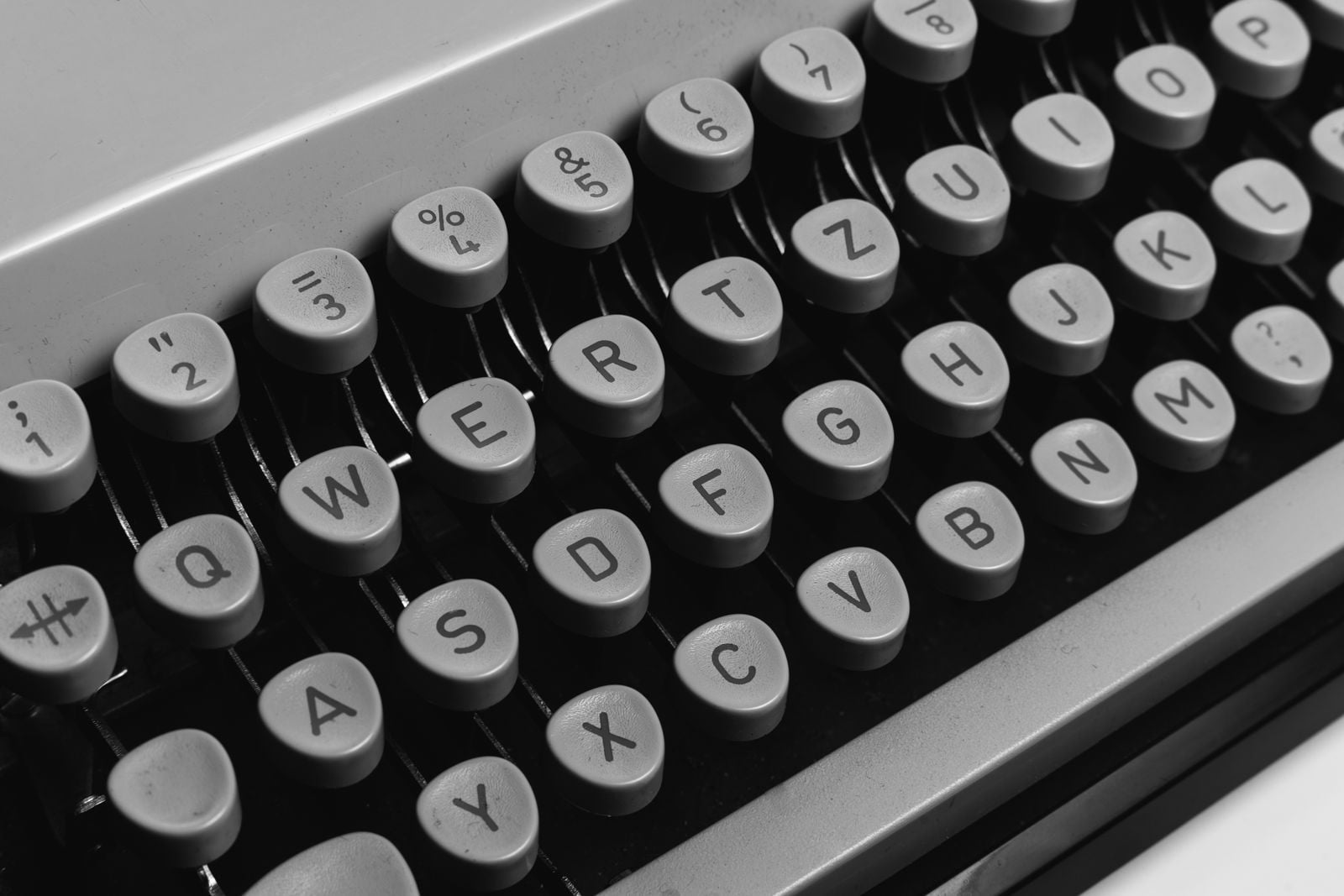

Christopher Latham Sholes reached the keyboard beneath modern fingers by way of a machine built to stamp page numbers into books. Before QWERTY there were ratchets, a moving carriage, a platen and an inked ribbon advancing one impression at a time.
In 1863, Sholes briefly served as Milwaukee’s postmaster during Abraham Lincoln’s presidency. The Wisconsin Historical Society confirms his Civil War-era postmastership, while a Milwaukee historical profile attributes the appointment directly to Lincoln.
Sholes was already a printer, newspaper editor and Wisconsin politician. He had served in both houses of the state legislature, and he approached letters and numbers as things that could be set in metal, struck against paper and rearranged by hand.
The numbering machine came first
On September 27, 1864, Sholes and Samuel W. Soulé received U.S. Patent No. 44,488 for a machine for paging books. A book sat in an opening in the table while a foot-operated platen pressed numbered type against the page.
The mechanism already contained pieces that would feel familiar inside a later writing machine. Its patent describes a moving carriage, ratchets, numbered type and an inked ribbon that advanced to expose fresh ink after each impression.
Two years later, Sholes and Soulé patented a more elaborate duplicate and consecutive numbering machine. Patent No. 59,675, dated November 13, 1866, was designed to print sequential numbers on items including bank notes, drafts, theater tickets, railroad tickets and coupons.
The next step happened in Charles F. Kleinsteuber’s Milwaukee machine shop. A Wisconsin Historical Society account of the first practical typewriter places Sholes, Soulé and Carlos Glidden there as the numbering-machine work gave way to experiments with mechanical writing.
By the fall of 1867, the group had produced a functioning writing machine. What began as a problem of making numbers advance automatically had expanded into the much harder problem of selecting and printing the letters of an alphabet one at a time.
The first typewriter was still visibly experimental
By October 1867, Sholes, Glidden and Soulé were pursuing patent protection for the writing machine. A Smithsonian history of the invention notes that Sholes, then a customs collector in Milwaukee, had been working on a page-numbering device before the typewriter project emerged.
The resulting U.S. Patent No. 79,265 was issued on June 23, 1868. The patent describes a piano-like keyboard whose keys lifted radial typebars toward a common printing point while a weighted paper carriage advanced by fixed increments.
That machine did not yet look like a twentieth-century office typewriter. Its paper sat above the type mechanism, the operator could not immediately see every character being struck, and the keyboard arrangement continued to change through repeated prototypes.
By 1874, E. Remington & Sons had put the Sholes and Glidden machine on the market. It became the first commercially successful typewriter, and the keyboard on the production machine carried the recognizable QWERTY arrangement that would outlive the mechanics surrounding it.
QWERTY has more than one origin story
The familiar explanation says QWERTY was created because adjacent typebars jammed when common letter combinations were struck rapidly. Mechanical collisions were a real problem on early typewriters, but historians do not agree that avoiding those collisions, by itself, explains the final layout.
A Smithsonian Magazine history of QWERTY describes the dispute directly. One explanation emphasizes separating commonly paired letters to reduce clashes, while another points to the needs of telegraph operators transcribing Morse code.
The latter argument has been developed by Koichi Yasuoka and Motoko Yasuoka. Their paper On the Prehistory of QWERTY, published in ZINBUN, traces the keyboard’s evolution through telegraph technology and the requirements of operators rather than treating it as a simple attempt to slow typing.
What the surviving record does not support is the popular claim that Sholes deliberately made typing inefficient so people would type slowly. The keyboard evolved while the machine itself was being rebuilt again and again.
That distinction also helps explain why QWERTY outlasted rival layouts. Once the arrangement became embedded in machines, training and learned finger movements, its survival no longer depended on whatever mechanical problem first influenced it.
Sholes’s federal jobs overlap the invention story
Sholes’s government service and his machine work overlapped, but the chronology is less tidy than the idea of a postmaster spending idle afternoons inventing a keyboard. The Wisconsin Historical Society records that he served briefly as Milwaukee postmaster during the Civil War and later became port collector.
The paging-machine patent dates to 1864, placing that line of experimentation around the period of his postmaster service. By the time the typewriter project was taking recognizable form in 1867, Smithsonian’s account identifies Sholes as Milwaukee’s customs collector.
That makes the federal appointments part of the setting rather than a simple explanation for the invention. The surviving sources support the offices he held and the machines he worked on, but they do not establish that long, quiet afternoons at the post office were what produced the typewriter.
The typebars disappeared, but their keyboard did not
Sholes continued working on typewriter improvements after the first commercial machines appeared. He died in Milwaukee in February 1890, after watching an experimental workshop machine become the basis of a growing office technology.
The mechanics changed far more dramatically than the alphabet beneath the operator’s hands. Later typewriters replaced or redesigned the early machinery, and computers eventually discarded the typebars, inked ribbon and moving paper carriage altogether.
QWERTY remained. Even keyboards designed around different assumptions have had to compete with a layout already learned by generations of users, a problem visible in the history of alternative keyboard layouts such as Dvorak and Colemak.
On a modern laptop or phone there is no semicircle of metal arms waiting to collide beneath the keys. The arrangement built for a nineteenth-century mechanical machine survives after almost every physical part around it has vanished.
The machine beneath the keyboard
The numbering devices are now the quieter part of Sholes’s story, but their patents preserve the transition in metal and ink. A foot pedal drives a platen, a ratchet advances the mechanism, a ribbon moves between spools, and one printed mark makes room for the next.
More than 160 years later, those gears and ribbons belong to museum cases and patent drawings. The six letters Sholes and his collaborators eventually placed across the upper-left row — Q, W, E, R, T and Y — are still sitting beneath millions of hands.