
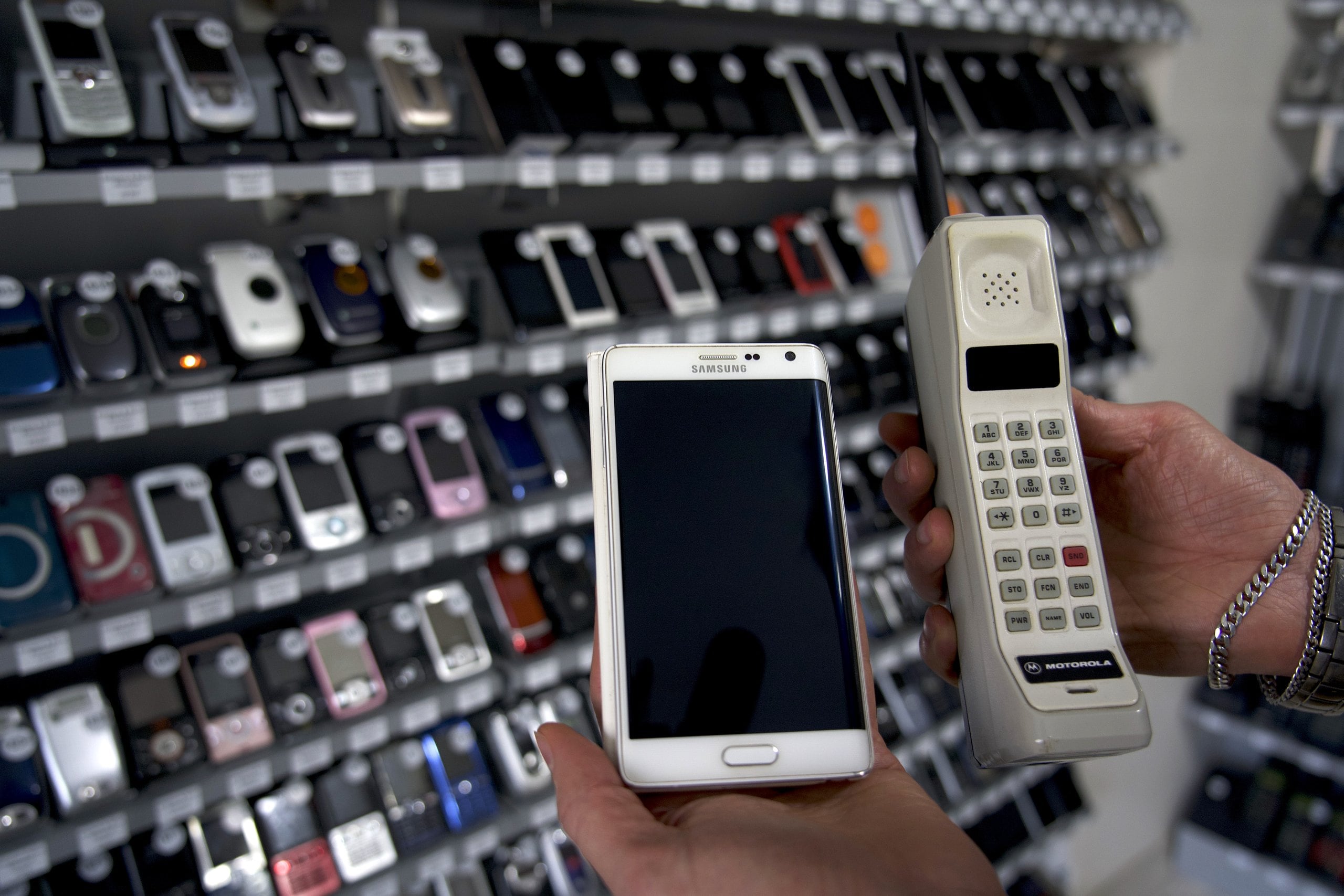


Martin Cooper’s call on 3 April 1973 was aimed at a competitor. According to the Milestones page of Dyna, Cooper’s own company, he dialled Dr Joel S. Engel at AT&T, his chief competitor, from a DynaTAC prototype while standing on Sixth Avenue in New York.
Motorola and AT&T were at that point competing for the same radio frequencies.
Motorola Solutions’ heritage page on cell phone development says cellular technology was conceptualised by Bell Laboratories (AT&T) years earlier. In 1968 the US Federal Communications Commission proposed frequencies in the 800 to 900 MHz range for a new technology to fix the limits of car radiotelephone systems. By the early 1970s both companies had announced plans for cellular systems.
A race for spectrum
The two companies took different paths. AT&T developed a system based on car phones. Motorola, which had made car phones since radiotelephone service began in the United States in 1946, decided to apply its radio expertise and compete with AT&T for access to the proposed new frequencies.
Motorola engineers wanted a phone that left the car with its owner.
“When you park your car and leave, you can’t use your mobile [car phone] but you can take your portable with you,” Cooper said, in a quote on the Motorola Solutions page. The company had to prove to the FCC that a cellular system compatible with portable phones would work, and the FCC meeting was six weeks away.
Cooper asked Motorola’s industrial design director, Rudy Krolopp, and his team to design the shape. After several days of work the team met for dinner at a nearby restaurant and emerged hours later with a design. “We called it a shoe phone, because it sort of looked a little bit like a boot,” Krolopp said.
The electronics then had to shrink to fit inside that handset.
By February 1973 Motorola had a working DynaTAC prototype, the name standing for DYNamic Adaptive Total Area Coverage. The company presented the phone and its system concept to the FCC, which soon announced it would hold new hearings on allocating spectrum for cellular service.
The call on Sixth Avenue
The public demonstration came on 3 April 1973, before Cooper and Motorola leader John F. Mitchell formally introduced the phone to the press, Dyna says.
Cooper stood on Sixth Avenue in New York and made a call from the prototype. It connected to a radio base station on the roof of the Burlington House, since renamed the Alliance Bernstein Building, and into the AT&T landline telephone system.
Reporters and onlookers watched as Cooper dialled the number of Engel at AT&T.
“Joel, this is Marty. I’m calling you from a cell phone, a personal, portable, handheld cell phone,” Cooper said, in Dyna’s account. Dyna says Cooper believed the cellular phone should be a personal telephone, with a number assigned to a person instead of a place, a desk or a home.
Ten more years of work followed. The DynaTAC system had to switch calls from cell to cell as users moved without a high rate of dropped calls. When the FCC granted a developmental licence for the Baltimore and Washington, DC, area in 1977, Motorola supplied DynaTAC equipment for a market trial with paying subscribers.
On 21 September 1983 the FCC approved the DynaTAC 8000X, after more than 10 years and a US$100 million investment.
Sources:
- Dyna LLC Milestones: https://dynallc.com/milestones/
- Motorola Solutions Cell Phone Development: https://www.motorolasolutions.com/en_us/about/history/explore-motorola-heritage/cell-phone-development.html