


One of the more exciting aspects of advances in technology is what it can do in the medical field. A recent advancement is no less exciting. A new mobile app can detect anemia by just using the camera to examine the user’s fingernails, all without the normally required blood test.
Scientific Research
I’ll add before I go even further how grateful I would have been for such an app a few years ago. I was diagnosed with anemia, and the doctors kept an eye on that with frequent blood tests. I was deemed okay until my blood tests and bone marrow biopsies eventually showed a worse problem: leukemia, a blood cancer. I have terrible veins, so the frequent blood tests were really difficult for me.
This medical advancement, however, means that until my condition worsened, instead of the frequent blood tests, I could have gotten by with checking my own levels with my smartphone, by using the camera to check out the color of my fingernails.
Anemia is a blood disorder that is present in 29 percent of pregnant women, 38 percent of non-pregnant women, and 43 percent of children. Its hallmark is a low hemoglobin count. This causes fatigue, heart problems, and pregnancy complications in two-billion people worldwide.
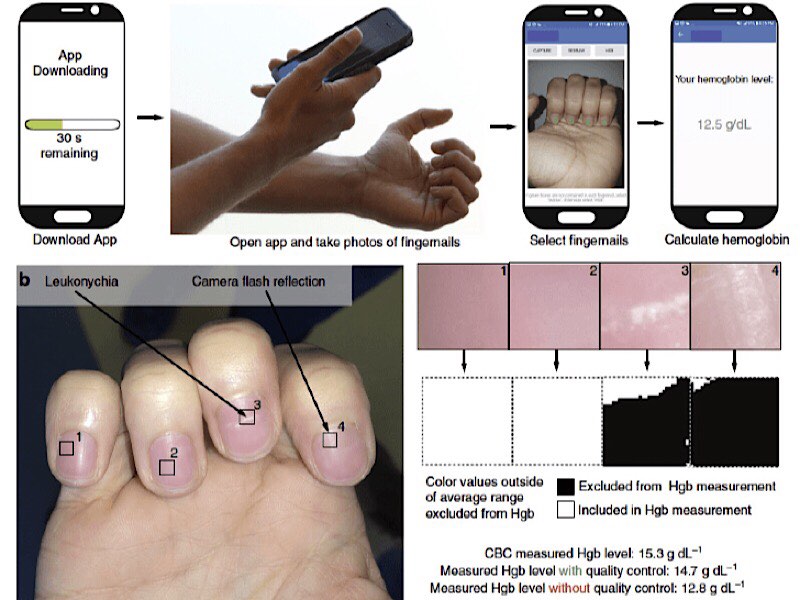
While blood samples are required of the patient, a trained phlebotomist and laboratory technicians, a clinical hematology analyzer that requires a power source, and biochemical reagents are all normally required to make that diagnosis.
Researchers from Georgia Tech and Emory University in Atlanta, Georgia, can detect anemia without the trained professionals and equipment. They relied on studies that showed anemia could be detected by analyzing a patient’s pale appearance of their fingernails (pallor), palm, or tongue.
The authors described the process in the Nature Communications science journal: “Here, we leverage the observation that pallor is associated with anemia to develop a method that quantitatively analyzes. Pallor in patient-sourced photos using image analysis algorithms to emable a noninvasive, accurate quantitative smartphone app for detecting anemia.”
This algorithm was created by Wilburn Lam and a team at Emory. It focused on the concentration of hemoglobin detected in fingernails, using photos taken with a smartphone camera to determine the results.
The app uses the photo’s metadata, adjusts for the background lighting conditions, and detects the paleness in a person’s fingernail bed. In all earlier non-invasive methods to detect anemia, this technique wasn’t discovered.
A study was conducted using the app on 337 people with various blood conditions, including 72 healthy people used as a control group. This app was able to better detect anemia than doctors with a traditional physical exam.
That said, this method was not as good as a blood test but was as good or better than existing FDA-approved diagnostic tools, making it good for screening but not clinical diagnosis. Yet they believe additional research could lead to it replacing blood-based testing methods.
The researchers believe that even with the current app, before further advancement, it could be used to monitor patients with chromic anemia to figure out when they would need further medical help or blood transfusions,
Furthermore
Certainly, I could have used this app while I was being monitored, before being diagnosed with something other than chronic anemia. It could be a godsend to the two-billion people across the globe that have this disease.
What do you think of using a mobile app for detecting or monitoring diseases such as anemia? Would you be able to trust the results? Drop your opinions and thoughts into the comments below.
Image Credit: Wilbur A. Lam et al.